Celebrity Culture and Role Models
Berühmte Leute und Vorbilder — Celebrity Culture and Role Models
The AQA GCSE German specification includes celebrity culture as part of Theme 2 (Popular Culture). You need to be able to discuss famous people, describe what they do, give opinions on their influence, and say whether you consider them Vorbilder (role models). This topic is excellent for demonstrating opinion phrases, conditional tense, and complex sentence structures in your writing and speaking exams.
Famous People from German-Speaking Countries
The exam may include references to well-known German, Austrian or Swiss figures. Knowing about some of them gives you content for writing and speaking responses.
Sportler/innen (Athletes): Sebastian Vettel — Formula 1 driver, born in Germany, lived in Switzerland. Jule Brand — German women’s football player. Mesut Özil — German footballer of Turkish heritage.
Schauspieler/innen und Models (Actors and Models): Michael Fassbender — German-Irish actor. Heidi Klum — German-American supermodel and TV presenter.
Musiker/innen (Musicians): Beethoven — one of the greatest classical composers, born in Bonn. Nena — famous for “99 Luftballons.” Rammstein — globally famous rock band from Berlin.
Example: Sebastian Vettel ist in Deutschland geboren und wohnt jetzt in der Schweiz. Er ist ein berühmter Rennfahrer und ein Vorbild für viele junge Leute.
Describing Celebrities
To describe a celebrity, you need vocabulary for appearance, personality and achievements. Combine what you learned in the identity unit with new opinion phrases:
Appearance: Er/Sie hat braune Haare und blaue Augen. Er/Sie ist groß und sportlich. Personality: Er/Sie ist freundlich, großzügig, ehrlich, erfolgreich. Achievements: Er/Sie hat viele Preise gewonnen. Er/Sie ist weltweit berühmt.
Key adjectives for describing celebrities: berühmt (famous), erfolgreich (successful), talentiert (talented), inspirierend (inspiring), großzügig (generous), ehrgeizig (ambitious), verantwortlich (responsible), einflussreich (influential).
Opinions on Celebrity Influence
The exam tests whether you can give and justify Meinungen (opinions) about celebrity culture. You should be able to argue both for and against celebrities as role models.
Prominente können gute Vorbilder sein, weil sie hart arbeiten und zeigen, dass man Erfolg haben kann. (Celebrities can be good role models because they work hard and show that you can be successful.)
Viele Prominente setzen sich für wohltätige Zwecke ein und spenden viel Geld. (Many celebrities support charitable causes and donate a lot of money.) Sie inspirieren junge Leute, ihre Träume zu verfolgen. (They inspire young people to follow their dreams.)
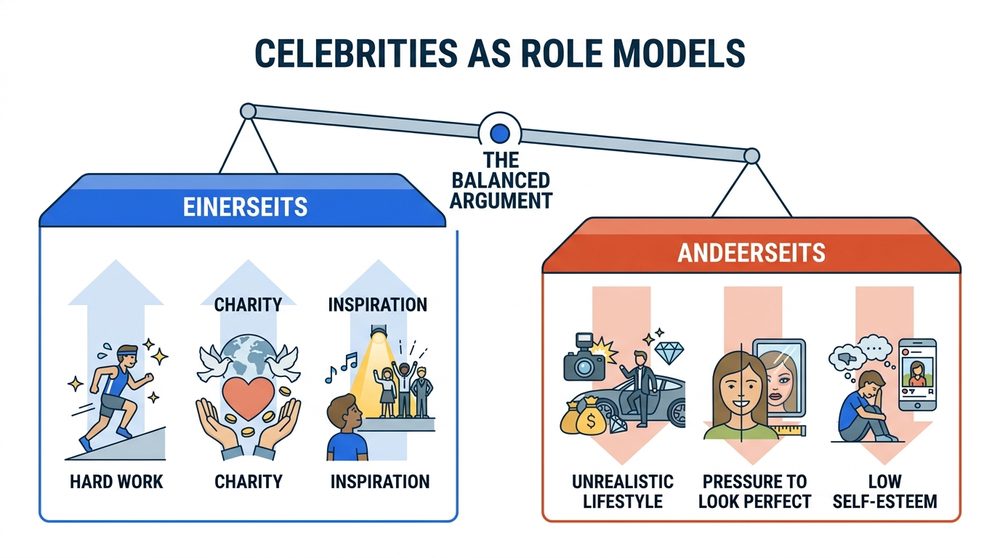
Manche Prominente sind kein gutes Vorbild, weil sie einen unrealistischen Lebensstil zeigen. (Some celebrities are not a good role model because they show an unrealistic lifestyle.)
Junge Leute vergleichen sich oft mit Prominenten und das kann zu niedrigem Selbstwertgefühl führen. (Young people often compare themselves with celebrities and that can lead to low self-esteem.) Es gibt zu viel Druck, perfekt auszusehen. (There is too much pressure to look perfect.)
Using the Conditional Tense
The Konjunktiv II (conditional tense) is very useful for discussing celebrities and role models. It lets you talk about what you would do, who you would like to meet, and hypothetical situations.
Key conditional forms: Ich würde gern … treffen (I would like to meet …). Ich wäre gern berühmt (I would like to be famous). Er/Sie würde … (He/She would …). Ich möchte … werden (I would like to become …). The conditional shows you can use complex grammar beyond basic tenses.
Example paragraph: Wenn ich eine berühmte Person treffen könnte, würde ich Sebastian Vettel wählen. Ich bewundere ihn, weil er nicht nur ein fantastischer Rennfahrer ist, sondern auch viel für die Umwelt tut. Er ist ein gutes Vorbild, weil er zeigt, dass Erfolg und Verantwortung zusammengehören.
Advanced Opinion Structures
Push your answers into the higher mark bands with these sophisticated structures:
Einerseits … andererseits … — On the one hand … on the other hand … Ich bin der Meinung, dass … — I am of the opinion that … Obwohl …, finde ich … — Although …, I find … Nicht nur … sondern auch … — Not only … but also …
Using einerseits … andererseits (on the one hand … on the other hand) shows you can present a balanced argument. Example: Einerseits sind Prominente inspirierend, andererseits zeigen sie oft einen unrealistischen Lebensstil.