Spanish Festivals and Celebrations
Spanish Festivals and Celebrations
Understanding festivals in Spanish-speaking countries is a key part of AQA GCSE Spanish Theme 2. The exam tests your knowledge of specific fiestas (festivals) and your ability to describe them, give opinions, and use a range of vocabulary and tenses. You should be able to say where and when festivals take place, what people do during them, and why they are important.
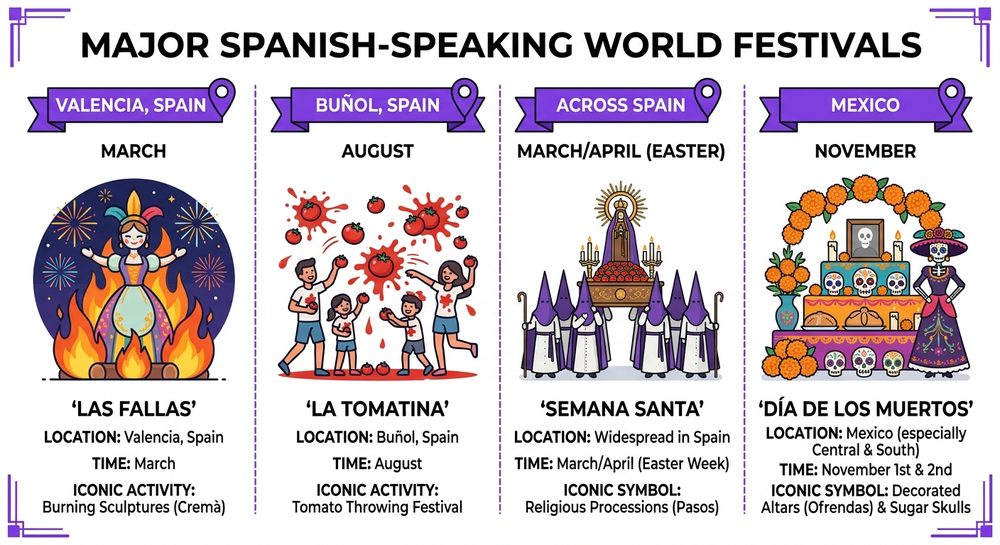
This lesson covers four major festivals that commonly appear in exam materials: Las Fallas, La Tomatina, Semana Santa, and El Día de los Muertos.
Las Fallas de Valencia
Las Fallas is one of Spain’s most famous festivals. It takes place every year in Valencia from 15 to 19 March. During the festival, enormous sculptures called fallas (made of papier-mâché and wood) are displayed in the streets. These figures are often satirical — they make fun of politicians, celebrities and current events.
On the final night of Las Fallas, called La Cremà, all the sculptures are burned in huge bonfires. There are also fireworks (fuegos artificiales), parades (desfiles) and music. The festival attracts over a million visitors each year and was declared a UNESCO Intangible Cultural Heritage in 2016.
La Tomatina
La Tomatina takes place on the last Wednesday of August in Buñol, a small town near Valencia. Thousands of participants throw overripe tomatoes at each other in the world’s largest food fight. The event began in 1945 and has become an international tourist attraction.
Key vocabulary for La Tomatina: tirar tomates (throw tomatoes), divertirse (enjoy oneself), llevar ropa vieja (wear old clothes), participar (participate), una batalla (a battle).
Semana Santa
Semana Santa (Holy Week) is celebrated across Spain in the week before Easter. It is one of the most important religious festivals in the Spanish-speaking world. Cities like Sevilla, Málaga and Valladolid are famous for their procesiones (processions), where religious brotherhoods carry elaborate floats through the streets.
During Semana Santa, members of religious brotherhoods (cofradías) wear distinctive robes and pointed hoods (capirotes) and carry heavy floats (pasos) bearing statues of Jesus and the Virgin Mary. Spectators line the streets, and there is traditional music from marching bands. People eat special sweets like torrijas (a type of French toast) and pestiños (honey-coated pastries).
El Día de los Muertos
El Día de los Muertos (Day of the Dead) is a Mexican festival celebrated on 1 and 2 November. Unlike what the name suggests, it is not a sad occasion — it is a joyful celebration of the lives of family members who have died. Families build colourful altars called ofrendas, decorated with photographs, flowers (especially marigolds — cempasúchil), candles and the favourite foods of the deceased.
People visit cemeteries to clean and decorate graves. They eat pan de muerto (bread of the dead) and sugar skulls called calaveras de azúcar. Many people paint their faces as skulls (calaveras) and there are parades, music and dancing. The festival combines indigenous Aztec traditions with Catholic beliefs brought by Spanish colonists.
El Día de los Muertos was recognised by UNESCO as an Intangible Cultural Heritage of Humanity in 2003. It is a celebration, not a mourning — Mexicans believe that the spirits of the dead return to visit their families during this time.
Useful Phrases for Writing About Festivals
When writing or speaking about festivals in the exam, use these structures from the source material:
Diría que (I would say that), Pienso que (I think that), Siempre he querido ir a… (I have always wanted to go to…), Me gustaría ir a… (I would like to go to…), La fiesta tiene lugar en… (The festival takes place in…), La fiesta ocurre… (The festival happens…), Durante la fiesta se puede… (During the festival you can…), Se debe… (You must…), Sería (It would be) + adjective.
Example: “Siempre he querido ir a La Tomatina en Buñol ya que sería inolvidable. Durante la fiesta se puede tirar tomates en las calles y divertirse.”