The impact of the First World War on Germany
Germany Defeated: the World War One Legacy
When the guns fell silent on 11 November 1918, Germany did not surrender on the battlefield. German troops still occupied foreign soil, and many soldiers returned home undefeated. Yet within weeks, the Kaiser had abdicated, a republic had been proclaimed, and German politicians had signed an armistice. This disconnect between military reality and political outcome would poison German democracy for the next fifteen years.
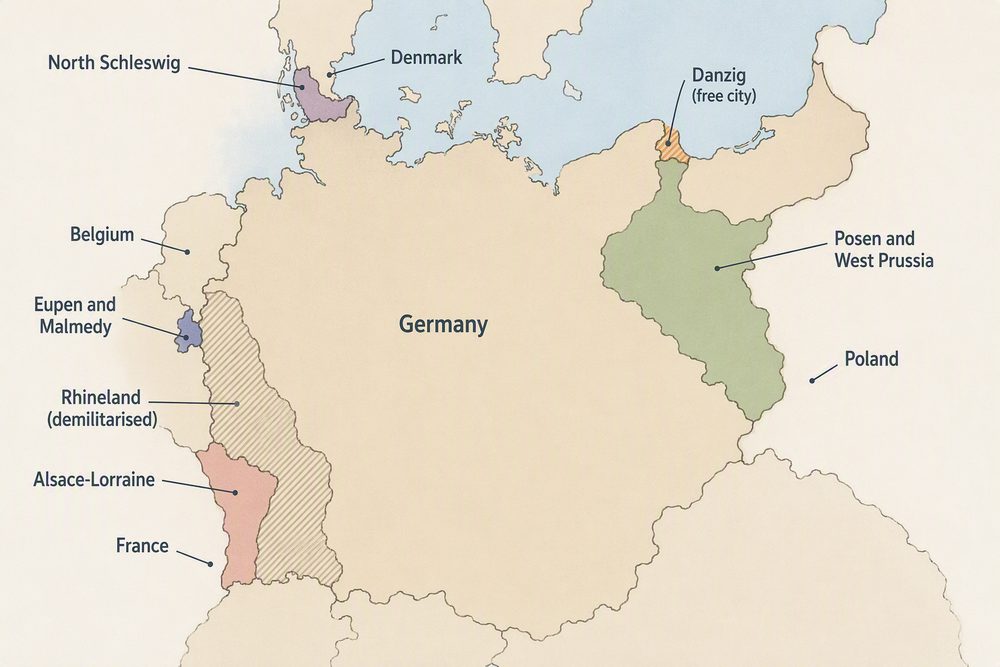
The Treaty of Versailles (June 1919) imposed on Germany: war guilt (Article 231), reparations of £6.6 billion (set 1921), loss of 13% of territory, the Rhineland demilitarised, and the army limited to 100,000 men.
The Treaty of Versailles, 1919
The Treaty of Versailles was signed by the new German government on 28 June 1919. German representatives were not allowed to negotiate — they were simply handed the document and told to sign. The treaty's main terms were devastating:
War guilt: Article 231, the ‘War Guilt Clause’, forced Germany to accept sole responsibility for the war. This had enormous moral and financial consequences. Reparations: Germany was required to pay compensation for war damage. The final figure, set in 1921, was £6.6 billion — a sum many economists believed impossible to pay in full. Territorial losses: Germany lost 13% of its European territory, including Alsace-Lorraine (to France), Eupen and Malmedy (to Belgium), North Schleswig (to Denmark after a plebiscite), Posen and West Prussia (to the newly created Poland). Danzig became a free city under League of Nations supervision. German colonies were redistributed as ‘mandates’ among the Allies. Military restrictions: The German army was limited to 100,000 men, no tanks or aircraft, and the navy was stripped of its main fleet. The Rhineland was demilitarised.
Germans across the political spectrum condemned the treaty as a Diktat — a peace dictated by force rather than agreed by negotiation. Many had expected a settlement based on Woodrow Wilson’s Fourteen Points, which promised national self-determination and no punitive terms. Instead they received humiliation. The army was outraged by the military clauses; industrialists feared reparations would cripple the economy; nationalists raged at territorial losses that left millions of German-speakers under foreign rule.
The politicians who signed the armistice in November 1918 were branded November Criminals by right-wing groups who claimed they had ‘stabbed Germany in the back’ by surrendering when the army could still have fought on. This ‘stab-in-the-back myth’ was historically false — the German High Command had itself requested an armistice because the military situation was hopeless — but it was politically powerful and would fuel right-wing resentment throughout the Weimar period.
The Birth of the Weimar Republic
On 9 November 1918, Kaiser Wilhelm II abdicated and Friedrich Ebert of the Social Democrat Party (SPD) became head of government. Two days later, the armistice was signed. In February 1919, a new constitution was drawn up at Weimar, giving the republic its name. The Weimar Constitution created a democratic system with proportional representation, where seats in the Reichstag were allocated in direct proportion to votes cast. This ensured that even small parties gained representation, but it also meant coalition governments were the norm and decisive majorities were rare.
Article 48 of the Weimar Constitution allowed the President to rule by emergency decree, bypassing the Reichstag. It was designed for genuine crises, but was used 136 times between 1930 and 1932, undermining parliamentary democracy.
Political Instability: the Spartacist Rising, 1919
The new republic faced violent opposition from both left and right from its first weeks. In January 1919, the Spartacists, led by Rosa Luxemburg and Karl Liebknecht, launched an armed uprising in Berlin. Inspired by the Bolshevik revolution in Russia, they seized newspaper offices and called on workers to overthrow the government. Ebert called in the Freikorps — right-wing volunteer ex-soldiers — to crush the revolt. The Freikorps suppressed the rising brutally; both Luxemburg and Liebknecht were murdered in custody in January 1919. The use of the Freikorps to defend the republic permanently alienated the German left from Ebert’s government.
Right-wing opposition erupted in March 1920 when the Kapp Putsch attempted to seize power in Berlin. Wolfgang Kapp, a nationalist politician, and General Walther von Lüttwitz marched Freikorps units into Berlin and declared a new government. The regular army refused to fire on the Freikorps. The Weimar government fled the capital. The putsch collapsed within four days when Berlin’s trade unions called a general strike that paralysed the city — transport, power and water all stopped. Kapp fled to Sweden. The episode revealed the fragility of the new republic: it had been saved not by its own security forces but by workers' industrial action.
The weakness of both putsches showed the deep divisions in German society. Left-wing workers, nationalist ex-soldiers, conservative businessmen and rural landowners had completely incompatible visions of Germany’s future. The Weimar Republic sat at the centre of these conflicts, lacking the broad popular legitimacy needed to command loyalty in a crisis.
Structural Weaknesses of the Weimar System
Beyond immediate crises, the republic had deeper structural problems. Proportional representation produced weak coalition governments that frequently collapsed. Between 1919 and 1933, Germany had twenty different cabinets. Article 48 gave the President emergency powers that could bypass parliament entirely. The judiciary and civil service were largely staffed by men loyal to the old imperial order, and treated the republic’s enemies with leniency: Hitler received a light sentence for his 1923 coup attempt, while left-wing defendants faced far harsher treatment. The army remained a ‘state within the state’, never fully committed to democratic government.