Hyperinflation and the Ruhr crisis, 1923
The Ruhr Crisis, 1923
By 1923, Germany had fallen behind on its reparations payments. In January 1923, French and Belgian troops marched into the Ruhr, Germany's industrial heartland, to seize coal and steel as payment in kind. The German government responded by ordering passive resistance — a general strike across the occupied zone. Workers stopped producing, officials refused to obey French orders, and sabotage became widespread. France responded with arrests, deportations and the shooting of protesters; thirteen workers died in the Krupp factory incident in Essen in March 1923.
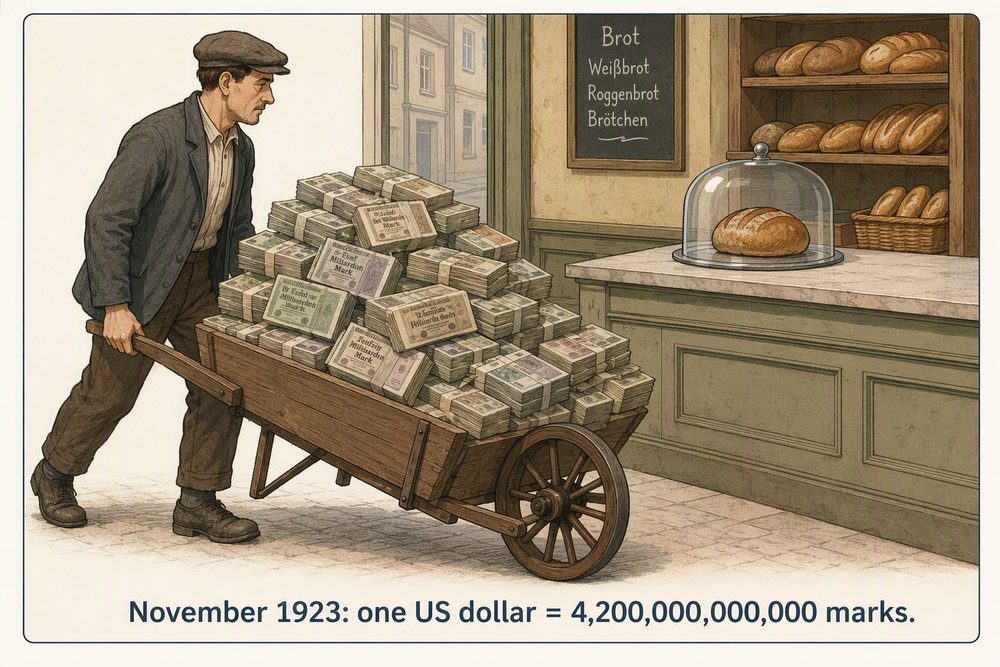
The German government paid striking Ruhr workers by printing money. This decision, combined with a loss of industrial output, triggered hyperinflation: by November 1923, one US dollar was worth approximately 4.2 trillion German marks.
Hyperinflation, 1923
Hyperinflation had deep roots before 1923 — Germany had printed money to fund the First World War, and reparations demands had strained public finances since 1921 — but the passive resistance payments turned a serious inflation into a catastrophe. The government printed billions of marks to pay strikers who were producing nothing. Prices rose so fast that workers were paid twice daily and rushed to shops before prices increased again. Wheelbarrows of banknotes were required to buy bread. At the peak in November 1923, one US dollar was worth approximately 4.2 trillion marks.
The social effects were devastating but uneven. Those on fixed incomes — pensioners, civil servants, people with savings — saw their wealth wiped out. Debtors benefited: mortgage holders and factory owners who owed money could pay off their debts with near-worthless notes. Some wealthy businessmen actually gained from hyperinflation by buying up real assets cheaply. This redistribution of wealth created intense social resentment that would last for decades.
The crisis was resolved by Gustav Stresemann, who became Chancellor in August 1923. He called off passive resistance in September 1923, accepting the political cost of appearing to surrender to France, because he recognised the printing presses had to stop. In November 1923, a new currency — the Rentenmark — was introduced at a rate of one Rentenmark to one trillion old marks. The Rentenmark was backed by Germany’s land and industrial assets, giving it credibility where paper money had none. Hyperinflation ended almost immediately. The following year, Stresemann's government negotiated the Dawes Plan, which restructured reparations payments and unlocked US loans that began Germany's economic recovery.
The Munich Putsch, November 1923
The crisis of 1923 encouraged those who believed the Weimar Republic was finished. In Munich, Adolf Hitler — leader of the small Nazi Party — attempted to use the chaos to seize power. On the evening of 8 November 1923, he burst into a meeting at the Bürgerbräukeller, a large beer hall in Munich, fired a pistol into the ceiling, and declared a ‘national revolution’. He hoped to trigger a march on Berlin, modelled on Mussolini's March on Rome in 1922.
The Munich Putsch (8–9 November 1923) failed within 24 hours when police fired on the Nazi march at the Odeonsplatz. Sixteen Nazis and four police officers were killed. Hitler was arrested, tried, and sentenced to five years — but served only nine months, during which he dictated Mein Kampf.
The putsch failed for practical reasons: the Bavarian government and the army did not support it. Hitler had miscalculated the strength of loyalty to the republic among local authorities. However, the trial proved an unexpected propaganda gift. Hitler used the courtroom to attack the Weimar government as traitors and deliver nationalist speeches that were widely reported in the press. His light sentence — five years, of which he served nine months at Landsberg Prison — revealed the judiciary’s sympathy with right-wing nationalism.
While in prison, Hitler dictated Mein Kampf (‘My Struggle’), which outlined his ideology: extreme nationalism, anti-Semitism, the concept of Lebensraum, and the need for a dictatorial leader. He concluded that power could not be seized by force — it had to be won through the ballot box and legal means. This tactical shift would shape Nazi strategy throughout the late 1920s and early 1930s.
The year 1923 is often treated as a turning point in Weimar history precisely because multiple crises converged simultaneously. The Ruhr occupation, hyperinflation and the Munich Putsch all occurred within a single calendar year, and all three reflected the same underlying truth: Germany in 1923 was a republic in crisis, unloved by the left, hated by the right, and battered by forces largely beyond its control. That it survived — and even stabilised rapidly in 1924 with Stresemann’s currency reform and the Dawes Plan — is itself significant. The recovery that followed was real, but it rested on American loans and Stresemann’s personal diplomatic skill, both of which would disappear within six years. The psychological scars of 1923, particularly the middle class’s memory of their savings being wiped out, never fully healed and would resurface when economic crisis returned after 1929.