The Stresemann years: a 'golden age'?
Gustav Stresemann and German Recovery
Gustav Stresemann dominated German foreign policy from 1923 until his death in October 1929. A former nationalist who had supported the war, he underwent a pragmatic conversion to the republic and concluded that Germany could only regain its place in the world through international co-operation rather than confrontation. His approach combined diplomatic skill with a willingness to make concessions, and it transformed Germany's international standing within six years.
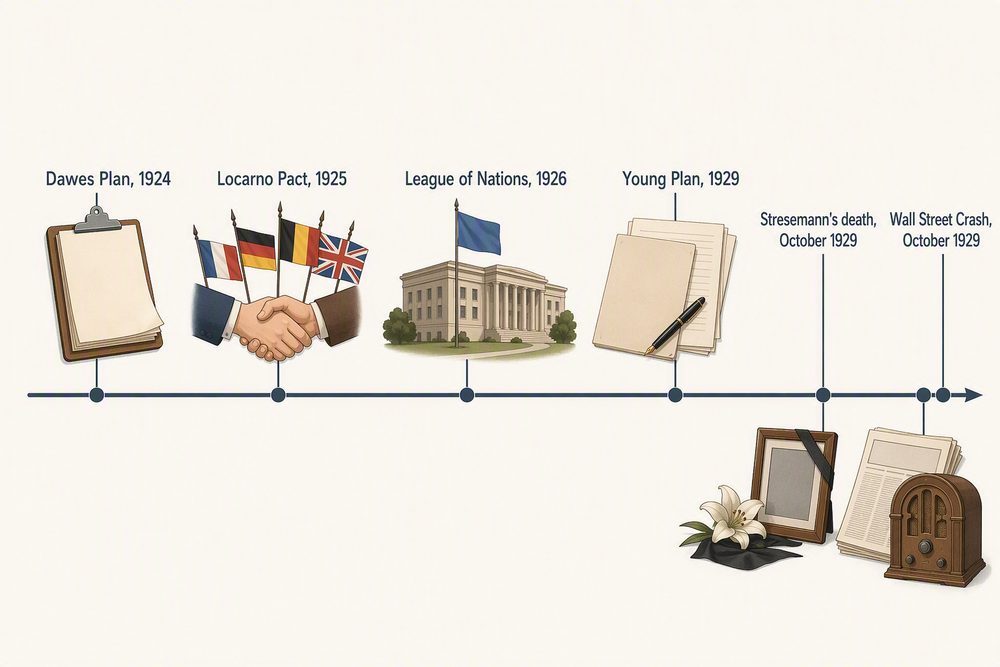
The Dawes Plan (1924) restructured reparations into affordable annual payments and unlocked American loans totalling approximately 800 million gold marks. The Young Plan (1929) further reduced the total reparations bill and extended repayment to 1988.
Economic Recovery: the Dawes and Young Plans
In 1924, American banker Charles Dawes chaired a commission that proposed the Dawes Plan. Germany would receive large American loans, reparations payments were restructured into affordable annual instalments, and France agreed to withdraw from the Ruhr. The plan worked: US dollars flowed into Germany, industries modernised, unemployment fell, and real wages rose. By the mid-1920s, Germany was producing more steel than Britain. The Young Plan of 1929 went further: the total reparations bill was cut and repayment spread over nearly sixty years. These two agreements underpinned what appeared to be genuine economic stability.
However, this recovery rested on a fragile foundation — American short-term loans that could be recalled at any time. The Weimar economy was dangerously dependent on continued US investment. As Stresemann himself reportedly remarked privately, Germany was ‘dancing on a volcano.’ When Wall Street crashed in October 1929, American banks demanded their loans back, and the German economy collapsed almost immediately.
In 1925, Stresemann negotiated the Locarno Pact. Germany accepted its western borders (including the loss of Alsace-Lorraine to France) as permanent and agreed to resolve all disputes with its neighbours through arbitration rather than war. In return, France and Britain guaranteed the new borders and Germany was promised entry to the League of Nations. The ‘Spirit of Locarno’ marked Germany’s re-entry into the community of nations. French troops began withdrawing from the Rhineland ahead of schedule.
In 1926, Germany joined the League of Nations and was granted a permanent seat on its Council — the same status as Britain, France, Italy and Japan. This was a remarkable diplomatic achievement: Germany, defeated and humiliated in 1919, had become a respected member of the international order within seven years. Stresemann won the Nobel Peace Prize in 1926.
Weimar Culture: a Creative Flourishing
The relative stability of the mid-1920s coincided with an extraordinary cultural flowering. Berlin became one of the most creative cities in the world. The Bauhaus school, founded by Walter Gropius in 1919, fused art, architecture and crafts into a revolutionary modernist aesthetic whose influence is still felt in design today. German cinema produced landmark works, including Fritz Lang’s Metropolis (1927) and F. W. Murnau’s Nosferatu (1922). Writers including Erich Maria Remarque (All Quiet on the Western Front, 1929) achieved international recognition.
Berlin's cabaret scene and nightlife became internationally famous, reflecting a new social freedoms in Weimar Germany. Women gained the vote in 1918, universities opened wider to women, and the 'New Woman' emerged as a cultural figure — though these changes were deeply controversial among conservative Germans.
Historians debate whether the Stresemann years deserve the label ‘golden age’. The recovery was real but uneven. Agricultural Germany struggled even in good times — falling grain prices hit farmers throughout the 1920s. Unemployment never fell below 1.3 million even in the best years. Political extremism did not disappear: the Nazis and communists remained active, and right-wing nationalists still regarded Versailles as an open wound. Coalition governments remained unstable. The cultural brilliance of Berlin coexisted with widespread poverty and social anxiety.
The period’s ‘golden’ quality depended almost entirely on American money and on Stresemann’s personal diplomatic skill. When Stresemann died in October 1929, just weeks before the Wall Street Crash, Germany lost both its economic lifeline and its most capable statesman simultaneously. The fragility of the recovery became apparent almost immediately.
Despite its achievements, the Stresemann era also contained the seeds of later crisis. The apparent stability masked deep political divisions: the Nazi Party, though marginal with only 2.6% of the vote in 1928, continued to operate; the Communist Party (KPD) was a significant force in industrial cities; and right-wing nationalist parties never accepted Locarno or the Dawes Plan as legitimate. The reparations question had not been resolved, only deferred. Germany’s continued resentment of Versailles meant that the international goodwill Stresemann had built could be reversed if the domestic political balance shifted. The mid-1920s stability was genuine, but it was also contingent on a set of international and economic conditions that proved temporary. When those conditions changed after 1929, the republic had no deep roots of popular loyalty to fall back on.