The collapse of Weimar, 1929-1933
The Wall Street Crash and the Great Depression in Germany
On 24 October 1929, the New York Stock Exchange collapsed. American banks immediately recalled the short-term loans that had underpinned Germany’s recovery since 1924. German factories lost their credit, banks failed, and unemployment rocketed. By the winter of 1932, over six million Germans were officially unemployed — approximately one in three workers. Millions more were on short-time working. The social consequences were devastating: hunger, poverty, family breakdown, and a pervasive sense of hopelessness.
In the 1928 Reichstag election, the Nazi Party won just 2.6% of the vote. By July 1932, at the height of the Depression, they won 37.4% — becoming the largest party in the Reichstag, though still without a majority.
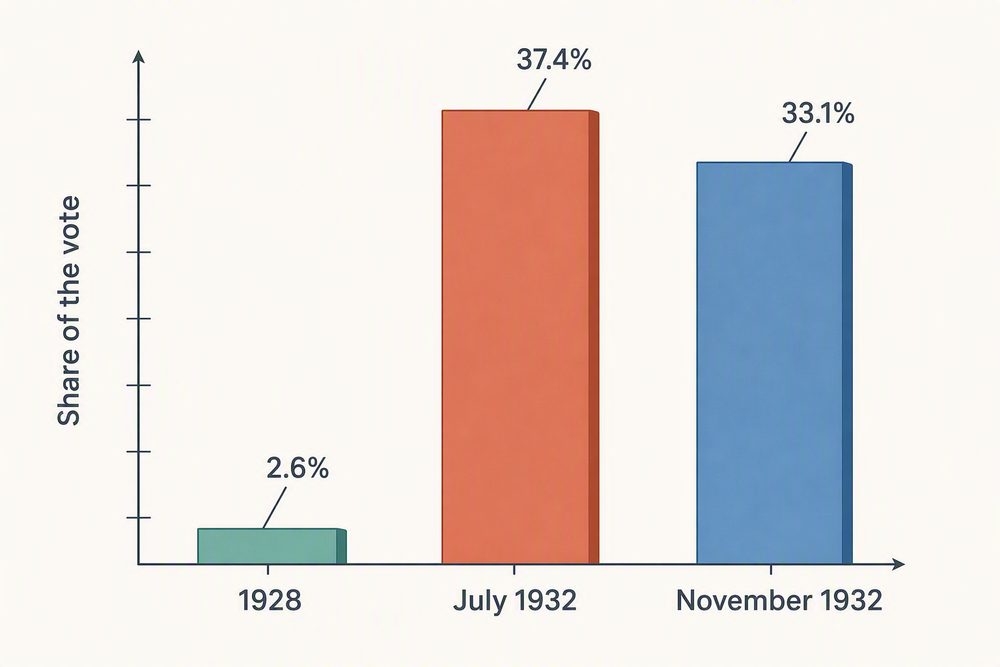
The Political Impact of the Depression
Chancellor Heinrich Brüning responded to the Depression with austerity: he cut wages, benefits and public spending, using Article 48 emergency decrees because he could not get his budget through the Reichstag. His measures deepened the depression rather than ending it. The human cost of austerity, combined with mass unemployment, turned millions of voters towards the political extremes. The Communist Party (KPD) grew significantly, but the Nazis grew far faster.
Hitler’s electoral appeal was remarkable in its breadth. He promised different things to different groups: jobs and economic recovery to the unemployed; protection of property and anti-communism to the middle classes and farmers; national greatness and revenge for Versailles to nationalists; strong leadership to those who saw coalition governments as weak and ineffectual. His speeches were emotionally charged, exploiting fear and resentment with extraordinary skill. The Nazi Party built a sophisticated propaganda machine, using modern techniques including radio, cinema and mass rallies.
The SA (Sturmabteilung), known as the Brownshirts, played a dual role. Their street violence — brawls with communists, attacks on Jewish businesses, disruption of opposition meetings — created an atmosphere of chaos. But paradoxically, this chaos helped the Nazis: voters who feared disorder were told that only Hitler could restore order. The SA also provided a sense of belonging and purpose to unemployed young men who had nothing else. By 1932, the SA had around 400,000 members.
Political violence escalated dramatically in 1932. In the summer of that year, there were hundreds of political killings on the streets of Germany. The Weimar Republic seemed unable to protect its citizens. This apparent weakness further discredited democratic government and pushed more voters towards parties that promised decisive action.
Elite Scheming: Papen, Hindenburg and Schleicher
By 1932, the Weimar political system was effectively deadlocked. The Nazis were the largest party but had no majority. The communists were strong. Moderate parties were weak. President Paul von Hindenburg, an elderly field marshal who privately despised Hitler, refused to appoint him Chancellor. Instead, he appointed Franz von Papen, a conservative aristocrat, in June 1932.
Franz von Papen persuaded Hindenburg to appoint Hitler as Chancellor on 30 January 1933. Papen believed he could control Hitler by surrounding him with conservative ministers. He was fatally wrong — within eighteen months Hitler had dismantled the entire constitutional order.
Historians have debated whether Hitler’s appointment was primarily the result of mass popular support or elite political miscalculation. Both factors mattered. The Nazis had the largest share of the popular vote (37.4% in July 1932, falling to 33.1% in November 1932 — a sign that support may have peaked). But Hitler became Chancellor not through a majority election victory but through the behind-the-scenes deal-making of Papen and Hindenburg. Papen calculated that he could use Hitler’s mass support while keeping real power in conservative hands. General Kurt von Schleicher, who briefly replaced Papen as Chancellor in December 1932, lost Hindenburg’s support and resigned in January 1933.
On 30 January 1933, Adolf Hitler was appointed Chancellor of Germany. The decision was made not by the German people through the ballot box but by an ageing president and a scheming ex-chancellor who fatally underestimated the man they thought they could control.
It is worth noting that Hitler never won a majority of the vote in a free election. The Nazis peaked at 37.4% in July 1932 and fell back to 33.1% in November 1932 as the worst of the Depression eased slightly and some voters returned to moderate parties. Had Hindenburg appointed a different Chancellor and stabilised the political situation, the Nazi surge might have continued to decline. The tragedy of January 1933 was that democracy was not overthrown from below by an unstoppable popular revolution — it was surrendered from above by conservative elites who calculated they had more to fear from communism than from Hitler, and who believed their money, institutions and social position would protect them once they had put him in office. They were catastrophically wrong on every count.