Nazi economic and social policy
Nazi Economic Policy: Reducing Unemployment
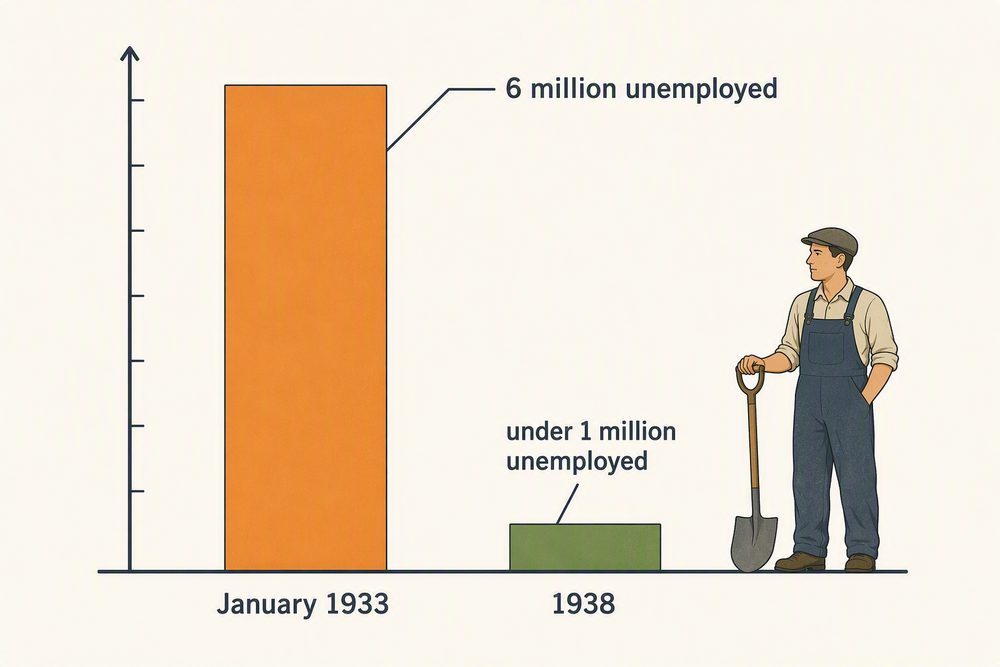
When Hitler came to power in January 1933, approximately six million Germans were unemployed. Reducing unemployment was the Nazis' most visible domestic success and a crucial source of their popularity. They achieved it through a combination of public works, rearmament, and labour service schemes. By 1938, official unemployment had fallen to below one million, though the actual figure was higher because women and Jewish workers had been excluded from the count.
The Nazis reduced unemployment through the RAD (Reichsarbeitsdienst — National Labour Service, 1935), which required young men to complete six months of labour service; a massive autobahn road-building programme; and rapid rearmament from 1935.
Public Works and the Autobahns
The autobahns became the most visible symbol of Nazi economic achievement. Construction began in 1933 and provided employment for hundreds of thousands of workers. The project was heavily promoted as evidence of National Socialist modernity and organisational power. In practice, the number employed directly on autobahn construction was smaller than propaganda claimed, and rearmament did far more to reduce unemployment; but the motorways became a powerful image of national renewal.
The RAD (Reichsarbeitsdienst) required all young men aged 18 to 25 to complete six months of compulsory labour, typically on agricultural or construction projects. Workers received food, accommodation and a small wage, but primarily the programme was about discipline, ideological training and removing young men from the unemployment statistics.
Strength Through Joy (Kraft durch Freude, KdF) provided workers with leisure activities — subsidised holidays, theatre tickets, concerts, and cruises — as a substitute for the trade union rights that had been abolished in May 1933. Workers could save towards a Volkswagen car (though none were delivered before the war). These benefits were real: millions of Germans experienced holidays they could never have afforded before. The Beauty of Labour scheme improved workplace conditions, adding canteens, showers, and sports facilities to factories. Both programmes worked to win worker loyalty without giving workers any genuine economic power.
Women in Nazi Germany: the Three Ks
Nazi ideology prescribed a specific role for women, captured in the phrase Kinder, Küche, Kirche (children, kitchen, church). Women were to be wives and mothers first; their role was to produce children for the German nation. Women were pushed out of professional jobs, discouraged from higher education, and rewarded with the Mother’s Cross for having large families (bronze for four children, silver for six, gold for eight or more). The marriage loan scheme (introduced 1933) gave newly-wed couples a loan of 1,000 Reichsmarks, with a quarter of it cancelled for each child born.
In practice, Nazi policy towards women was contradictory. The economy increasingly needed female labour as rearmament expanded. By the late 1930s, the regime was quietly encouraging women back into the workforce — especially in nursing, farming and munitions factories — while still officially promoting the domestic ideal. Women’s experiences of the Nazi period varied enormously depending on class, region and individual circumstance.
The Hitler Youth (Hitlerjugend) for boys aged 14–18 and the League of German Girls (BDM, Bund Deutscher Mädel) for girls aged 14–18 became compulsory from March 1939. Younger children went to the German Young People (Deutsches Jungvolk) and Jungmädel respectively.
Schools were used to indoctrinate the next generation. All teachers had to join the Nazi Teachers’ League and follow revised curricula. History lessons emphasised Germany’s past greatness, Versailles as a crime, and the Nazi rise as a national salvation. Biology introduced racial theory, presenting the Jews as a biologically inferior race. Physical education received far more timetable time. Girls’ education emphasised domestic science and preparation for motherhood.
The Hitler Youth supplemented school with outdoor activities, sport, military drill and ideological instruction. It offered genuine fun — camping, hiking, competitions — alongside the propaganda. Membership grew from around 100,000 in 1933 to over seven million by 1939. For many boys, it provided a strong sense of belonging and purpose. However, by the late 1930s, compulsory membership had eroded enthusiasm and some young people expressed subtle resistance through ‘Swing Youth’ groups that preferred American jazz and British swing music to Nazi ideology.