Racial policy: Nazi treatment of the Jews to 1939
Nazi Racial Ideology and the Jews
At the heart of Nazi ideology was a virulent anti-Semitism. Hitler had argued in Mein Kampf that Jewish people were a separate and inferior race responsible for Germany’s defeat in 1918 and for the evils of communism and international capitalism. This was not merely personal hatred — it was a systematic ideology that divided humanity into a racial hierarchy with ‘Aryan’ Germans at the top and Jewish people at the bottom. This ideology shaped Nazi policy from the moment Hitler took power.
Before 1933, there were approximately 523,000 Jews in Germany, making up less than one percent of the population. They were a largely assimilated community — many were professionals, academics, lawyers, doctors and businesspeople who considered themselves German first. The persecution they faced after 1933 came not from popular demand, but was driven from above by the state, though it built on existing social prejudices that the Nazis deliberately inflamed.
The Nuremberg Laws (September 1935) stripped Jews of German citizenship and banned marriage and sexual relations between Jews and non-Jews. They legally defined who was Jewish based on grandparentage, creating a bureaucratic framework for racial persecution.
Early Persecution: the 1933 Boycott
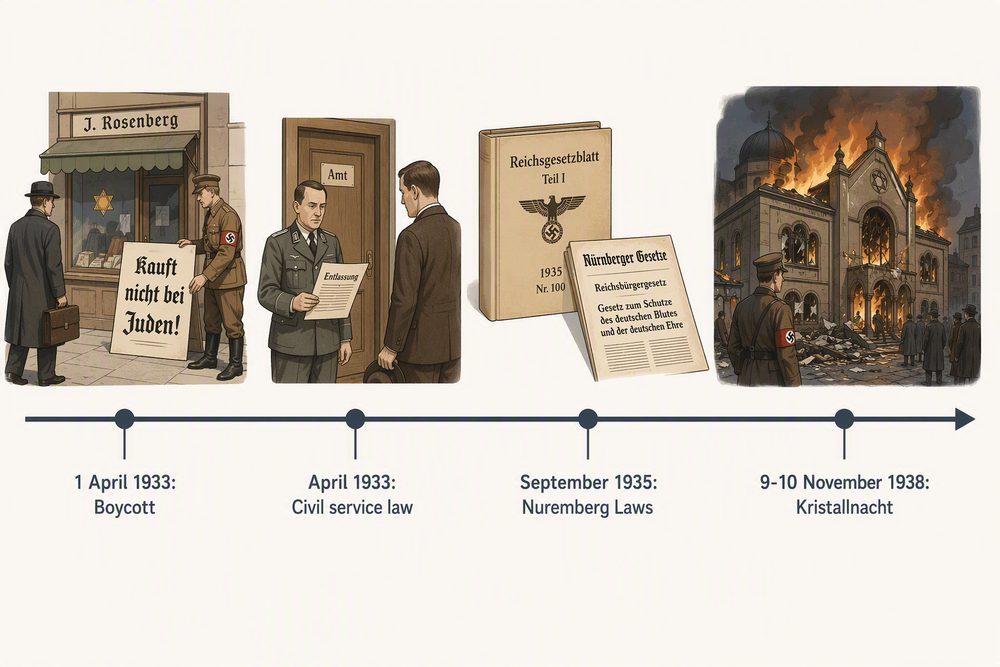
On 1 April 1933, the Nazi regime organised a national boycott of Jewish-owned businesses. SA stormtroopers stood outside Jewish shops, law offices and medical practices, intimidating customers and painting ‘Jude’ (Jew) on windows. The boycott lasted only one day because of international criticism and because many Germans did not observe it; but it signalled the regime’s intentions. Over the following months, Jews were expelled from the civil service under the Law for the Restoration of the Professional Civil Service (April 1933), removed from journalism, broadcasting and the arts, and excluded from many professions.
At the Nazi Party rally in Nuremberg in September 1935, Hitler announced two new laws that fundamentally altered the legal status of Jewish people in Germany. The Reich Citizenship Law stripped Jews of German citizenship, making them ‘subjects of the state’ rather than full citizens. The Law for the Protection of German Blood and Honour banned marriage and sexual relations between Jews and non-Jews. Together, the Nuremberg Laws provided a legal framework for racial separation. Supplementary decrees defined who was ‘Jewish’ on the basis of grandparentage, creating categories of full Jews, half-Jews and quarter-Jews with different legal statuses.
Aryanisation and Economic Exclusion
Aryanisation was the forced transfer of Jewish-owned businesses into non-Jewish hands. Initially informal pressure and intimidation persuaded many Jewish business owners to sell cheaply; from 1937, the process became more systematic and legally enforced. Jewish professionals were progressively barred from their occupations. Jewish children were expelled from German schools. By late 1938, Jews had been almost entirely excluded from German economic life.
Kristallnacht (the Night of Broken Glass), 9–10 November 1938: approximately 7,500 Jewish businesses were smashed, around 267 synagogues were burned to the ground (and many more were damaged), at least 91 Jews were killed, and approximately 30,000 Jewish men were arrested and sent to concentration camps. The name refers to the broken glass that covered the streets.
On 7 November 1938, a young Jewish man, Herschel Grynszpan, shot a German diplomat in Paris, Ernst vom Rath, in protest at the deportation of his parents from Germany. When vom Rath died on 9 November, Propaganda Minister Joseph Goebbels used it as a pretext to orchestrate nationwide violence. SA and SS units, directed by the Nazi Party, attacked Jewish property across Germany. The violence was presented as a spontaneous popular reaction.
The aftermath was as devastating as the night itself. Jews were collectively fined one billion Reichsmarks for the damage done to their own property. Jewish emigration was officially encouraged — Jews were pressured to leave Germany but could only take a fraction of their assets. By September 1939, approximately half of Germany’s pre-1933 Jewish population had emigrated. The violence of Kristallnacht shocked international observers, though it produced no effective international response.
Historians describe the period 1933 to 1939 as one of escalating but not yet fully systematic persecution. The pattern was one of incremental radicalisation: each measure normalised the next. The 1933 boycott introduced public identification of Jews as targets; professional exclusions separated them from mainstream economic life; the Nuremberg Laws gave racial separation a legal framework; Aryanisation destroyed their economic independence; and Kristallnacht demonstrated that the state would use open violence with impunity. The international community’s muted reaction to Kristallnacht — expressions of horror but no sanctions, no military threat — was a signal that the regime noted. After September 1939, under the cover of war, persecution would escalate still further into systematic mass murder. Understanding the pre-war period is essential to understanding how that escalation became possible.