Terror and persuasion: how the Nazis controlled Germany
Two Pillars of Nazi Control
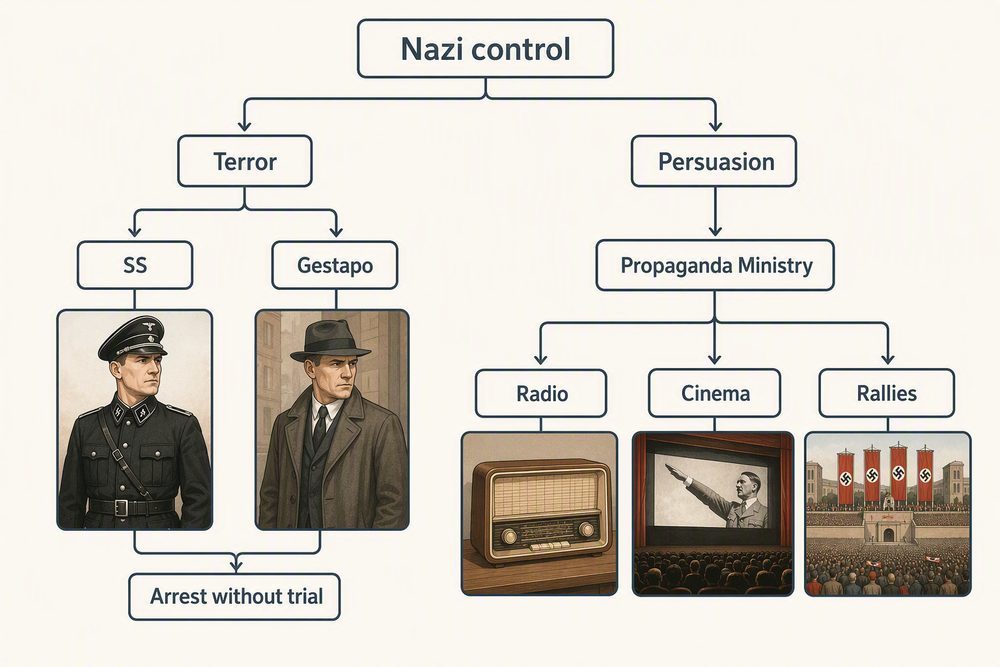
Historians of Nazi Germany distinguish between two systems of control that reinforced each other: terror (the threat and use of violence) and persuasion (propaganda, education and cultural control). Neither alone would have been sufficient — a regime relying purely on terror exhausts itself and breeds resentment, while a regime relying purely on persuasion cannot suppress determined opposition. The Nazis combined both with remarkable effectiveness throughout the 1930s.
The SS and Heinrich Himmler
The SS (Schutzstaffel) began as Hitler’s personal bodyguard but grew under Heinrich Himmler into a vast security empire. By the late 1930s, Himmler controlled the SS, the Gestapo, the concentration camp system, and ultimately most of Germany’s police forces. SS membership was based on racial purity requirements as well as loyalty — members had to prove Aryan ancestry. The SS presented itself as an elite within an elite, a new racial aristocracy.
The Gestapo (Geheime Staatspolizei — secret state police) had around 32,000 officers in 1939 for a population of approximately 80 million. It operated largely on the basis of denunciations — ordinary Germans informing on neighbours, colleagues and family members — rather than a vast network of spies.
The Gestapo could arrest, imprison and send people to concentration camps without trial or appeal. It was particularly feared because of the power of self-censorship it induced: people never knew who might report them, so many refrained from expressing any dissent even privately. Modern historical research has emphasised that the Gestapo was actually relatively small — most of its intelligence came from citizens voluntarily denouncing others. Some denouncers were motivated by genuine ideological commitment; many others had personal grievances they used the Gestapo to settle.
The legal system was restructured to serve the regime. The People’s Court (Volksgerichtshof), established in 1934, handled political cases with hand-picked Nazi judges. Its notorious president, Roland Freisler, conducted show trials characterised by theatrical denunciations of defendants. Appeal to any ordinary court was impossible. Ordinary courts also reflected Nazi ideology — judges who showed leniency to political offenders were replaced.
Goebbels and the Propaganda Ministry
Joseph Goebbels was appointed Minister for Public Enlightenment and Propaganda in March 1933. He immediately established control over all means of mass communication. All journalists, writers, artists, musicians and filmmakers were required to join the Reich Chamber of Culture — those excluded (mainly Jews and political opponents) could not work. Goebbels understood that the most effective propaganda did not feel like propaganda: it entertained as well as indoctrinated.
The Nazis promoted the Volksempfänger ('People's Receiver') — a cheap radio set — so that by 1939 approximately 70% of German households owned one. Radio broadcasts were controlled by the state, giving Goebbels direct access to German living rooms. Cinema newsreels preceded every film, and the Propaganda Ministry approved all film productions.
The annual Nuremberg rallies were the most spectacular public events of the Nazi era. Hundreds of thousands attended; searchlights created a ‘cathedral of light’ effect; massed formations of Hitler Youth and SA presented an image of total national unity. Leni Riefenstahl’s 1935 film Triumph of the Will documented the 1934 rally and became one of the most influential propaganda films ever made. The rallies communicated the message that resistance was futile against such overwhelming force.
Censorship was total. Newspapers were required to follow a daily list of approved stories from the Propaganda Ministry. Books considered dangerous were burned in public ceremonies in May 1933 — works by Jewish authors, Marxists, pacifists and others were destroyed. Modern art (labelled degenerate art) was removed from galleries and displayed in a deliberately mocking exhibition in 1937. Only art celebrating Nazi themes, German landscapes, heroic workers and racial purity was permitted.
The interaction between terror and propaganda was more subtle than it might appear. Propaganda was most effective not where people were forced to believe it but where it reinforced things Germans already wanted to believe: that the Depression was ending, that national humiliation was being reversed, that a strong leader was restoring order. Economic recovery after 1933 gave propaganda real material to work with. The Gestapo’s power, meanwhile, rested less on its actual size — approximately 32,000 agents for 80 million people was far smaller than many assumed — than on the fear of denunciation by neighbours. This fear was the regime’s most cost-effective tool. Most Germans were not watched; they policed themselves, avoiding political conversations, keeping dissenting thoughts private, performing compliance whether they felt it or not. This combination of genuine support among many, passive compliance among most, and terror-induced silence among the rest proved remarkably stable throughout the 1930s.