Organisation and the Digestive System
Levels of Organisation
The human body is organised into a hierarchy. Individual cells with a similar structure and function are grouped together into tissues. Different tissues combine to form organs, and organs work together as organ systems. The digestive system is one of the main organ systems you need to know.
The hierarchy of organisation: cells → tissues → organs → organ systems → organism. Each level builds on the one below it.
The Digestive System
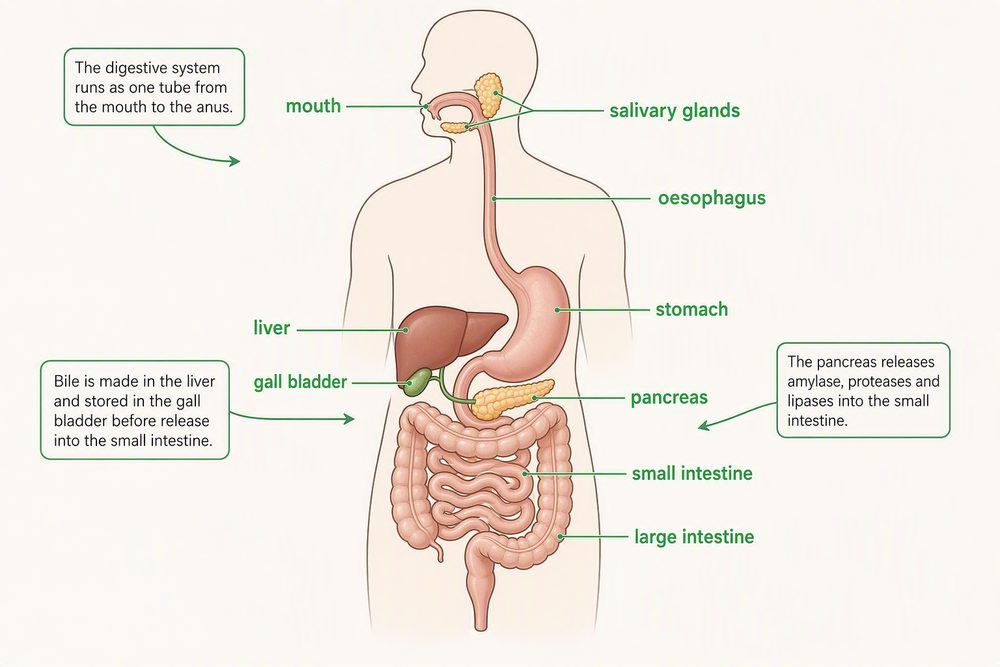
The digestive system is a muscular tube running from the mouth to the anus. Its role is to break large, insoluble food molecules into smaller, soluble molecules that can be absorbed into the blood. Digestion involves both mechanical breakdown (teeth, churning in the stomach) and chemical breakdown by enzymes.
The main digestive enzymes are:
- Amylase — produced in the salivary glands and pancreas; breaks down starch into sugars (maltose).
- Proteases — produced in the stomach (pepsin), pancreas and small intestine; break down proteins into amino acids.
- Lipases — produced in the pancreas and small intestine; break down lipids (fats) into fatty acids and glycerol.
Bile is produced by the liver and stored in the gall bladder. It is released into the small intestine where it has two key functions: it neutralises the hydrochloric acid from the stomach (creating alkaline conditions for enzymes in the small intestine) and it emulsifies fats — breaking large fat droplets into smaller ones to increase the surface area for lipase to work on.
Bile is made in the liver, stored in the gall bladder, and emulsifies fats in the small intestine. It also neutralises stomach acid to create the alkaline conditions needed by intestinal enzymes.
Enzymes and the Lock-and-Key Model
Enzymes are biological catalysts — they speed up reactions without being used up. Each enzyme has a specific active site with a unique shape. Only a substrate with the matching shape can fit into the active site, like a key in a lock. This is called the lock-and-key model.
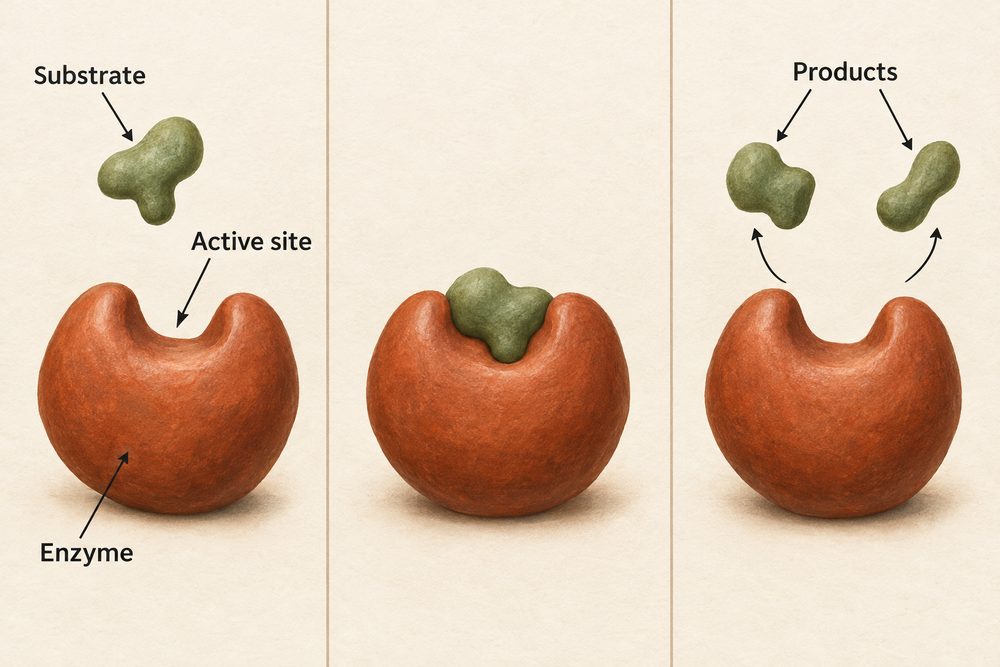
Enzymes work best at an optimum temperature and pH. If the temperature is too high or the pH is too extreme, the active site changes shape (denaturation) and the substrate can no longer fit. The enzyme stops working.
You should know the food tests for AQA Required Practical 3:
- Starch — Iodine solution turns from brown-orange to blue-black.
- Sugars — Benedict’s reagent heated; turns from blue to green/yellow/orange/red (depending on sugar concentration).
- Proteins — Biuret reagent turns from blue to purple/lilac.
- Lipids — Sudan III test; a red layer forms if lipids are present.
The digestive system demonstrates how organs work together as a system. The stomach churns food and adds acid; the pancreas produces enzymes; the liver makes bile; the small intestine absorbs soluble products into the blood; and the large intestine absorbs water.