Health, Non-Communicable Diseases and Plant Tissues
Health and Disease
Health is a state of physical and mental wellbeing. Disease is a condition where part of the body does not function properly. Diseases can be communicable (caused by pathogens and spread between people) or non-communicable (not caused by pathogens and cannot be passed on). Sometimes diseases interact — for example, immune system conditions can make a person more susceptible to communicable diseases.
Non-communicable diseases (NCDs) are not caused by pathogens and cannot be spread. Major NCDs include cardiovascular disease, type 2 diabetes, lung disease and cancer. Risk factors include smoking, obesity, alcohol and lack of exercise.
Risk Factors for Non-Communicable Diseases
A risk factor is something that increases the probability of developing a disease. Key risk factors include:
- Smoking — linked to lung cancer, cardiovascular disease and lung disease.
- Obesity — a risk factor for type 2 diabetes and cardiovascular disease.
- Alcohol — linked to liver disease and some cancers.
- Lack of exercise — increases the risk of cardiovascular disease and obesity.
It is important to understand the difference between a risk factor and a cause. Risk factors are correlated with disease — they make disease more likely — but correlation does not always prove causation.
Cancer is caused by changes in cells that lead to uncontrolled growth and division. Benign tumours are growths of abnormal cells contained in one area — they do not invade other tissues. Malignant tumours invade neighbouring tissues and can spread to other parts of the body through the blood, forming secondary tumours — this is known as metastasis.
Risk factors for cancer include genetic factors, ionising radiation (e.g. UV light), certain viruses (e.g. HPV), and lifestyle factors such as smoking and obesity.
Plant Tissues and Organ Systems
Plants are also organised into tissues and organs. The main plant tissues include:
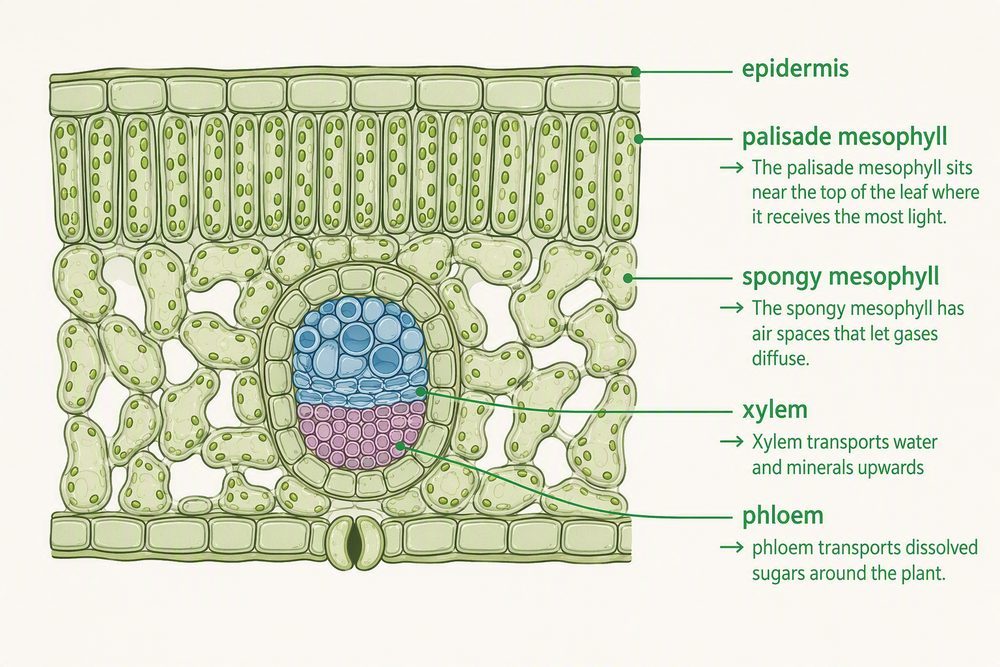
- Epidermal tissue — covers the surface of the plant for protection.
- Palisade mesophyll — packed with chloroplasts and located near the top of the leaf where it receives the most light for photosynthesis.
- Spongy mesophyll — has air spaces that allow gases (\(CO_2\) and \(O_2\)) to diffuse easily.
- Xylem — xylem tissue transports water and mineral ions from the roots to the leaves. It is made of hollow, dead cells with lignified walls.
- Phloem — phloem tissue transports dissolved sugars from the leaves to the rest of the plant in a process called translocation.
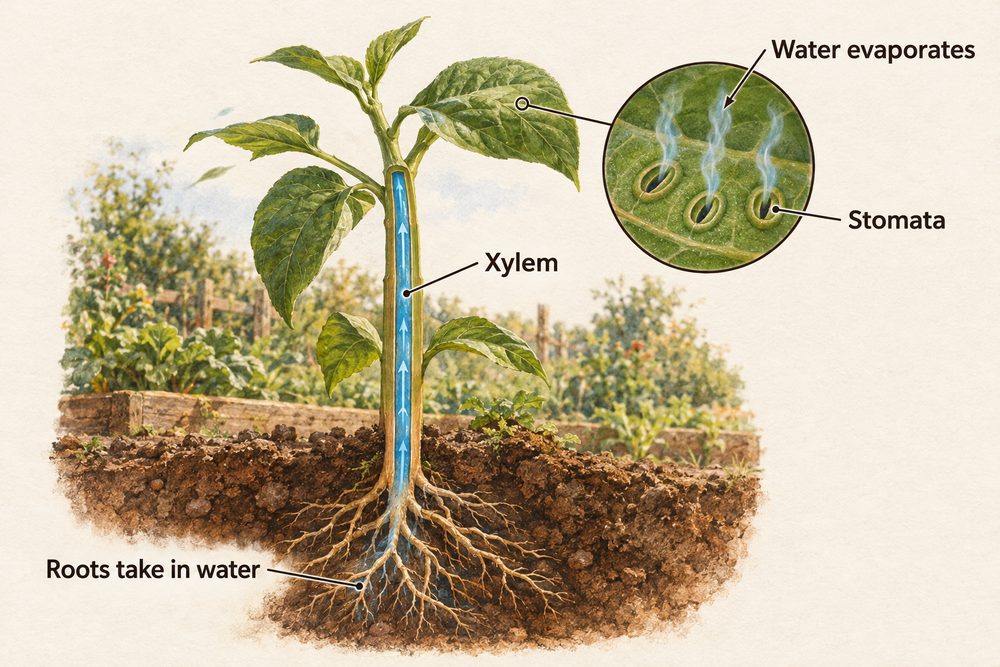
Xylem transports water and minerals upwards (transpiration stream). Phloem transports dissolved sugars to where they are needed (translocation). Xylem cells are dead and hollow; phloem cells are living.
Transpiration is the evaporation and diffusion of water from the surface of leaves, mainly through the stomata. This creates a continuous transpiration stream that pulls water up through the xylem from the roots. The rate of transpiration is affected by temperature, humidity, air movement and light intensity.