Photosynthesis and Respiration
Photosynthesis
Photosynthesis is an endothermic reaction that takes place in the chloroplasts of plant cells. It uses light energy to convert carbon dioxide and water into glucose and oxygen. The word equation is:
$$\text{carbon dioxide} + \text{water} \xrightarrow{\text{light}} \text{glucose} + \text{oxygen}$$
The balanced symbol equation is:
$$6CO_2 + 6H_2O \xrightarrow{\text{light}} C_6H_{12}O_6 + 6O_2$$
Photosynthesis is an endothermic reaction: \(6CO_2 + 6H_2O \rightarrow C_6H_{12}O_6 + 6O_2\). It takes place in the chloroplasts and requires light energy absorbed by chlorophyll.
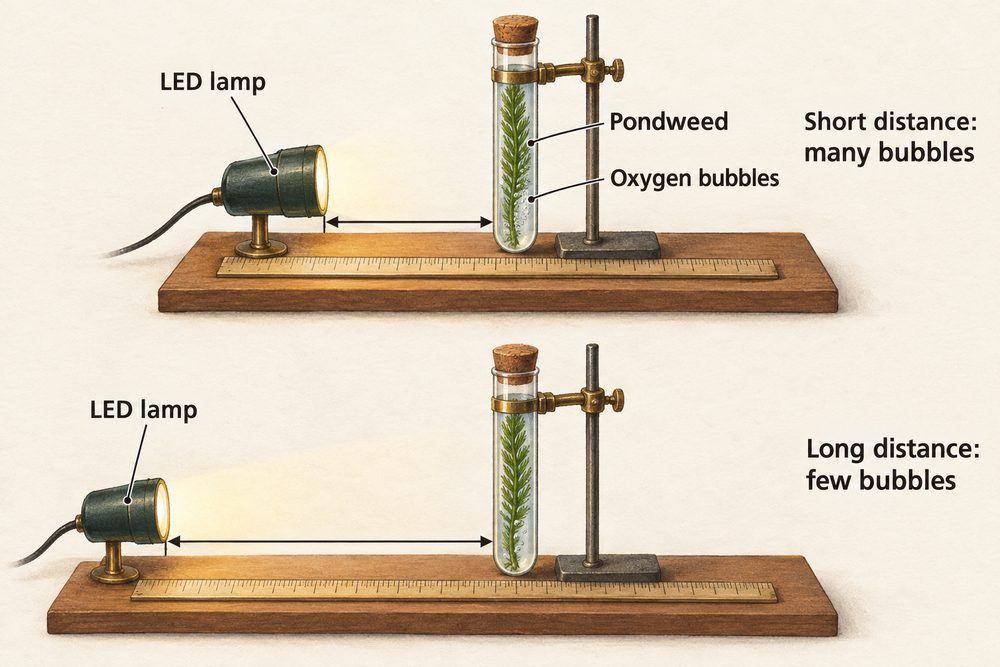
The rate of photosynthesis is affected by the amount of chlorophyll in the leaf, and by three limiting factors:
- Light intensity — as light intensity increases, the rate of photosynthesis increases until another factor becomes limiting.
- Carbon dioxide concentration — increasing \(CO_2\) increases the rate until another factor limits it.
- Temperature — higher temperatures increase the rate of enzyme-controlled reactions up to an optimum, beyond which enzymes denature and the rate drops sharply.
These limiting factors interact, and any one of them may be the factor that limits photosynthesis at a given time. Light intensity follows an inverse square law — it is inversely proportional to the square of the distance from the light source: \(\text{light intensity} \propto \frac{1}{d^2}\). You may need to explain graphs of photosynthesis rate involving two or three limiting factors simultaneously.
Plants use the glucose produced during photosynthesis for several purposes: respiration (to release energy), converting glucose to starch for storage, producing cellulose for cell walls, producing amino acids (by combining with nitrate ions from the soil) for protein synthesis, and producing lipids (fats and oils) for storage in seeds.
Aerobic Respiration
Aerobic respiration is an exothermic reaction that takes place continuously in all living cells. It occurs in the mitochondria and requires oxygen. The word equation is:
$$\text{glucose} + \text{oxygen} \rightarrow \text{carbon dioxide} + \text{water}$$
The balanced symbol equation is:
$$C_6H_{12}O_6 + 6O_2 \rightarrow 6CO_2 + 6H_2O$$
Aerobic respiration: \(C_6H_{12}O_6 + 6O_2 \rightarrow 6CO_2 + 6H_2O\). It is exothermic, occurs in mitochondria, and releases energy for life processes including muscle contraction, maintaining body temperature and building molecules.
Anaerobic Respiration
Anaerobic respiration occurs when oxygen is not available. It releases much less energy per glucose molecule than aerobic respiration because glucose is only partially broken down.
In animals: \(\text{glucose} \rightarrow \text{lactic acid}\)
In plants and yeast (fermentation): \(\text{glucose} \rightarrow \text{ethanol} + \text{carbon dioxide}\)
During intense exercise, the muscles cannot get enough oxygen for aerobic respiration, so anaerobic respiration occurs alongside it. This produces lactic acid, which builds up in the muscles and causes fatigue and cramp. After exercise, you continue to breathe heavily to repay the oxygen debt — the extra oxygen needed to break down the accumulated lactic acid.
Blood flowing through the muscles transports the lactic acid to the liver where it is converted back into glucose. Oxygen debt is the amount of extra oxygen the body needs after exercise to react with the accumulated lactic acid and remove it from the cells.
During exercise, the body responds to the increased demand for energy: heart rate increases, breathing rate and depth increase, and blood is redirected to the muscles. These changes supply more oxygen and glucose for aerobic respiration and remove more carbon dioxide.