Ecosystems, Biodiversity and Human Impact
Communities and Ecosystems
An ecosystem is the interaction of a community of living organisms (biotic factors) with the non-living (abiotic) parts of their environment. A community includes all the organisms of different species living together. A population is all the organisms of one species in a habitat.
Abiotic factors include light intensity, temperature, moisture, soil pH and mineral content, wind speed and direction, and availability of carbon dioxide and oxygen. Biotic factors include availability of food, new predators, new pathogens and competition between organisms.
Ecosystems consist of biotic (living) and abiotic (non-living) factors. In a stable community, the populations of all species are balanced. Changes to abiotic or biotic factors can destabilise a community.
Food Chains and Interdependence
Organisms in a community depend on each other for food, shelter and other resources. This is called interdependence. Food chains show the flow of energy from producers to consumers:
Producer → Primary consumer → Secondary consumer → Tertiary consumer
Producers (plants) convert light energy into chemical energy through photosynthesis. Consumers obtain energy by eating other organisms. If one species in a food chain is removed, it affects all the other organisms — this is called interdependence.
Carbon is recycled through ecosystems. Plants take in \(CO_2\) for photosynthesis and use it to make glucose. Animals eat plants and release \(CO_2\) through respiration. When organisms die, decomposers (bacteria and fungi) break down the dead material, releasing \(CO_2\) through respiration. Combustion of fossil fuels also releases \(CO_2\).
Biodiversity and Human Impact
Biodiversity is the variety of different species in an ecosystem. High biodiversity makes ecosystems more stable and resilient to change. However, human activities are rapidly reducing biodiversity worldwide.
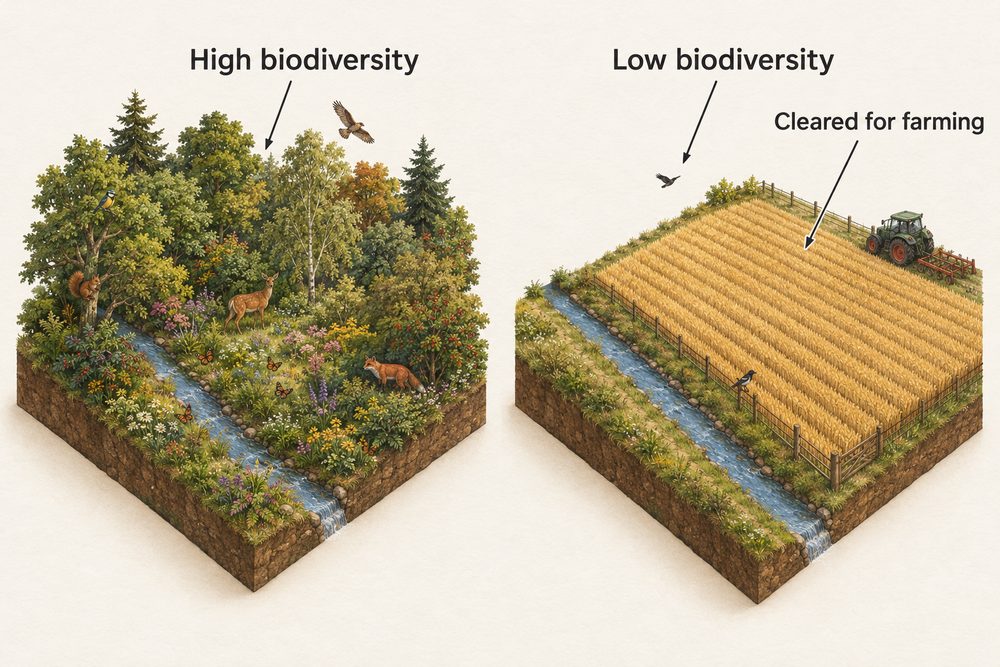
Human activities that reduce biodiversity include:
- Deforestation — clearing forests for agriculture and building destroys habitats.
- Pollution — land, water and air pollution damage habitats and kill organisms.
- Global warming — rising temperatures alter habitats and cause species migration or extinction.
- Overexploitation — overfishing, hunting and intensive farming reduce populations.
Biodiversity is being reduced by deforestation, pollution, global warming and overexploitation. Conservation programmes, breeding programmes, seed banks and habitat restoration help maintain biodiversity.
Strategies to maintain biodiversity include: breeding programmes for endangered species, protection of rare habitats (e.g. national parks, SSSIs), reintroduction of hedgerows and field margins in agricultural areas, seed banks to preserve genetic diversity, and reducing deforestation and carbon emissions. Scientists also use techniques like quadrats and transects to sample and monitor biodiversity in ecosystems.