Enzymes and Transport
Enzymes and the Active Site
Enzymes are biological catalysts. They speed up chemical reactions in living organisms without being used up or changed permanently. Without enzymes, the reactions needed for life would happen far too slowly.
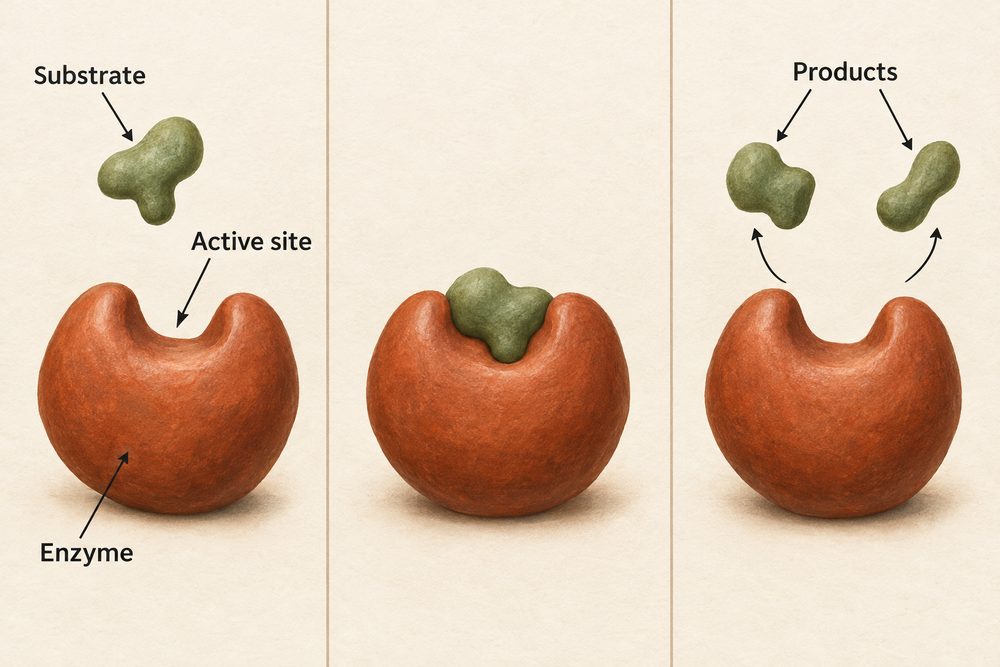
Each enzyme has a specific shape, including a region called the active site. The substrate (the molecule the enzyme acts on) fits into the active site like a key fitting into a lock. This is called the lock and key model. The enzyme is specific to its substrate — only a substrate with the correct complementary shape can bind to the active site.
Once the substrate binds, the enzyme lowers the activation energy needed for the reaction. The products are released, and the enzyme is free to catalyse another reaction.
Key Fact
Enzyme specificity means each enzyme only catalyses one type of reaction. The shape of the active site is complementary to only one substrate. If the shape changes (e.g. by high temperature or extreme pH), the substrate can no longer fit.
Factors Affecting Enzyme Activity
Temperature: As temperature increases, enzyme activity increases because molecules move faster and collide more frequently with the active site. However, above the optimum temperature (typically around 37°C for human enzymes), the enzyme begins to denature. The bonds holding the active site in shape break, the shape changes permanently, and the substrate can no longer fit.
pH: Each enzyme has an optimum pH at which it works fastest. Moving away from this optimum in either direction reduces enzyme activity. Extreme pH values cause the active site to change shape (denaturing the enzyme). For example, pepsin in the stomach works best at pH 2, while amylase in the mouth works best at around pH 7.
Substrate concentration: Increasing substrate concentration increases the rate of reaction because there are more substrate molecules to collide with the active sites. However, at very high concentrations, the rate levels off because all active sites are occupied — the enzyme is said to be saturated.
Core Practical: Investigating the Effect of pH on Enzyme Activity
In this core practical, you investigate how pH affects the rate at which amylase breaks down starch. You set up test tubes with amylase and starch at different pH values using buffer solutions. At regular intervals, you take a sample and test it with iodine solution. Iodine turns blue-black in the presence of starch. You record the time for the iodine to stop changing colour (meaning all starch has been digested). The shorter the time, the faster the enzyme activity.
Rate of reaction = 1 ÷ time. You can plot rate against pH to find the optimum pH for amylase.
Enzymes in Digestion
Enzymes play a vital role in digestion. Large, insoluble food molecules must be broken down into smaller, soluble molecules that can be absorbed into the blood.
- Carbohydrases break down carbohydrates into simple sugars (e.g. amylase breaks starch into maltose and then glucose).
- Proteases break down proteins into amino acids.
- Lipases break down lipids (fats) into fatty acids and glycerol.
Enzymes are also essential for synthesis — building large molecules from smaller ones. For example, enzymes join amino acids together to form proteins, and join simple sugars together to form complex carbohydrates like starch and glycogen.
Key Fact
In the exam, you need to know that enzymes catalyse both the breakdown AND the synthesis of biological molecules: carbohydrates ↔ sugars, proteins ↔ amino acids, lipids ↔ fatty acids + glycerol.
Transport Across Cell Membranes
Substances must move into and out of cells for the cell to function. There are three key transport mechanisms you need to know.
Diffusion is the net movement of particles from an area of higher concentration to an area of lower concentration. It is a passive process — no energy is required. It occurs because particles are constantly moving randomly. Examples include oxygen diffusing into cells for respiration and carbon dioxide diffusing out as a waste product.
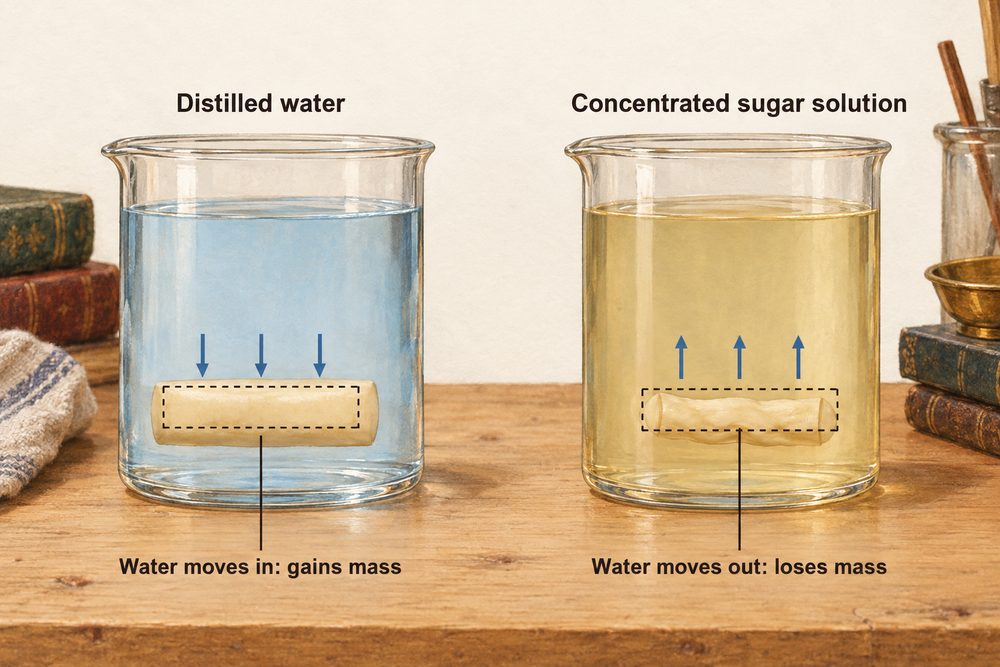
Osmosis is a special case of diffusion. It is the movement of water molecules from a dilute solution (high water concentration) to a more concentrated solution (low water concentration) through a partially permeable membrane. The cell membrane is partially permeable.
Active transport moves substances from a lower concentration to a higher concentration — against the concentration gradient. This requires energy from cellular respiration. An example is the absorption of mineral ions by plant root hair cells from the soil, where the mineral concentration is lower in the soil than inside the root cell.
Core Practical: Investigating Osmosis in Potatoes
In this core practical, you cut potato cylinders of equal length and mass, then place them in sucrose solutions of different concentrations. After a set time (e.g. 30 minutes), you remove them, blot dry, and re-measure their mass. In dilute solutions, the potato gains mass (water moves in by osmosis). In concentrated solutions, the potato loses mass (water moves out). You calculate percentage change in mass using: (final mass − initial mass) ÷ initial mass × 100.
Key Fact
Diffusion and osmosis are passive (no energy needed). Active transport requires energy from respiration and moves substances against the concentration gradient. Know the direction of movement for each process.