Cell Division and Stem Cells
The Cell Cycle and Mitosis
Cells divide to produce new cells for growth, repair and replacement. The process of cell division in body cells is called mitosis. Mitosis is part of the cell cycle — the repeating sequence of growth and division that cells go through.
The cell cycle has several stages. Before mitosis begins, the cell goes through interphase, during which the cell grows, carries out its normal functions, and makes a copy of every chromosome (DNA replication). Once interphase is complete, mitosis can begin.
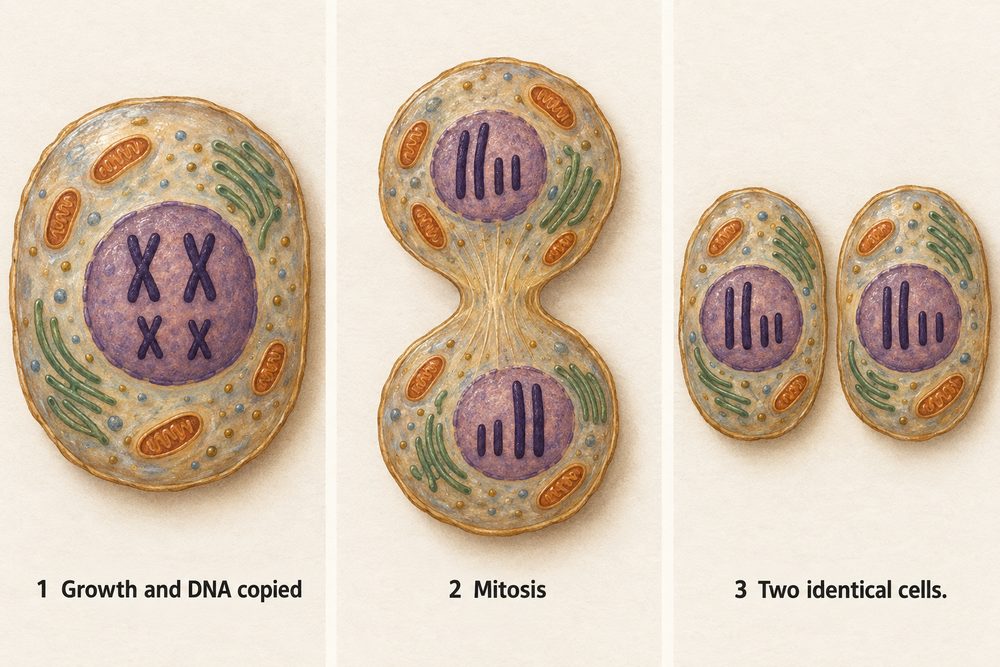
The Edexcel specification requires you to know the stages of mitosis:
- Prophase — chromosomes condense and become visible. The nuclear membrane starts to break down.
- Metaphase — chromosomes line up along the middle (equator) of the cell.
- Anaphase — the two copies of each chromosome are pulled apart to opposite ends (poles) of the cell by spindle fibres.
- Telophase — a new nuclear membrane forms around each set of chromosomes. The chromosomes begin to uncoil.
- Cytokinesis — the cytoplasm divides, producing two separate daughter cells.
Key Fact
Mitosis produces two daughter cells that are genetically identical to each other AND to the parent cell. Each daughter cell is diploid — it has the full set of chromosomes. Remember the order: Prophase → Metaphase → Anaphase → Telophase (PMAT).
Importance of Mitosis
Mitosis is important for three key reasons:
- Growth — organisms grow by producing more cells through mitosis.
- Repair — damaged or worn-out cells are replaced by identical new cells made through mitosis (e.g. skin cells replacing a wound).
- Asexual reproduction — some organisms reproduce by mitosis alone, producing offspring that are genetically identical to the parent (clones). For example, strawberry plants send out runners, and bacteria divide by binary fission.
Cancer
Cancer occurs when changes (mutations) in a cell's DNA cause the cell to divide uncontrollably. Normal cells have checkpoints in the cell cycle that prevent division when it is not needed. In cancer, these controls fail. The rapidly dividing cells form a mass called a tumour. Some tumours are benign (stay in one place), but malignant tumours can spread to other parts of the body.
Growth in Organisms
Growth happens differently in animals and plants:
- Animals grow by cell division (mitosis) and then cell differentiation — cells become specialised for particular functions.
- Plants grow by cell division, cell elongation (cells stretch and lengthen), and cell differentiation.
Percentile charts are used to monitor growth in children. They show how a child's height or weight compares to others of the same age. For example, if a child is on the 75th percentile for height, it means 75% of children of the same age are shorter. Doctors use percentile charts to check for potential growth problems — a child who drops significantly across percentile lines might need further investigation.
Key Fact
Plant growth differs from animal growth because it involves cell elongation as well as cell division and differentiation. Most plant growth occurs at the tips of roots and shoots, where meristems are located.
Stem Cells
Stem cells are undifferentiated cells — they have not yet become specialised. They can divide to produce more stem cells or differentiate into different types of specialised cell.
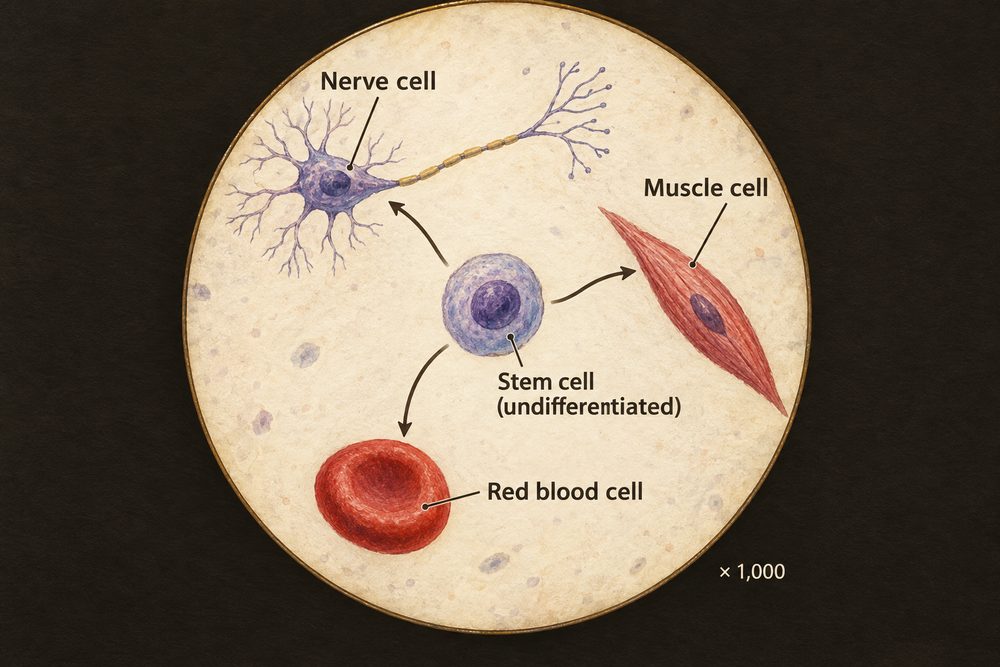
There are different types of stem cell:
- Embryonic stem cells — found in early embryos. These can differentiate into almost any type of cell in the body. They have the greatest potential for medical use.
- Adult stem cells — found in some adult tissues (e.g. bone marrow). These can only differentiate into a limited range of cell types. For example, bone marrow stem cells can produce different types of blood cell.
- Meristems — found in plants at the tips of roots and shoots. Meristem cells can differentiate into any type of plant cell throughout the plant's life. This is why plants continue growing for their entire lifespan.
Stem Cells in Medicine: Benefits and Risks
Stem cells offer exciting possibilities in medicine. They could be used to replace damaged or diseased cells — for example, replacing faulty insulin-producing cells in type 1 diabetes, or repairing damaged nerve cells after spinal injuries.
However, there are also risks and ethical concerns. The use of embryonic stem cells is controversial because it involves the destruction of embryos. There are also medical risks — stem cells could divide uncontrollably and cause tumours. The body's immune system may reject transplanted stem cells. Adult stem cell treatments are less controversial but are more limited in what they can differentiate into.
Key Fact
In the exam, you may be asked to discuss the benefits and risks of stem cell use. Benefits: potential to treat diseases like diabetes, Parkinson's, and paralysis. Risks: tumour formation, immune rejection, ethical issues around embryo destruction. Balance both sides in your answer.