The Nervous System
The Nervous System: An Overview
The nervous system allows organisms to detect changes in their environment and respond to them. It enables rapid communication between different parts of the body. The human nervous system consists of the central nervous system (CNS) — the brain and spinal cord — and the peripheral nerves that connect the CNS to the rest of the body.
The nervous system works through a sequence of events: a stimulus is detected by a receptor, an electrical impulse travels along neurones to the CNS, the CNS processes the information, and a response is carried out by an effector (a muscle or gland).
Key Fact
The pathway is: Stimulus → Receptor → Sensory neurone → CNS (relay neurone) → Motor neurone → Effector → Response. Receptors detect changes; effectors carry out responses.
Types of Neurone
There are three types of neurone (nerve cell) that you need to know:
Sensory neurones carry electrical impulses from receptors to the CNS. Receptors are specialised cells that detect stimuli — for example, light receptors in the eye detect light, and temperature receptors in the skin detect heat changes.
Relay neurones are found in the CNS (brain and spinal cord). They connect sensory neurones to motor neurones and process the information.
Motor neurones carry electrical impulses from the CNS to effectors (muscles or glands). When a muscle receives an impulse, it contracts. When a gland receives an impulse, it secretes a chemical such as a hormone.
Neurone Structure
Neurones have specialised structures that enable them to transmit electrical impulses efficiently:
- Cell body — contains the nucleus and most of the cytoplasm and organelles.
- Dendron — a long fibre that carries impulses towards the cell body. It branches into dendrites at the end, which connect to other neurones or receptors.
- Axon — a long fibre that carries impulses away from the cell body towards the next neurone or effector. The axon can be very long (e.g. from the spinal cord to the toes).
- Myelin sheath — a fatty, insulating layer that surrounds the axon. The myelin sheath speeds up the transmission of electrical impulses by insulating the axon and causing the impulse to jump between gaps in the sheath.
Key Fact
Dendron carries impulses TOWARDS the cell body. Axon carries impulses AWAY from the cell body. The myelin sheath speeds up impulse transmission. Remember these directions — they are commonly tested.
Synapses
Neurones do not physically touch each other. There is a tiny gap between them called a synapse. Electrical impulses cannot jump across this gap. Instead, the signal is transmitted chemically:
- An electrical impulse arrives at the end of the first neurone (the pre-synaptic neurone).
- This triggers the release of chemical neurotransmitters from vesicles into the synaptic gap.
- The neurotransmitters diffuse across the gap.
- They bind to specific receptors on the membrane of the second neurone (the post-synaptic neurone).
- This triggers a new electrical impulse in the second neurone.
Synapses ensure that impulses travel in one direction only — from the pre-synaptic neurone to the post-synaptic neurone. This is because neurotransmitters are only released from one side and receptors are only on the other side.
The Reflex Arc
A reflex action is a rapid, automatic response to a potentially dangerous stimulus. Reflexes are faster than voluntary responses because they do not involve conscious thought — the impulse is processed by the spinal cord rather than the brain.
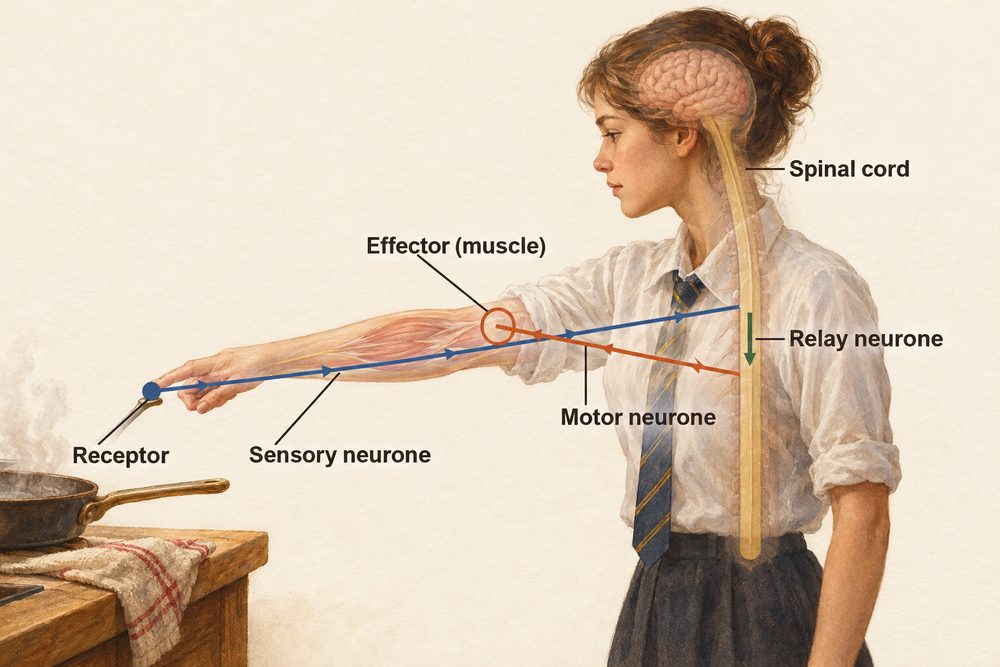
The pathway for a reflex action is called a reflex arc:
- Stimulus — e.g. touching a hot object.
- Receptor — pain receptors in the skin detect the stimulus.
- Sensory neurone — carries the impulse to the spinal cord.
- Relay neurone — in the spinal cord, passes the impulse directly to a motor neurone (no brain involvement).
- Motor neurone — carries the impulse to the effector.
- Effector — a muscle contracts to pull the hand away from the hot object.
Key Fact
In a reflex arc, the relay neurone is in the spinal cord (not the brain). This is what makes reflexes fast — the signal takes the shortest possible route. Reflexes protect the body from damage before you are even aware of the danger.
Examples of Reflex Actions
Common examples include: pulling your hand away from a hot surface (pain reflex), the pupil constricting in bright light (pupil reflex), and blinking when something approaches your eye. In each case, the response is automatic and rapid, protecting the body from potential harm.
You can investigate human responses to stimuli in a practical — for example, the ruler drop test measures reaction time. This is a voluntary response, so it is slower than a true reflex. Factors such as caffeine, tiredness, or distractions can affect reaction times.
Key Fact
At a synapse, the signal changes from electrical to chemical (neurotransmitter) and back to electrical. Neurotransmitters diffuse across the synaptic gap and bind to receptors on the next neurone, triggering a new impulse.