Genetics and DNA
The Structure of DNA
DNA (deoxyribonucleic acid) is a polymer made of two strands coiled together to form a double helix. The two strands are linked by pairs of complementary bases joined by weak hydrogen bonds.
Each strand is built from repeating units called nucleotides. Every nucleotide has three parts: a sugar, a phosphate group and one of four bases — adenine (A), thymine (T), cytosine (C) or guanine (G). The bases always pair in a fixed pattern: A with T and C with G. This is called complementary base pairing.
DNA is a double helix of nucleotides. Each nucleotide = sugar + phosphate + base. Bases pair A–T and C–G, joined by weak hydrogen bonds.
Genomes and Genes
The genome is the entire DNA of an organism. A gene is a small section of DNA on a chromosome that codes for a specific protein. The order of bases along a gene acts as a code, telling the cell which amino acids to join together to make that protein. Different proteins give an organism its characteristics.
There is usually extensive genetic variation within a population of a species. This variation arises through mutations. Most genetic mutations have no effect on the phenotype. Some have a small effect, and only rarely does a single mutation significantly change the phenotype.
Meiosis
Meiosis is the type of cell division that produces gametes — sex cells. Unlike mitosis, meiosis produces four genetically different haploid daughter cells, each with half the chromosome number of the parent cell. The stages of meiosis are not required for this specification.
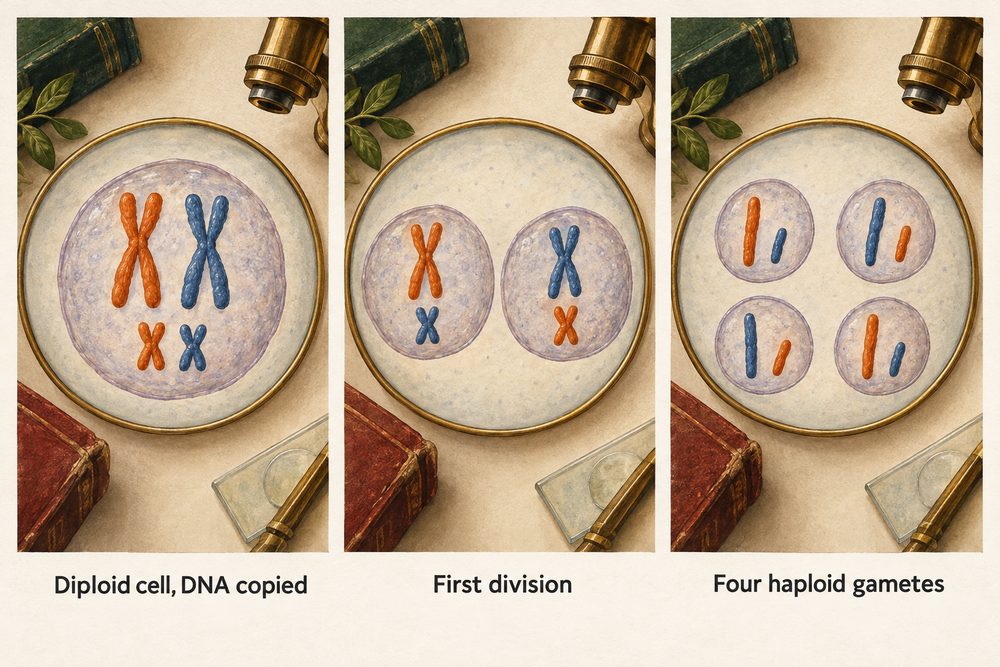
In humans, body cells are diploid with 46 chromosomes. Meiosis halves this to 23 per gamete. At fertilisation, two gametes fuse and the full diploid number (46) is restored in the zygote.
Meiosis produces 4 genetically different haploid gametes. Fertilisation restores the diploid number. This is why offspring from sexual reproduction show genetic variation.
You can extract DNA from strawberries by mashing the fruit, adding salt water and washing-up liquid to break open cells, filtering the mixture, then carefully layering ice-cold ethanol on top. DNA precipitates as white, stringy threads at the boundary between the two liquids.
Alleles and Inheritance
An allele is a version of a gene. Organisms inherit two alleles for each gene — one from each parent. If both alleles are the same the organism is homozygous; if different it is heterozygous. A dominant allele is expressed whenever it is present. A recessive allele is only expressed in the homozygous state.
The combination of alleles is the genotype. The observable characteristic it produces is the phenotype. Most phenotypic features result from multiple genes, not single-gene inheritance.
Monohybrid Crosses and Punnett Squares
A monohybrid cross tracks one gene with two alleles. A Punnett square shows all possible offspring genotypes. For example, crossing two heterozygous parents (Bb × Bb) gives genotypes BB, Bb, Bb and bb — a 3:1 phenotype ratio (3 dominant : 1 recessive).
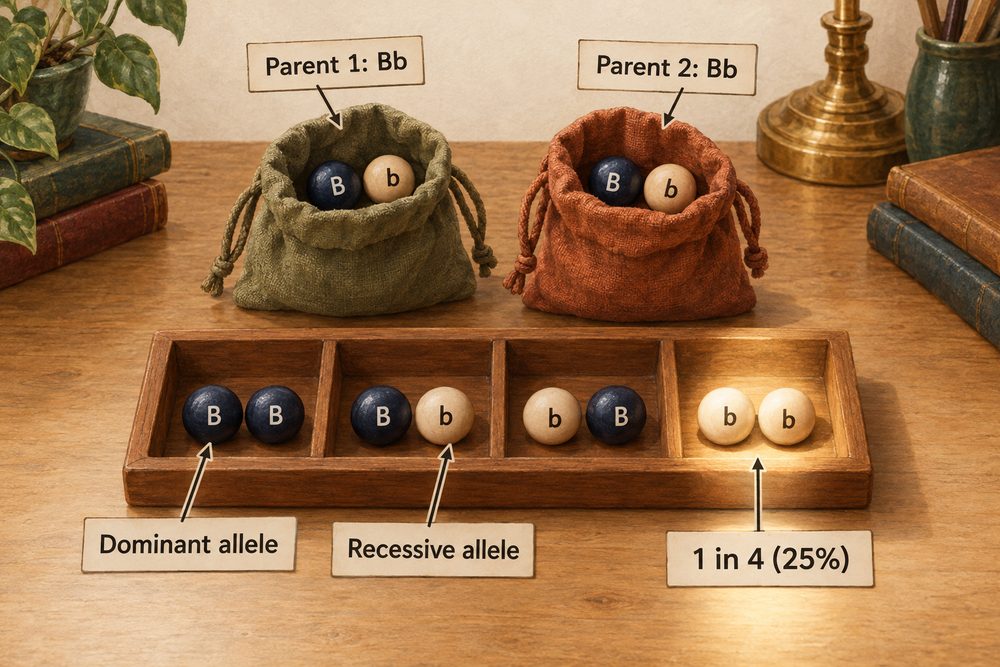
You must be able to calculate probabilities, ratios and percentages from these crosses. In the example above there is a 75% (\(\frac{3}{4}\)) chance of the dominant phenotype and a 25% (\(\frac{1}{4}\)) chance of the recessive phenotype. Family pedigree diagrams can also be used to trace the inheritance of alleles across generations.
Use Punnett squares to predict offspring genotypes and phenotypes. Bb × Bb gives 3:1 dominant : recessive. Calculate outcomes as ratios, fractions or percentages.
Sex Determination
The 23rd pair of chromosomes determines biological sex. Females have two X chromosomes (XX); males have one X and one Y (XY). Each egg carries an X chromosome. Sperm carry either X or Y. If an X-carrying sperm fertilises the egg the offspring is female; if a Y-carrying sperm fertilises the egg the offspring is male. This gives a 50:50 chance, which you can show with a Punnett square.
Variation
Variation in phenotype has two causes. Genetic variation arises from mutations and from sexual reproduction (meiosis shuffles alleles, and fertilisation creates new combinations). Environmental variation comes from an organism’s surroundings — for example, diet, climate or exercise. Most phenotypic features are influenced by both.
The Human Genome Project mapped every gene in human DNA. Potential applications include identifying genes linked to diseases, developing personalised medicines, improving understanding of human evolution and migration, and creating genetic tests to assess the risk of inherited conditions.