Evolution and Classification
Darwin’s Theory of Evolution by Natural Selection
Charles Darwin proposed the theory of natural selection. His theory can be summarised in four steps:
First, within any population there is variation — individuals have different characteristics due to differences in their alleles. Second, organisms produce more offspring than the environment can support, leading to a struggle for survival. Third, individuals with characteristics best suited to the environment are more likely to survive and reproduce. Fourth, these advantageous alleles are passed on to the next generation, so over time the population changes.
Natural selection: variation in a population → struggle for survival → best-adapted individuals survive and reproduce → advantageous alleles passed to offspring → population changes over time.
Antibiotic Resistance as Evidence for Evolution
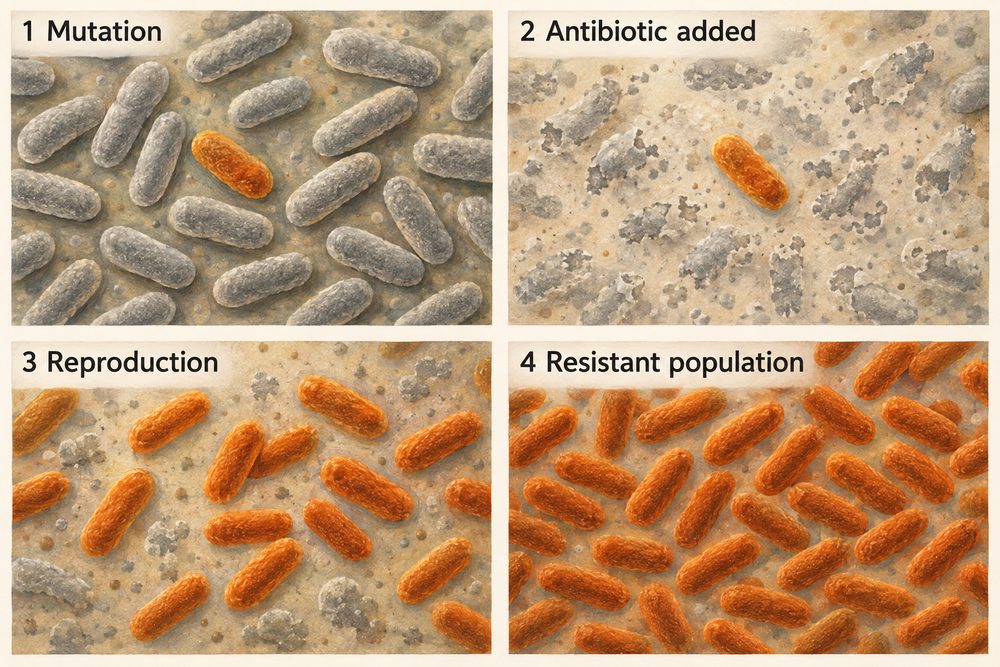
The emergence of antibiotic-resistant bacteria supports Darwin’s theory. Within a bacterial population, random mutations may produce an individual that is resistant to an antibiotic. When the antibiotic is used, non-resistant bacteria are killed, but the resistant bacterium survives. It reproduces rapidly, passing the resistance allele to its offspring. Over time, the population becomes dominated by resistant bacteria. This is natural selection in action.
MRSA (methicillin-resistant Staphylococcus aureus) is an example of a bacterium that has evolved resistance to several antibiotics. This is why doctors are encouraged to prescribe antibiotics only when necessary and patients must complete the full course.
Evidence for Human Evolution — Fossils
Fossils provide evidence for human evolution. The Edexcel specification requires you to know three key fossil discoveries:
Ardi (Ardipithecus ramidus) dates from about 4.4 million years ago. Ardi had both ape-like features (long arms, an opposable big toe for gripping branches) and human-like features (she could walk upright on two legs, at least some of the time). This suggests she was an early stage in the evolution from apes to humans.
Lucy (Australopithecus afarensis) dates from about 3.2 million years ago. Lucy had a smaller brain than modern humans but her skeleton shows she walked upright more efficiently than Ardi. Her knee and hip joints were adapted for bipedal walking, showing that walking upright evolved before large brains.
Richard Leakey’s discovery from about 1.6 million years ago (often called Turkana Boy) was a nearly complete skeleton of Homo erectus. This individual was tall, had a relatively large brain, and had a body shape much more like modern humans. These three fossils show a gradual change over millions of years from ape-like ancestors to modern humans.
Three key fossils: Ardi (4.4 million years ago), Lucy (3.2 mya) and Leakey’s Homo erectus (1.6 mya). They show a gradual progression from ape-like to human-like features.
Evidence from Stone Tools
Stone tools also provide evidence for human evolution. The earliest tools were simple pebble tools, used for cutting and scraping. Over time, tools became more sophisticated — hand axes, blades and eventually finely crafted arrowheads. This development shows increasing brain capacity and problem-solving ability. Stone tools can be dated from the rock layers (strata) in which they are found.
Classification — From Five Kingdoms to Three Domains
Traditionally, living organisms were classified into five kingdoms: Animals, Plants, Fungi, Protists and Prokaryotes. This system was based on observable features such as cell structure and how organisms obtained food.
More recently, genetic analysis has shown that the five-kingdom system does not accurately reflect evolutionary relationships. Scientists now use the three-domain system instead:
Archaea — primitive prokaryotes, often found in extreme environments. Bacteria — true bacteria (prokaryotes). Eukarya — all organisms with eukaryotic cells (animals, plants, fungi and protists). Genetic analysis revealed that Archaea are more different from Bacteria than was previously thought, which is why they were separated into their own domain.
The five-kingdom system relied on physical features, which can be misleading — organisms may look similar but be distantly related (convergent evolution). Genetic analysis compares DNA sequences directly, giving a more accurate picture of evolutionary relationships. This led Carl Woese to propose the three-domain system in 1990.