Genetic Engineering
Selective Breeding
Selective breeding (also called artificial selection) is the process by which humans choose organisms with desirable characteristics and breed them together. This is repeated over many generations until the desired trait is strongly expressed in the population.
Selective breeding has been used for thousands of years. Examples include breeding food plants for higher yield, disease resistance or improved taste, and breeding domesticated animals for traits such as increased milk production in cows, faster growth in chickens or tameness in dogs.
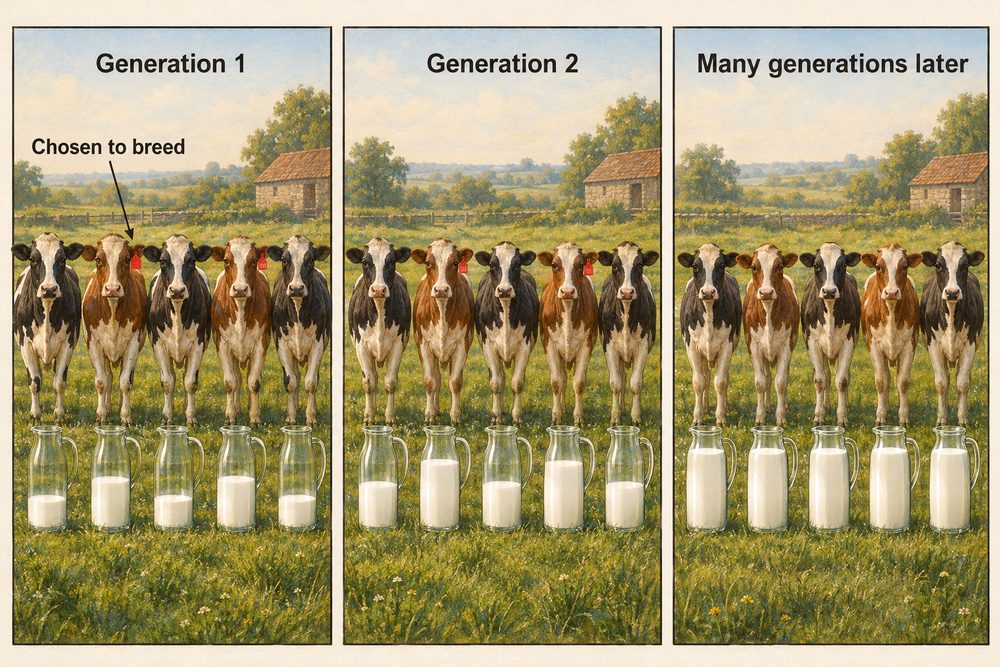
The process works because the parents with the best characteristics are selected, so their alleles are more likely to be passed on. Over many generations, the frequency of the desirable alleles increases in the population.
Selective breeding: choose parents with desirable traits → breed them → select the best offspring → repeat over many generations. Used to improve food plants and domesticated animals.
A major risk of selective breeding is inbreeding. Because only organisms with similar desirable traits are bred, the gene pool narrows. This reduces genetic variation, making the population more vulnerable to new diseases or environmental changes. In animals, inbreeding can also lead to health problems — for example, breathing difficulties in flat-faced dog breeds.
What Is Genetic Engineering?
Genetic engineering is the process of modifying the genome of an organism to introduce desirable characteristics. Unlike selective breeding, which works within a species, genetic engineering can transfer genes between completely different species. An organism that contains a gene from a different species is called a genetically modified organism (GMO) or transgenic organism.
The Main Stages of Genetic Engineering
The Edexcel specification requires you to describe the main stages of genetic engineering, including the use of restriction enzymes, ligase, sticky ends and vectors.
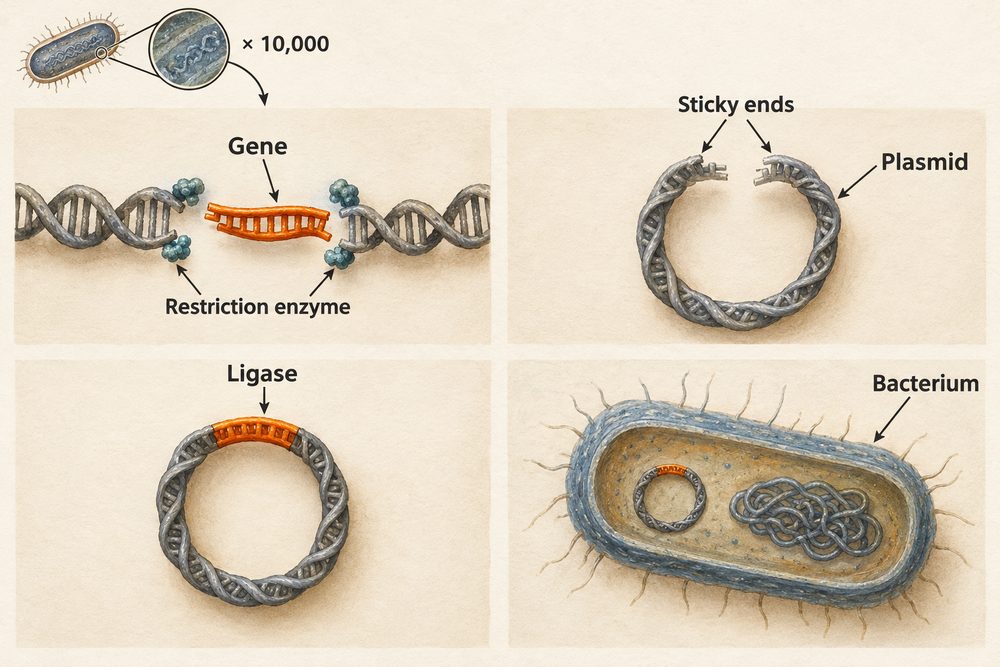
Step 1 — Identify and cut out the desired gene. Restriction enzymes are used to cut the desired gene out of the DNA of the donor organism. These enzymes cut at specific base sequences, leaving short unpaired stretches of bases called sticky ends.
Step 2 — Open the vector. The same restriction enzyme is used to cut open a vector — a carrier molecule that will transport the gene into the host organism. Common vectors include bacterial plasmids and viruses. Because the same restriction enzyme is used, the vector has complementary sticky ends.
Step 3 — Insert the gene. The desired gene is inserted into the vector. The complementary sticky ends of the gene and the vector pair up. Ligase enzyme is then used to seal the gene into the vector by joining the sugar-phosphate backbone, creating recombinant DNA.
Step 4 — Transfer to host organism. The vector carries the gene into the host organism’s cells. If the gene is successfully taken up, the host organism will produce the protein coded for by the inserted gene, giving it the desired characteristic.
Genetic engineering: restriction enzymes cut out the gene (leaving sticky ends) → same enzyme opens the vector → gene inserted, sticky ends pair up → ligase seals the join → vector transfers gene to host organism.
Examples of Genetic Engineering
In agriculture, crops such as soya and maize have been genetically modified to be resistant to herbicides or to produce their own insecticide (Bt crops). Golden rice has been engineered to produce beta-carotene, which the body converts into vitamin A, to help prevent deficiency in developing countries.
In medicine, the gene for human insulin has been inserted into bacteria. These bacteria are grown in fermenters and produce large quantities of human insulin to treat diabetes. This replaced insulin extracted from pig or cow pancreases, which sometimes caused allergic reactions.
Benefits and Risks of Genetic Engineering and Selective Breeding
The Edexcel specification requires you to evaluate the benefits and risks of both genetic engineering and selective breeding in modern agriculture and medicine, including practical and ethical implications.
Benefits of genetic engineering: genes can be transferred between species that could never breed naturally; crops can be made pest-resistant, reducing pesticide use; medicines like insulin can be produced cheaply and reliably; Golden Rice could reduce vitamin A deficiency in developing countries.
Risks and concerns: GM crops could cross-pollinate with wild plants, spreading modified genes into the environment in unpredictable ways; there are concerns about the long-term effects of eating GM food (though no evidence of harm has been found); some people have ethical objections to ‘playing God’ with organisms’ DNA; GM seeds are often patented, making farmers dependent on seed companies.
Selective breeding is considered more ‘natural’ but reduces genetic diversity, which can cause health problems and makes populations vulnerable to disease. Genetic engineering is faster and more precise, but raises more ethical and environmental concerns.