Health, Disease and Medicines
Defining Health
The World Health Organization (WHO) defines health as a state of complete physical, mental and social well-being — not merely the absence of disease or infirmity. This means that being healthy involves more than just not being ill; it includes emotional wellbeing and having good social relationships.
Diseases fall into two broad categories. Communicable diseases can be spread from one organism to another and are caused by pathogens. Non-communicable diseases cannot be passed on and are often linked to lifestyle or genetic factors. The presence of one disease can increase susceptibility to others — for example, a weakened immune system from HIV can make a person more vulnerable to tuberculosis.
Pathogens and Common Infections
A pathogen is a disease-causing organism. There are four types of pathogen: bacteria, viruses, fungi and protists. The Edexcel specification requires you to know several named infections:
Cholera (caused by bacteria) — causes severe diarrhoea and dehydration. Spread through contaminated water. Prevented by clean water supplies and sanitation.
Tuberculosis (TB, caused by bacteria) — causes lung damage, persistent cough and weight loss. Spread by airborne droplets when an infected person coughs or sneezes. Prevented by vaccination (BCG) and treating infected people with antibiotics.
Chalara ash dieback (caused by a fungus) — causes leaf loss and bark lesions in ash trees. Spread by airborne spores carried by wind. Difficult to prevent; infected trees are often removed to slow the spread.
Malaria (caused by a protist) — damages blood cells and the liver, causing fever and chills. Spread by animal vectors (female Anopheles mosquitoes). Prevented by mosquito nets, insecticides and draining stagnant water where mosquitoes breed.
HIV (a virus) — destroys white blood cells, weakening the immune system. If untreated, it leads to AIDS. HIV is a sexually transmitted infection (STI) and can also be spread through blood-to-blood contact (e.g. shared needles). Prevented by using condoms and screening blood donations.
Chlamydia (caused by bacteria) — the most common STI in the UK. Often has no symptoms but can cause infertility if untreated. Spread by unprotected sexual contact. Prevented by using condoms and treated with antibiotics. Screening programmes help identify and treat cases early.
Learn the six named infections: cholera (bacteria, water), TB (bacteria, airborne), Chalara (fungus, airborne), malaria (protist, mosquito vector), HIV (virus, sexual/blood), chlamydia (bacteria, sexual).
The Body’s Defences
The human body has physical barriers to prevent pathogens from entering: the skin provides a continuous barrier; mucus in the respiratory tract traps pathogens; and cilia (tiny hair-like structures) sweep mucus and trapped pathogens towards the throat to be swallowed.
The body also has chemical defences: lysozymes in tears, saliva and nasal secretions destroy bacteria by breaking down their cell walls. Hydrochloric acid in the stomach (pH 1–2) kills most pathogens that are swallowed with food or drink.
The Immune System
If pathogens get past the body’s physical and chemical defences, the immune system responds. Pathogens have unique molecules on their surface called antigens. White blood cells called lymphocytes detect these antigens and produce specific antibodies that bind to the antigens and mark the pathogen for destruction.
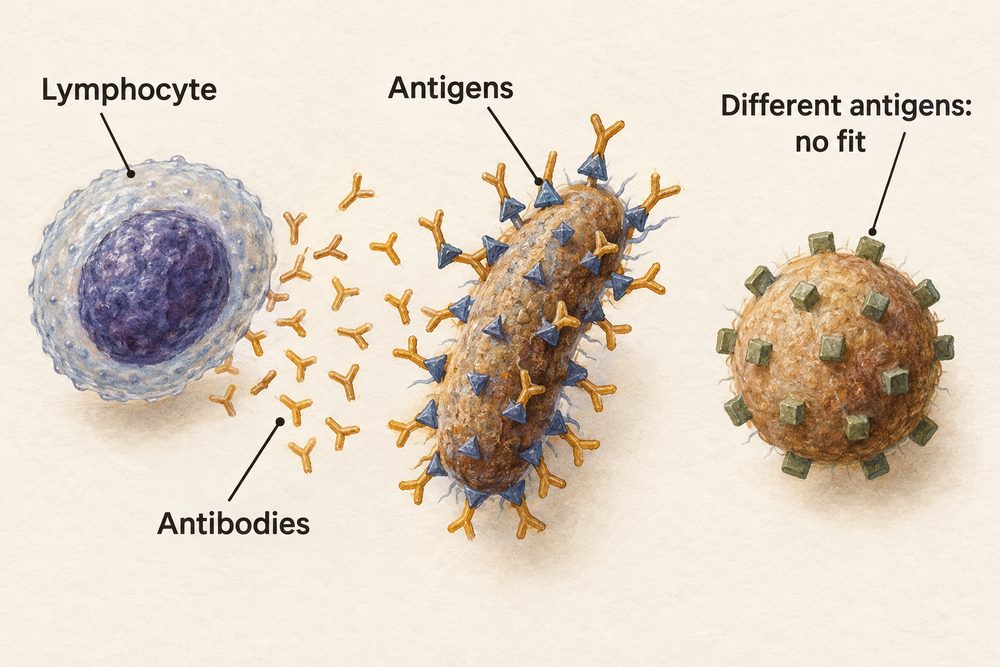
After the infection is cleared, memory lymphocytes remain in the blood. If the same pathogen enters the body again, memory lymphocytes trigger a secondary response — a much faster and stronger production of antibodies, destroying the pathogen before symptoms develop.
Immune response: pathogen enters → antigens trigger lymphocytes → antibodies produced → pathogen destroyed → memory lymphocytes remain for faster secondary response.
Vaccination
Vaccination (immunisation) involves injecting a dead or inactive form of a pathogen into the body. The antigens on the inactive pathogen still trigger an immune response — lymphocytes produce antibodies and memory lymphocytes are formed. The person does not become ill because the pathogen is inactive. If the real pathogen enters the body later, memory lymphocytes enable a rapid secondary response, preventing the disease.
Antibiotics and Drug Development
Antibiotics are medicines that kill bacteria or prevent them from reproducing. They work by inhibiting specific cell processes in the bacterium — for example, preventing cell wall formation. Antibiotics cannot treat viral infections because viruses reproduce inside host cells and do not have their own cell machinery.
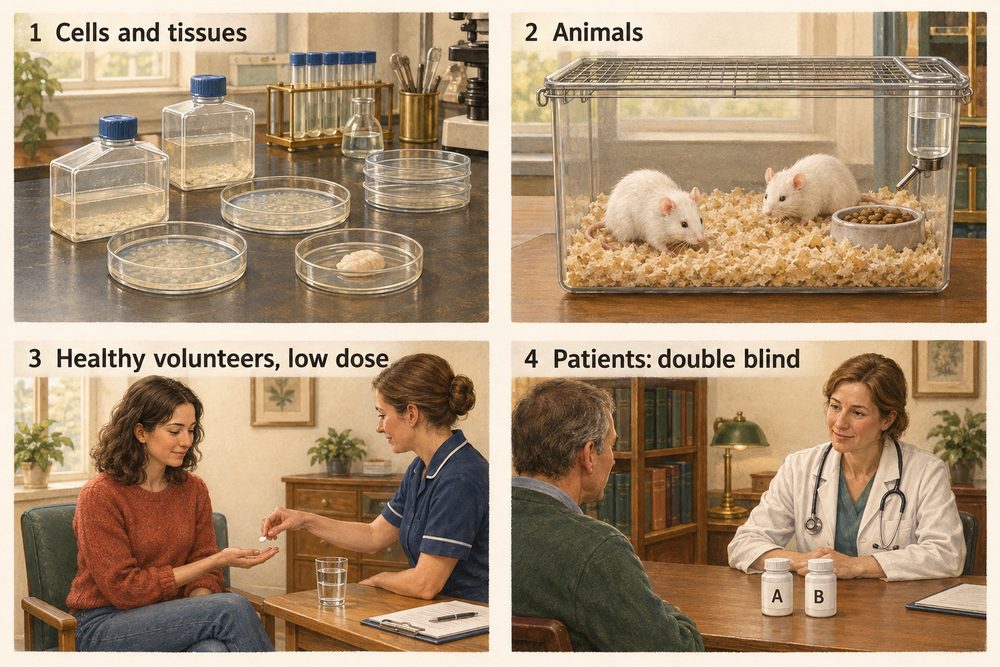
Developing new medicines involves many stages: discovery (identifying a potential new drug from plants, microorganisms or computer modelling), development (refining the compound), preclinical testing (testing on cells, tissues and animals to check for toxicity and effectiveness) and clinical testing (trials on healthy volunteers and then patients, including double-blind trials with placebos to ensure the drug is both safe and effective).
Non-Communicable Diseases and Lifestyle
Many non-communicable diseases are caused by the interaction of several factors, including genetics, lifestyle and environment. Examples include cardiovascular diseases, many cancers, and some lung and liver diseases.
Lifestyle factors that increase the risk of non-communicable diseases include: poor diet and lack of exercise leading to obesity (measured using BMI = mass in kg ÷ height in m², and waist-to-hip ratio); excessive alcohol consumption leading to liver disease and cirrhosis; and smoking which damages blood vessels and increases the risk of coronary heart disease, stroke and lung cancer.
Treatments for cardiovascular disease include lifestyle changes (improved diet, more exercise, stopping smoking), life-long medication (statins to lower cholesterol, blood-thinning drugs) and surgical procedures (stents to open blocked arteries, bypass surgery). Each treatment has advantages and disadvantages — for example, medication must be taken daily and may have side effects, while surgery carries risks but can be immediately effective.