Homeostasis & the Nervous System
What Is Homeostasis?
Your body works best when its internal conditions stay within narrow limits. Homeostasis is the process that keeps factors such as body temperature, blood glucose concentration and water balance at optimal levels. Without homeostasis, enzymes would denature and chemical reactions inside cells would slow down or stop entirely.
Homeostasis maintains a stable internal environment by controlling conditions such as body temperature, blood glucose concentration and water balance — all of which affect enzyme activity.
All homeostatic control systems involve three key components. A receptor detects a change in the environment (a stimulus). A coordination centre (such as the brain or spinal cord) receives and processes the information. An effector (a muscle or gland) carries out the response to bring the condition back to its set point.
The Nervous System
The nervous system enables humans to react to their surroundings and coordinate behaviour. It uses electrical impulses that travel along nerve cells to produce fast, short-lived responses. The central nervous system (CNS) consists of the brain and the spinal cord. Information from receptors passes along sensory neurones to the CNS, which then sends signals along motor neurones to effectors.
There are three types of neurone you need to know. Sensory neurones carry impulses from receptors to the CNS. Relay neurones are found entirely within the CNS and connect sensory neurones to motor neurones. Motor neurones carry impulses from the CNS to effectors.
Each neurone has a cell body containing the nucleus, thin fibres called axons and dendrons. The axon is often surrounded by a myelin sheath — a fatty layer that insulates the nerve fibre and speeds up the transmission of impulses.
Synapses
Neurones do not touch each other directly. The tiny gap between two neurones is called a synapse. When an electrical impulse reaches the end of the first neurone, it triggers the release of chemical neurotransmitters. These chemicals diffuse across the synaptic gap and bind to receptors on the membrane of the next neurone, triggering a new electrical impulse. This means signals can only travel in one direction across a synapse.
At a synapse, electrical signals are converted into chemical signals (neurotransmitters) and then back into electrical signals in the next neurone. This ensures impulses travel in one direction only.
The Reflex Arc
A reflex action is an automatic, rapid response to a potentially harmful stimulus. Reflexes protect the body — for example, pulling your hand away from a hot object or your pupil constricting in bright light.
The pathway of a reflex is called a reflex arc. It follows this sequence:
Stimulus → Receptor → Sensory neurone → Relay neurone (in CNS) → Motor neurone → Effector → Response
For example, if you touch a hot plate, pain receptors in your skin detect the stimulus. The impulse travels along a sensory neurone to a relay neurone in the spinal cord. The relay neurone passes the impulse to a motor neurone, which stimulates the effector (a muscle in your arm) to contract and pull your hand away. This all happens without conscious thought — your brain is not involved in the initial response.
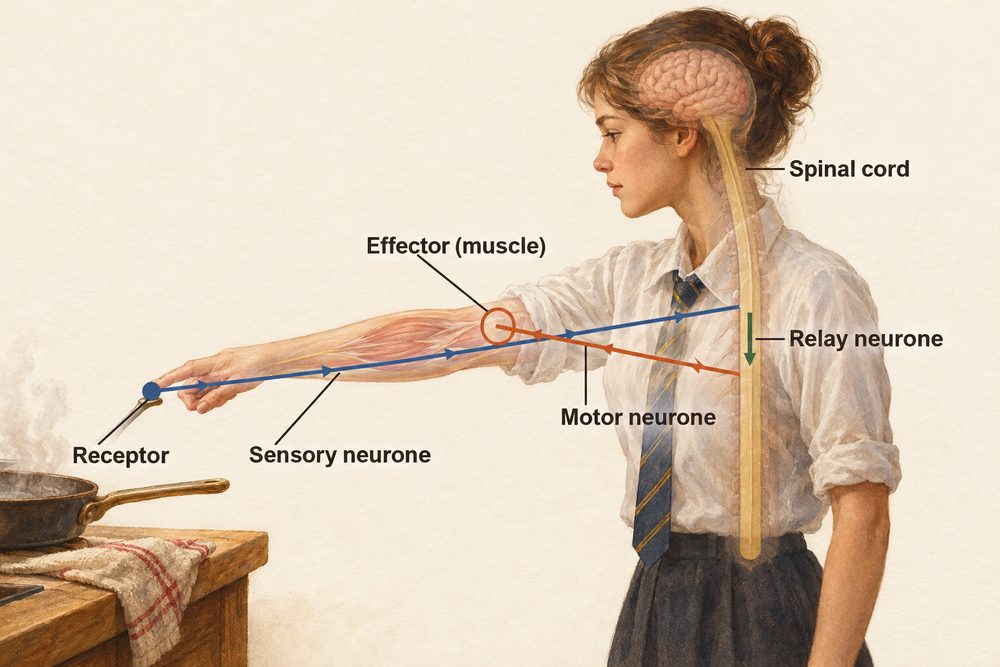
The reflex arc follows the pathway: stimulus → receptor → sensory neurone → relay neurone (CNS) → motor neurone → effector → response. The brain is bypassed, making the response extremely fast.
Why Homeostasis Matters
The internal environment must stay stable because cells depend on enzyme-controlled reactions. Enzymes have an optimum temperature and pH — if conditions drift too far from the optimum, enzymes change shape (denature) and can no longer catalyse reactions. This is why the body constantly monitors and adjusts conditions using the receptor → coordination centre → effector pathway described above.
Both the nervous system and the endocrine (hormonal) system play roles in homeostasis. The nervous system produces fast, short-term responses via electrical impulses, while the endocrine system produces slower, longer-lasting responses via hormones. You will explore the endocrine system in the next lesson.