Hormonal Coordination & the Endocrine System
The Endocrine System
The endocrine system is a network of glands that produce chemical messengers called hormones. Unlike the nervous system, which uses fast electrical impulses, hormones travel in the blood and produce slower, longer-lasting effects. Hormones are secreted directly into the bloodstream and carried to specific target organs, where they trigger a response.
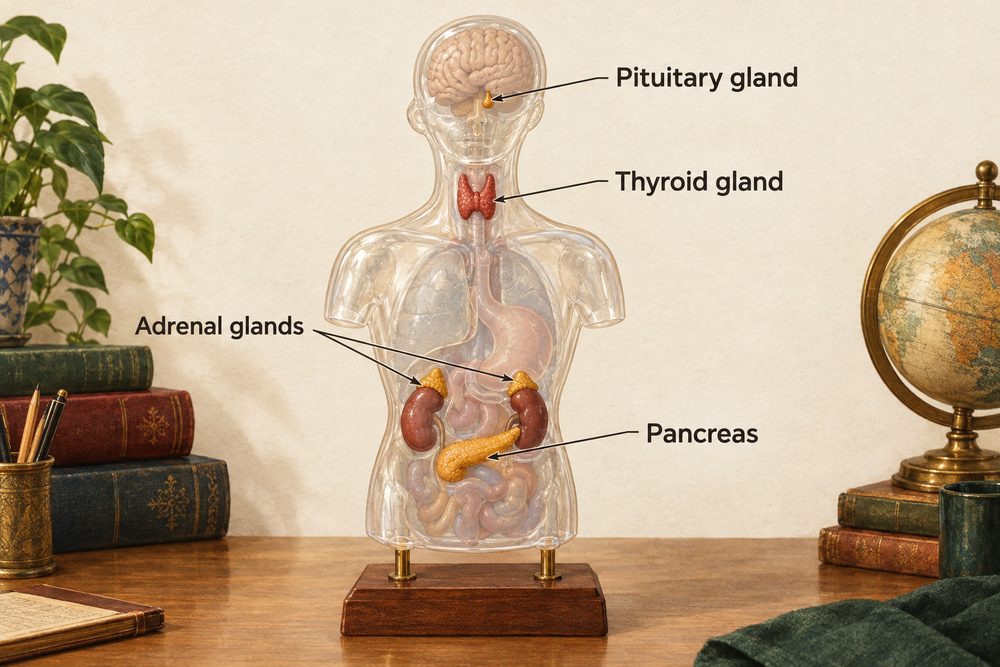
The main endocrine glands are: the pituitary gland (the "master gland"), thyroid gland, adrenal glands, pancreas, ovaries (in females) and testes (in males). Each gland produces specific hormones that are transported in the blood to target organs.
Key Endocrine Glands and Their Hormones
The pituitary gland, located at the base of the brain, is often called the "master gland" because it secretes hormones that control other endocrine glands. For example, it releases TSH (thyroid-stimulating hormone) to control the thyroid.
The thyroid gland produces thyroxine, which controls the body's metabolic rate. The adrenal glands, sitting on top of the kidneys, produce adrenaline. The pancreas produces insulin and glucagon to regulate blood glucose. The ovaries produce oestrogen and progesterone, while the testes produce testosterone.
Adrenaline is released by the adrenal glands in response to a stressful or dangerous situation. It prepares the body for "fight or flight" by:
• Increasing heart rate, so more blood is pumped to muscles.
• Raising blood pressure, improving oxygen delivery.
• Increasing blood flow to skeletal muscles, ready for action.
• Stimulating the liver to convert stored glycogen into glucose, raising blood sugar for energy.
Negative Feedback and Thyroxine
Negative feedback is the mechanism by which the body reverses a change to bring conditions back to normal. Thyroxine regulation is a key example you need to understand.
When thyroxine levels drop, the hypothalamus releases TRH (thyrotropin-releasing hormone). TRH stimulates the pituitary gland to release TSH. TSH then acts on the thyroid gland to produce more thyroxine. Once thyroxine levels return to normal, thyroxine inhibits the release of both TRH from the hypothalamus and TSH from the pituitary — this is the "negative feedback" loop that prevents overproduction.
Thyroxine is controlled by negative feedback: low thyroxine → hypothalamus releases TRH → pituitary releases TSH → thyroid produces thyroxine. When levels are normal, thyroxine inhibits TRH and TSH release.
Blood Glucose Regulation
Blood glucose concentration must be kept within a narrow range. After a meal, blood glucose rises. The pancreas detects this and secretes insulin. Insulin causes cells (especially liver and muscle cells) to absorb glucose from the blood. Excess glucose is converted to glycogen and stored in the liver. This brings blood glucose back down to normal.
When blood glucose falls too low (for example, during exercise), the pancreas releases glucagon. Glucagon stimulates the liver to break down glycogen into glucose and release it into the blood. This is another example of negative feedback — insulin and glucagon work in opposition to keep blood glucose stable.
Type 1 diabetes is an autoimmune condition where the pancreas produces little or no insulin. The body's immune system destroys the insulin-producing cells. It is treated with regular insulin injections and careful monitoring of blood glucose and diet.
Type 2 diabetes occurs when the body's cells no longer respond properly to insulin (insulin resistance) or the pancreas does not produce enough. It is strongly linked to obesity, poor diet and lack of exercise. It can often be controlled through lifestyle changes — a balanced diet, regular exercise and weight loss — though some patients may also need medication.
Doctors use BMI (Body Mass Index) and waist-to-hip ratio to assess the risk of type 2 diabetes. BMI is calculated using: \(\text{BMI} = \frac{\text{mass (kg)}}{\text{height (m)}^2}\). A higher BMI is correlated with a greater risk of developing type 2 diabetes.
Type 1 diabetes — the pancreas produces no insulin (autoimmune); treated with insulin injections. Type 2 diabetes — cells become resistant to insulin; linked to obesity and treated with diet and exercise.
When asked to explain negative feedback, always describe both directions: what happens when the level is too low AND what stops production when the level returns to normal. Many students only describe one direction and lose marks. For blood glucose, make sure you name both hormones (insulin and glucagon) and state they have opposite effects.