Reproduction & Contraception
The Menstrual Cycle
The menstrual cycle is a roughly 28-day process controlled by hormones. It prepares the female body for pregnancy each month. If the released egg is not fertilised, the lining of the uterus is shed during menstruation (a period), and the cycle begins again.
The cycle has four main stages. Days 1–5: Menstruation occurs — the uterus lining breaks down and is shed. Days 6–13: The uterus lining begins to rebuild and thicken. Day 14: Ovulation occurs — a mature egg is released from one of the ovaries. Days 15–28: The uterus lining is maintained, ready for a fertilised egg to implant. If no fertilisation occurs, the cycle starts again.
Hormones Controlling the Menstrual Cycle
Four hormones interact to control the menstrual cycle. FSH (follicle-stimulating hormone) is released by the pituitary gland. It causes an egg to mature inside a follicle in the ovary and stimulates the ovaries to produce oestrogen.
Oestrogen is produced by the ovaries. It causes the uterus lining to thicken and repair after menstruation. Rising oestrogen levels also stimulate the pituitary gland to release a surge of LH (luteinising hormone). LH triggers ovulation around day 14.
FSH matures the egg and stimulates oestrogen production. Oestrogen thickens the uterus lining and triggers LH release. LH triggers ovulation. Progesterone maintains the uterus lining after ovulation and inhibits FSH and LH.
After ovulation, the empty follicle becomes the corpus luteum and produces progesterone. Progesterone maintains the thick uterus lining so that a fertilised egg can implant. It also inhibits FSH and LH, preventing another egg from maturing. If no fertilisation occurs, the corpus luteum breaks down, progesterone levels drop, and the uterus lining is shed — beginning menstruation and the next cycle.
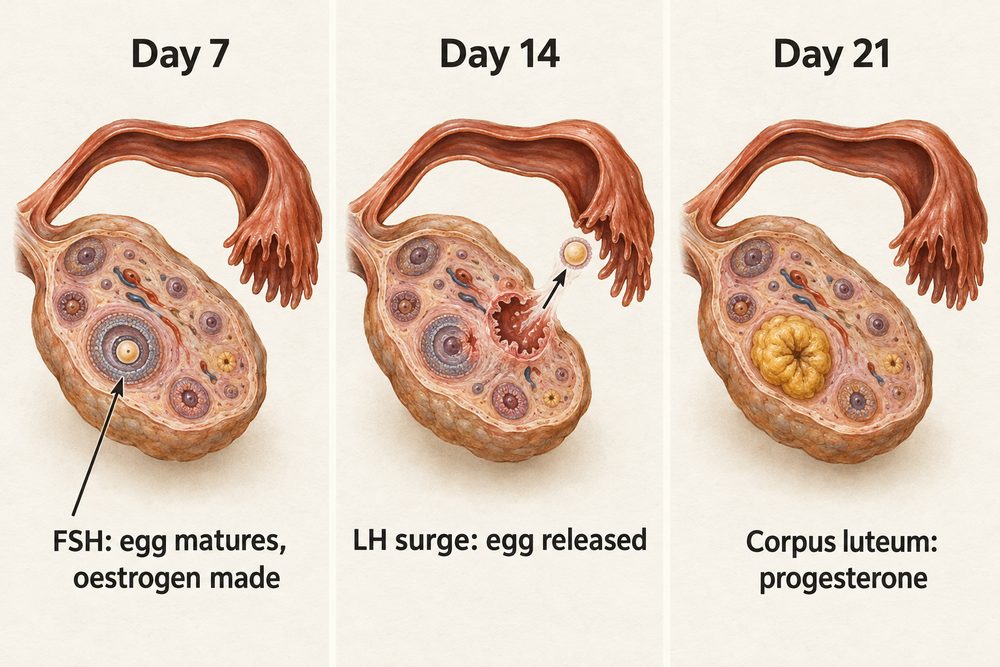
The hormones of the menstrual cycle interact through feedback loops. Oestrogen produced by the developing follicle stimulates LH release (a positive feedback effect). After ovulation, progesterone from the corpus luteum inhibits both FSH and LH (negative feedback), preventing a second egg from being released. When progesterone falls, FSH is no longer inhibited, so the cycle restarts.
Contraception
Contraception prevents pregnancy. Methods fall into two main categories: hormonal contraception and barrier methods.
Hormonal methods work by releasing hormones that interfere with the menstrual cycle. The combined pill contains oestrogen and progesterone — it prevents ovulation and thickens cervical mucus so sperm cannot pass through easily. The progesterone-only pill (mini-pill) mainly thickens cervical mucus. Other options include contraceptive injections, implants and intrauterine devices (IUDs) that release hormones.
Barrier methods physically block sperm from reaching the egg. Condoms (male and female) also protect against sexually transmitted infections (STIs). Diaphragms cover the cervix and are used with spermicide. Barrier methods have no hormonal side effects but must be used correctly every time.
Hormonal methods are very effective at preventing pregnancy when used correctly but can have side effects such as headaches, mood changes or blood clots. They do not protect against STIs. Barrier methods are less effective at preventing pregnancy but condoms are the only method that protects against STIs. The choice of contraception depends on reliability, side effects, convenience and whether STI protection is needed.
Hormonal contraception is highly effective at preventing pregnancy but does not protect against STIs and can have side effects. Barrier methods (e.g. condoms) protect against STIs but are less effective at preventing pregnancy.
Assisted Reproductive Technology (ART)
Some couples have difficulty conceiving naturally. ART includes treatments that help people become pregnant.
IVF (in vitro fertilisation) involves giving the mother FSH and LH to stimulate multiple eggs to mature. The eggs are collected and fertilised with sperm in a laboratory. Fertilised embryos develop for a few days before one or two are transferred to the mother’s uterus. IVF is effective but expensive, physically demanding and has a relatively low success rate per cycle.
Clomifene therapy is a fertility drug. It works by stimulating the release of FSH and LH from the pituitary gland, which triggers ovulation. It is less invasive and cheaper than IVF, though it can increase the chance of multiple pregnancies.
IVF involves stimulating egg production with FSH/LH, collecting eggs, fertilising them with sperm in a lab, and transferring embryos to the uterus. Clomifene therapy stimulates ovulation by triggering FSH and LH release.