DNA, Genes & Inheritance
The Structure of DNA
DNA (deoxyribonucleic acid) is a polymer found in the nucleus of cells. It is shaped as a double helix — two strands twisted around each other like a spiral ladder. Each strand is made up of repeating units called nucleotides.
Each nucleotide consists of three parts: a sugar (deoxyribose), a phosphate group and one of four bases — adenine (A), thymine (T), cytosine (C) or guanine (G). The two strands are linked by complementary base pairs joined by weak hydrogen bonds. Adenine always pairs with thymine (A–T), and cytosine always pairs with guanine (C–G).
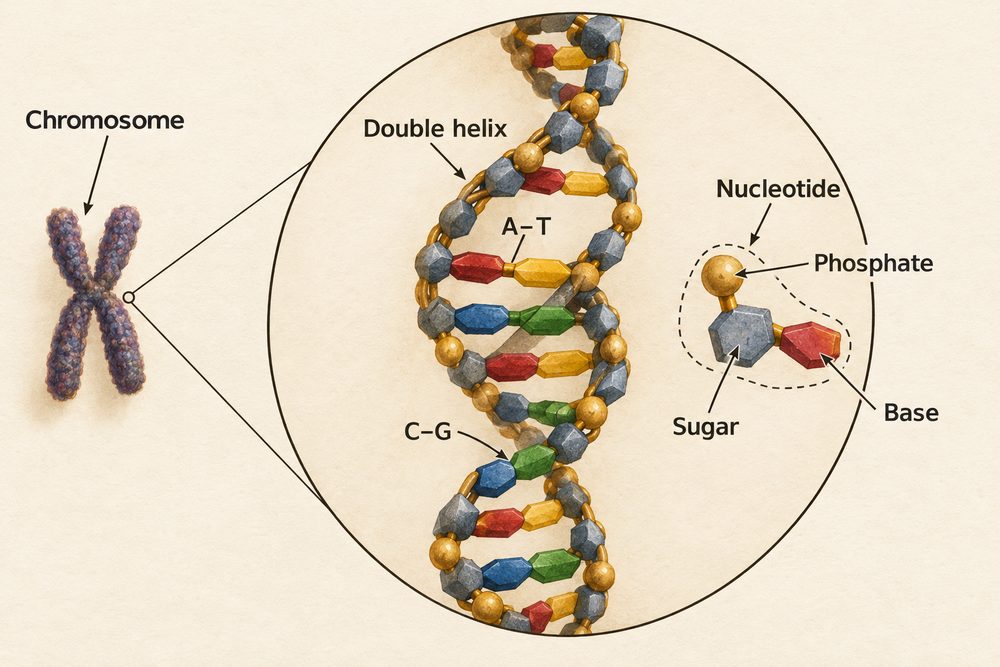
A nucleotide = sugar + phosphate + base. The base pairing rules are: A pairs with T, and C pairs with G. The strands are held together by weak hydrogen bonds between complementary base pairs.
Genes, Genomes and Protein Synthesis
A gene is a section of DNA that codes for a specific protein. Different proteins control different characteristics. The genome is the entire DNA of an organism — all of its genes and the DNA between them. Understanding the genome helps scientists identify genes linked to diseases and develop new treatments.
Genes are found on chromosomes inside the nucleus. Humans have 23 pairs of chromosomes (46 in total). Each gene can exist in different versions called alleles, and it is the combination of alleles that determines an organism’s characteristics.
Meiosis is a type of cell division that produces sex cells (gametes) — sperm in males and eggs (ova) in females. Unlike mitosis, meiosis produces four daughter cells, each with half the number of chromosomes of the parent cell. These cells are haploid (23 chromosomes in humans).
Because meiosis involves shuffling of genetic material, each gamete is genetically different. When two gametes fuse at fertilisation, the resulting zygote has the full set of 46 chromosomes and a unique combination of alleles from both parents.
Monohybrid Inheritance
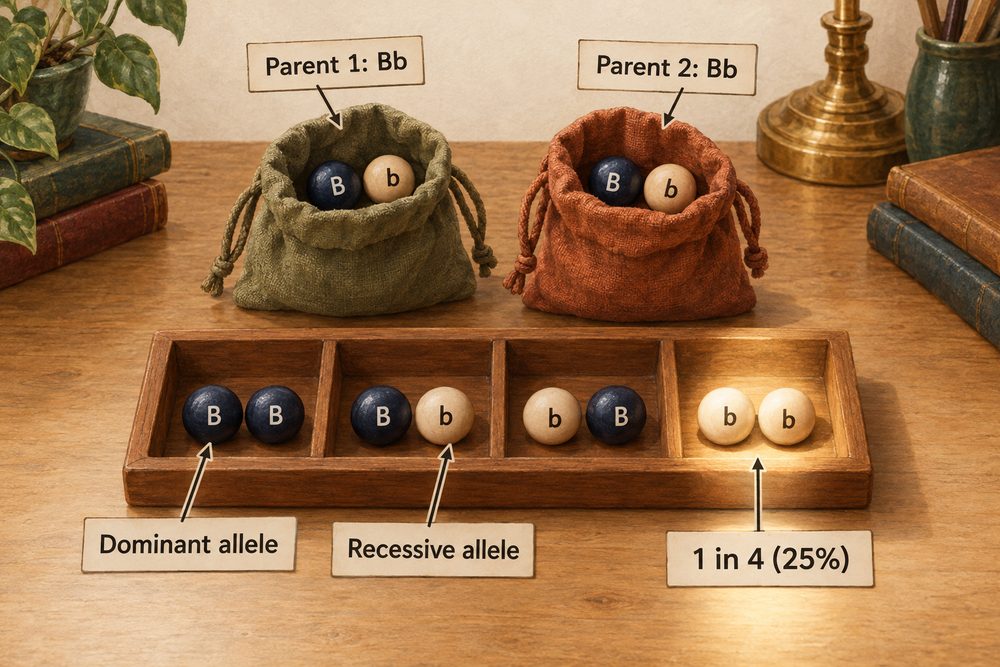
Inheritance describes how characteristics are passed from parents to offspring through alleles. An allele can be dominant (shown with a capital letter, e.g. B) or recessive (lowercase, e.g. b). A dominant allele is always expressed when present. A recessive allele is only expressed when two copies are inherited (one from each parent).
An organism with two identical alleles for a gene is homozygous (BB or bb). An organism with two different alleles is heterozygous (Bb). The combination of alleles is the genotype; the physical characteristic that is expressed is the phenotype.
Dominant alleles are expressed when one or two copies are present. Recessive alleles are only expressed when homozygous (two copies). Genotype = alleles an organism has. Phenotype = the characteristic shown.
A Punnett square is a diagram used to predict the possible outcomes of a genetic cross. You place the alleles from one parent along the top and the alleles from the other parent down the side. Each box shows a possible genotype of the offspring.
For example, if both parents are heterozygous (Bb × Bb), the Punnett square gives: BB, Bb, Bb, bb. The ratio of phenotypes would be 3 dominant : 1 recessive. This means there is a 75% probability of the dominant phenotype and a 25% probability of the recessive phenotype.
You also need to understand how sex is determined. Females have two X chromosomes (XX), and males have one X and one Y (XY). A Punnett square for sex inheritance shows a 50:50 chance of the offspring being male or female.
Variation
Variation refers to the differences between individuals of the same species. Genetic variation is caused by differences in DNA — these arise through mutations and the mixing of alleles during sexual reproduction (meiosis). Environmental variation results from the conditions an organism lives in, such as diet, sunlight or exercise.
Most characteristics are influenced by both genes and the environment. Most phenotypic features result from multiple genes rather than a single gene. Mutations occur naturally and produce new alleles. Most mutations have no effect on the phenotype. Some have a small effect, and very rarely a single mutation can significantly change the phenotype.
Variation can be genetic (from DNA/alleles), environmental (from surroundings) or both. Most mutations have no effect on phenotype. Most phenotypic features are controlled by multiple genes.
The Human Genome Project
The Human Genome Project was a major international effort to map and sequence every gene in the human genome. Its potential applications include identifying genes linked to inherited diseases, developing personalised medicines, understanding evolutionary relationships between species and advancing forensic science.