Variation & Evolution
What Is Variation?
No two organisms are exactly alike — even identical twins develop small differences over time. The differences between individuals of the same species are called variation. Understanding variation is essential for explaining how evolution works, because natural selection acts on these differences.
Variation can be caused by genetic factors, environmental factors, or usually a combination of both. Genetic variation arises because offspring inherit different combinations of alleles from their parents. Environmental variation is caused by the conditions an organism experiences during its life, such as diet, climate, or injuries.
Genetic variation is caused by differences in DNA (e.g. blood group, eye colour). Environmental variation is caused by an organism’s surroundings (e.g. scars, accent, muscle mass). Most features, like height and weight, are influenced by both.
Sources of Genetic Variation
There are several processes that create genetic variation within a population:
1. Mutations — random changes in the DNA sequence. Most mutations have no effect on the organism, but occasionally a mutation produces a new allele that changes a characteristic. Very rarely, a mutation gives an organism an advantage in its environment.
2. Sexual reproduction — the fusion of gametes from two parents means each offspring inherits a unique combination of alleles. The random mixing of alleles during meiosis and the random fertilisation of gametes both increase variation.
Continuous variation shows a range of values with no clear categories — think of height, mass, or hand span. If you measured the height of every student in a year group and plotted a graph, you would get a smooth bell-shaped curve. Continuous variation is typically controlled by multiple genes and influenced by the environment.
Discontinuous variation falls into distinct categories with no in-between values — blood group (A, B, AB, or O), for example, or whether you can roll your tongue. Discontinuous variation is usually controlled by a single gene with a small number of alleles.
Charles Darwin and Natural Selection
In 1859, Charles Darwin published On the Origin of Species, in which he set out his theory of natural selection. Darwin observed that:
1. Individuals within a species show variation in their characteristics. 2. Organisms produce more offspring than the environment can support, so there is competition for resources. 3. Individuals with characteristics best suited to the environment are more likely to survive and reproduce — this is sometimes called “survival of the fittest”. 4. These individuals pass on the alleles for their advantageous characteristics to their offspring. 5. Over many generations, the advantageous allele becomes more common in the population, and the species evolves.
Natural selection: Variation → Competition → Survival of the best adapted → Reproduction → Alleles passed on. Over many generations, this changes the characteristics of a population — this is evolution.
Evolution — Change Over Time
Evolution is the gradual change in the inherited characteristics of a population over successive generations. It occurs through natural selection when the environment favours certain traits. Given enough time, natural selection can lead to the development of entirely new species — a process called speciation.
Speciation typically happens when populations of the same species become geographically isolated (separated by a physical barrier such as a mountain range or river). Each group experiences different environmental conditions, so different characteristics are favoured by natural selection. Over a very long time, the two groups become so different that they can no longer interbreed — they have become separate species.
Fossils provide evidence for evolution by showing how organisms have changed over millions of years. The fossil record reveals a progression from simple life forms to more complex ones. Key fossils for human evolution include Ardi (4.4 million years ago), Lucy (3.2 million years ago), and fossils discovered by Richard Leakey (1.6 million years ago). These show a gradual change from ape-like ancestors to modern humans, including changes in skull size, posture, and foot structure.
The development of stone tools over time also provides evidence for human evolution. Early tools were simple and roughly shaped, while later tools became increasingly refined and specialised. Scientists can date stone tools by examining the rock layers and other materials found in the same environment.
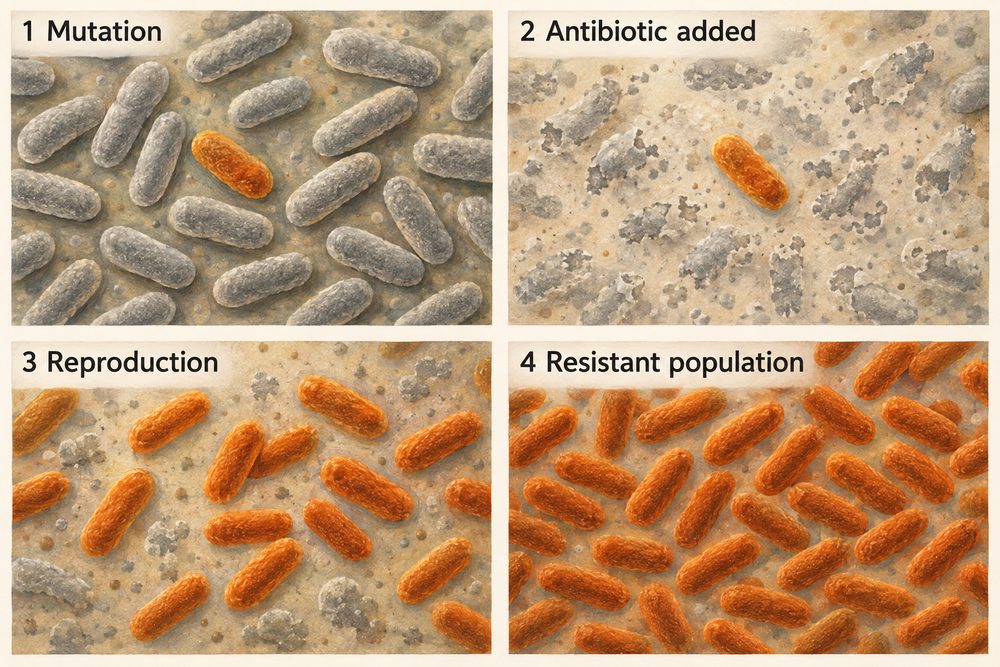
The emergence of antibiotic-resistant bacteria is a modern example that supports Darwin’s theory. When antibiotics are used, most bacteria are killed, but any bacterium with a random mutation that makes it resistant will survive and reproduce. The resistant allele is passed to the next generation. Over time, the whole population becomes resistant. MRSA is a well-known example. This happens within our lifetimes — observable evolution.
Selective Breeding
Selective breeding (also called artificial selection) is when humans deliberately choose which organisms to breed based on desired characteristics. For example, farmers might breed cows that produce the most milk together, or select wheat plants with the highest grain yield. Over many generations, the desired characteristic becomes more pronounced in the population.
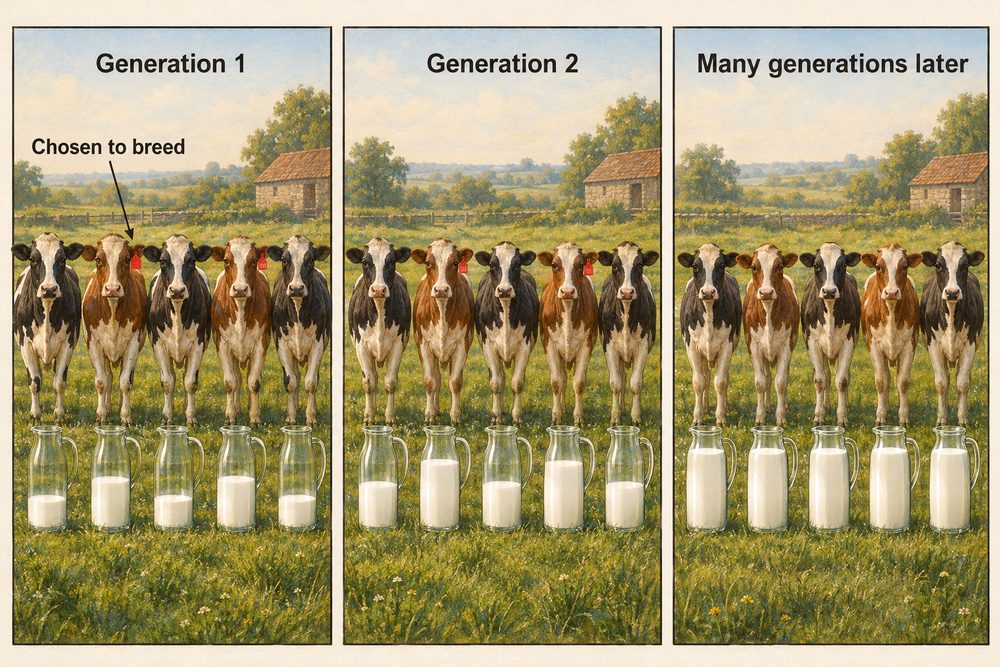
Selective breeding has been used for thousands of years to improve food plants (larger fruits, disease resistance, higher yields) and domesticated animals (faster horses, more docile cattle, dogs with specific traits). However, it reduces genetic variation within the bred population, which can cause problems — such as inherited health conditions in pedigree dogs or vulnerability to new diseases in crops with limited genetic diversity.
Natural selection is driven by the environment and takes many generations. Selective breeding is driven by humans choosing which organisms to breed and can produce rapid changes. Both lead to a change in allele frequency in a population.
Edexcel often tests whether you can explain the steps of natural selection using a specific example. Practise writing out the full sequence (variation → competition → survival → reproduction → alleles inherited) applied to a named organism, such as antibiotic-resistant bacteria or peppered moths. Make sure you mention alleles being passed on, not just “traits”.