Natural Selection & Classification
Classification — Organising the Living World
With millions of species on Earth, scientists need a system to organise and name them. Classification places organisms into groups based on their shared characteristics. Traditionally, organisms were classified into five kingdoms: animals, plants, fungi, protists, and prokaryotes. This system was based mainly on observable features such as body structure and how organisms obtain food.
Modern genetic analysis has led scientists to reclassify life into three domains: Archaea (ancient prokaryotes found in extreme environments), Bacteria (true bacteria), and Eukarya (all organisms with cells containing a nucleus — animals, plants, fungi, and protists). DNA analysis revealed that Archaea are more different from Bacteria than previously thought, so they were separated.
From Five Kingdoms to Three Domains
The five-kingdom system grouped all prokaryotes together. However, when scientists analysed the genome of different prokaryotes, they discovered that Archaea are fundamentally different from Bacteria at the genetic level. Their DNA sequences, cell membrane chemistry, and metabolic processes are distinct. This genetic evidence led to the three-domain system proposed by Carl Woese, which better reflects the evolutionary relationships between organisms.
The third domain, Eukarya, contains all organisms with eukaryotic cells (cells with a nucleus). This domain includes the animal, plant, fungal, and protist kingdoms.
Before DNA technology, classification relied on physical features — what organisms looked like. This sometimes led to mistakes. For example, two organisms might look similar because they adapted to the same environment (convergent evolution), not because they are closely related. Dolphins and sharks look similar but are very different genetically — one is a mammal, the other a fish.
Genetic analysis compares DNA sequences directly. The more similar the DNA of two organisms, the more closely related they are and the more recently they shared a common ancestor. This approach gives a much more accurate picture of evolutionary relationships than physical features alone.
Genetic Engineering
Genetic engineering is the process of modifying the genome of an organism to introduce a desirable characteristic. Unlike selective breeding, which takes many generations, genetic engineering can transfer a specific gene from one organism to another in a single step — even between completely different species.
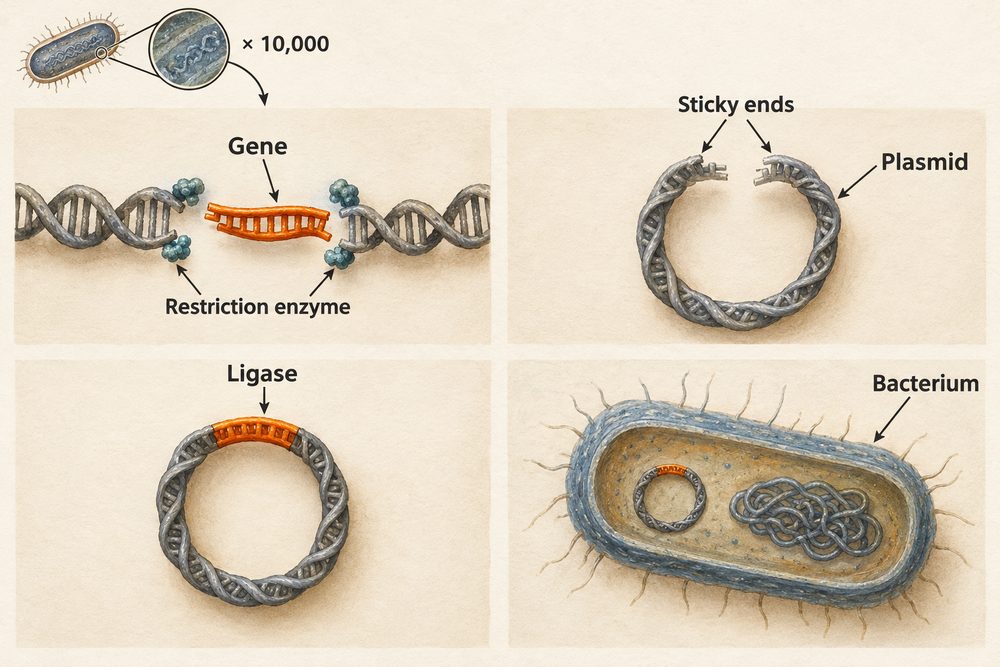
The Main Stages of Genetic Engineering
The process involves four key stages:
1. The desired gene is identified and cut out of the donor organism's DNA using restriction enzymes. These enzymes cut at specific DNA sequences, leaving short, unpaired sections of bases called sticky ends.
2. A vector (such as a bacterial plasmid or a virus) is cut open with the same restriction enzyme, creating matching sticky ends.
3. The desired gene is inserted into the vector. The sticky ends of the gene and the vector are complementary, so they pair up. Ligase enzyme then seals the DNA backbone, joining the gene permanently into the vector.
4. The vector is introduced into the target organism's cells. If successful, the target organism will now produce the protein coded for by the inserted gene, giving it the desired characteristic.
Genetic engineering steps: Cut the gene out with restriction enzymes → Cut the vector with the same enzyme → Insert the gene (sticky ends pair up) → Seal with ligase → Transfer vector to target organism.
Medicine: Human insulin is produced by genetically engineered bacteria. The human insulin gene is inserted into bacterial plasmids, and the bacteria produce large quantities of insulin for people with diabetes. This is more reliable and ethical than extracting insulin from pig or cow pancreases.
Agriculture: Crop plants can be engineered to resist herbicides, pests, or drought. For example, Bt corn contains a gene from a bacterium that produces a natural insecticide, reducing the need for chemical pesticides.
Benefits: Genetic engineering can produce organisms with very specific, useful characteristics quickly. It can improve crop yields, reduce reliance on pesticides, and produce medicines cheaply. Risks and concerns: Genes could transfer to wild populations (gene flow), potentially creating "superweeds". There are ethical concerns about "playing God" and modifying organisms. Long-term effects on ecosystems are not fully understood. Some people are concerned about eating genetically modified (GM) food, although scientific evidence has not shown it to be harmful.
When asked to evaluate genetic engineering, give both sides — benefits and risks — and then reach a conclusion. Use specific examples (e.g. insulin production, GM crops) rather than vague statements. Always consider practical, ethical, and environmental implications.