Ecosystems & Biodiversity
Levels of Organisation in an Ecosystem
An ecosystem is a community of living organisms interacting with each other and with the non-living parts of their environment. Ecosystems can be as small as a pond or as large as an ocean. To understand how they work, we organise living things into levels:
Individual → Population → Community → Ecosystem. An individual is a single organism. A population is all the organisms of one species living in the same area. A community is all the different populations living and interacting together. An ecosystem includes the community plus the non-living (abiotic) environment they depend on.
The levels of organisation: Individual → Population (one species, same area) → Community (all species in an area) → Ecosystem (community + abiotic environment).
Abiotic and Biotic Factors
Communities are affected by both living and non-living factors. Abiotic factors are non-living conditions that influence where organisms can survive. Key abiotic factors include:
Temperature — affects the rate of enzyme-controlled reactions and therefore metabolic processes. Most organisms have an optimum range. Light — essential for photosynthesis in plants; affects where plants grow and the animals that depend on them. Water — all organisms need water; availability limits where organisms can live, especially in deserts. Pollutants — chemicals released into the environment can poison organisms or disrupt ecosystems.
Biotic factors are living influences on an ecosystem. The two most important are:
Competition — organisms compete for limited resources. Animals compete for food, water, territory, and mates. Plants compete for light, water, minerals, and space. Predation — the relationship between predators and their prey affects population sizes. If a predator population increases, more prey are eaten, so prey numbers fall. With less food available, predator numbers then decline too, creating cyclical patterns.
Species in a community depend on each other — this is called interdependence. If one species is removed, it can have a knock-on effect throughout the food web. For example, if a pollinating insect declines, the plants it pollinates cannot reproduce, which then affects the animals that eat those plants.
Some organisms have particularly close relationships. In parasitism, one organism (the parasite) benefits at the expense of another (the host). Fleas on a dog and tapeworms in a human gut are examples — the parasite gains food or shelter, while the host is harmed. In mutualism, both organisms benefit. For example, mycorrhizal fungi grow on plant roots — the fungi help the plant absorb mineral ions from the soil, and the plant provides the fungi with sugars from photosynthesis.
Sampling Organisms — Quadrats and Belt Transects
To study the distribution and abundance of organisms in an ecosystem, scientists use sampling techniques. It is not practical to count every individual, so we sample and then estimate the total.
A quadrat is a square frame placed on the ground. You count the organisms inside it. For a reliable estimate, place quadrats randomly (using random number coordinates) and repeat many times. The more quadrats you use, the more reliable your estimate.
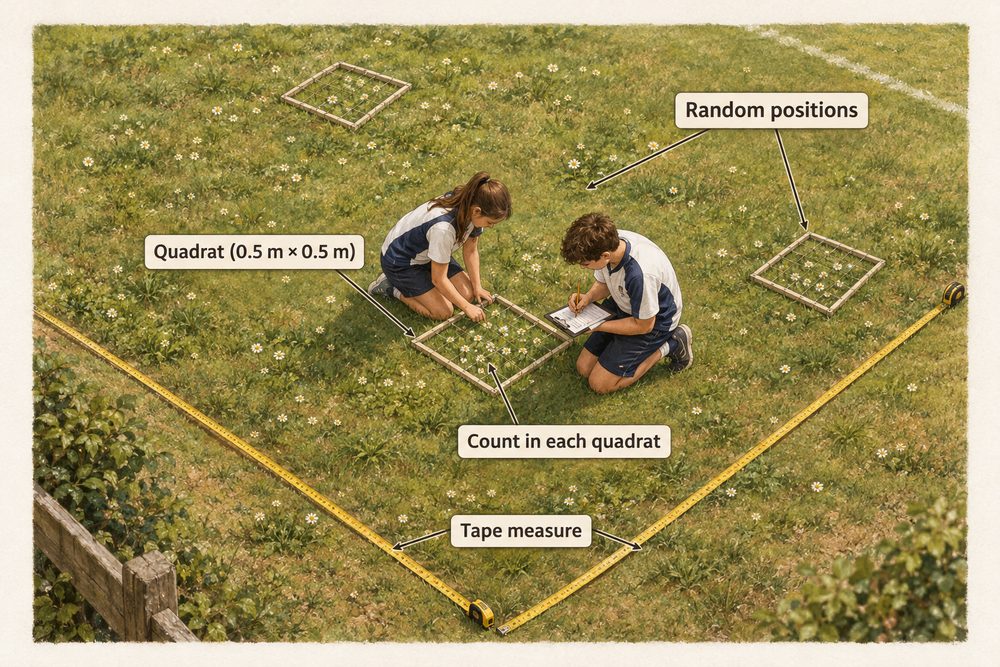
A belt transect uses a line (a tape measure) laid across an area. Quadrats are placed at regular intervals along the line. This shows how the distribution of organisms changes across a habitat — for example, from a pond edge into woodland.
To estimate the number of organisms in an area: count the organisms in several quadrats, calculate the mean per quadrat, then multiply by the total area ÷ quadrat area. Formula: $$\text{Estimated population} = \frac{\text{mean count per quadrat} \times \text{total area}}{\text{area of quadrat}}$$
Human Impacts on Biodiversity
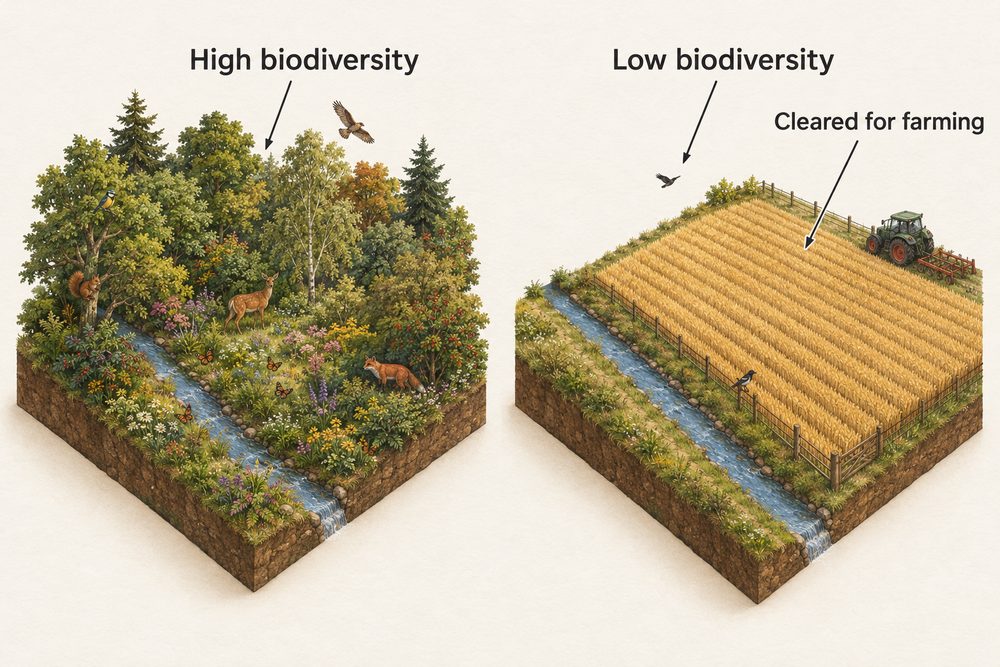
Biodiversity is the variety of different species in an ecosystem. High biodiversity makes ecosystems more stable and resilient. However, human activities can both increase and decrease biodiversity.
Fish farming can have negative effects on wild ecosystems. Farmed fish are kept in high densities, which can lead to disease spreading to wild populations. Waste from fish farms pollutes surrounding water, and escaped farmed fish can outcompete native species or interbreed with them, reducing genetic diversity.
Introduction of non-indigenous species (species not native to an area) can devastate local ecosystems. The introduced species may outcompete native organisms for food and habitat, prey on native species, or introduce diseases. For example, grey squirrels introduced to the UK outcompeted the native red squirrel for food and habitat.
Eutrophication occurs when excess nutrients (usually from agricultural fertilisers) wash into rivers and lakes. The nutrients cause rapid growth of algae (an algal bloom). The algae block light to aquatic plants, which die. Bacteria decompose the dead organisms, using up dissolved oxygen. Fish and other aquatic organisms suffocate due to the lack of oxygen.
Maintaining Biodiversity
It is important to maintain biodiversity at both local and global levels. Locally, conservation programmes protect habitats and endangered species. This includes creating nature reserves, protecting hedgerows, and managing woodlands. The conservation of animal species involves breeding programmes, habitat restoration, and legal protection.
Reforestation — replanting trees in deforested areas — has multiple benefits. It restores habitats for wildlife, absorbs carbon dioxide from the atmosphere (reducing the greenhouse effect), prevents soil erosion, and increases biodiversity. Globally, international agreements and conservation organisations work to protect endangered species and critical habitats such as rainforests, coral reefs, and wetlands.
Humans reduce biodiversity through fish farming, introducing non-indigenous species, and eutrophication. We can maintain biodiversity through conservation (protecting species and habitats) and reforestation (planting trees to restore ecosystems and absorb CO₂).
Fieldwork questions often ask you to describe a method and explain why certain steps improve reliability. Remember: random placement of quadrats avoids bias, repeating measurements improves reliability, and using a belt transect shows how distribution changes across a habitat. Always state the specific measurements you would take.