Trophic Levels, Pyramids & the Carbon Cycle
Trophic Levels and Food Chains
In any ecosystem, energy flows from the Sun through living organisms. The position an organism occupies in a food chain is called its trophic level. Every food chain begins with a producer — an organism (usually a green plant or alga) that converts light energy into chemical energy through photosynthesis.
Organisms that eat producers are called primary consumers (trophic level 2). Those that eat primary consumers are secondary consumers (trophic level 3). Tertiary consumers eat secondary consumers and sit at trophic level 4 or above.
Trophic levels: level 1 = producers (plants) → level 2 = primary consumers (herbivores) → level 3 = secondary consumers (carnivores) → level 4 = tertiary consumers (top predators). Energy is transferred along the chain but decreases at each level.
Pyramids of Biomass
A pyramid of biomass represents the total mass of living material at each trophic level. The producer level always forms the widest bar at the bottom, and each successive level is narrower. This is because energy is lost at every trophic level, so less biomass can be supported higher up the food chain.
Energy is lost between trophic levels through several processes: organisms use energy for movement and other life processes; energy is lost as heat during respiration; and not all parts of an organism are eaten (bones, shells, roots). As a result, only about 10% of the energy at one trophic level is passed to the next.
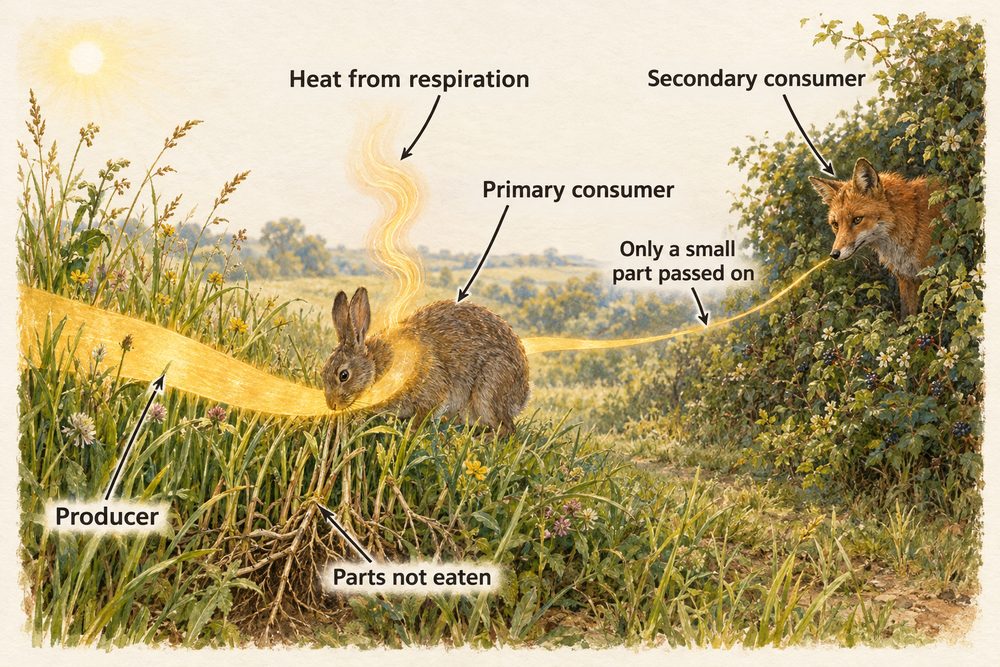
Unlike pyramids of numbers (which can sometimes be inverted, for example when a single large tree supports many insects), pyramids of biomass are almost always a true pyramid shape. This is because they show the total mass of organisms, not just how many there are. Since energy is lost at each transfer, the total biomass decreases at each trophic level, regardless of the number or size of individual organisms.
This also explains why food chains rarely have more than four or five trophic levels — by the fifth level, so little energy remains that it cannot support a viable population of top predators.
Material Cycles — Why Recycling Matters
The materials that living organisms are made from are constantly recycled between the living (biotic) and non-living (abiotic) parts of an ecosystem. When organisms die, decomposers (mainly bacteria and fungi) break down the dead material. This releases nutrients back into the soil and gases back into the atmosphere, where they can be used again by other organisms. Without decomposition, essential elements would remain locked up in dead organisms and would eventually run out.
The Carbon Cycle
The carbon cycle describes how carbon moves between the atmosphere, living organisms, and the environment. It is one of the most important material cycles because carbon is the basis of all organic molecules.
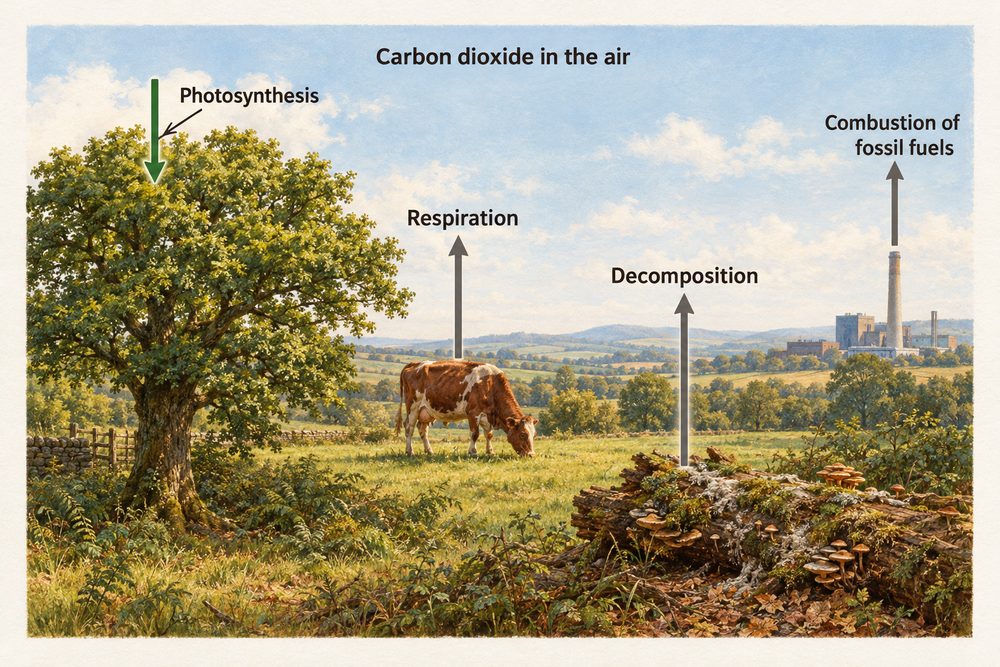
The key processes in the carbon cycle are:
Photosynthesis — producers remove carbon dioxide from the atmosphere and convert it into glucose (organic compounds). This is the main way carbon enters living systems.
Respiration — all living organisms (plants, animals, and microorganisms) carry out respiration, releasing carbon dioxide back into the atmosphere. The equation: $$\text{glucose} + \text{oxygen} \rightarrow \text{carbon dioxide} + \text{water}$$
Feeding — carbon passes along food chains when animals eat plants or other animals.
Decomposition — when organisms die, decomposers (bacteria and fungi) break down the organic matter. The decomposers respire, returning carbon dioxide to the atmosphere. This is a critical role of microorganisms in the carbon cycle.
Combustion — burning fossil fuels (coal, oil, natural gas) releases carbon dioxide that was locked away millions of years ago, increasing atmospheric CO₂ levels.
Carbon enters living systems through photosynthesis and returns to the atmosphere through respiration, decomposition, and combustion. Decomposers (bacteria and fungi) play a vital role by breaking down dead matter and respiring, returning carbon to the cycle.
The Water Cycle
The water cycle describes how water moves continuously between the Earth's surface and the atmosphere. The main processes are: Evaporation — water from oceans, lakes, and rivers is heated by the Sun and turns into water vapour. Transpiration — plants release water vapour from their leaves. Condensation — water vapour cools as it rises and condenses into tiny droplets, forming clouds. Precipitation — water falls as rain, snow, or hail. The water then collects in rivers, lakes, and oceans, or soaks into the ground.
In areas of drought, potable water (safe drinking water) can be produced by desalination — removing salt from seawater. This can be done by distillation (boiling and condensing) or reverse osmosis (forcing water through a membrane). Desalination is effective but requires a lot of energy, making it expensive.
Plants need nitrates from the soil to make amino acids and proteins. But plants cannot use nitrogen gas (N₂) directly from the atmosphere. Nitrates are made available to plants in three main ways:
1. Nitrogen-fixing bacteria — these live freely in the soil or in root nodules of leguminous plants (peas, beans, clover). They convert atmospheric nitrogen into ammonia, which is then converted to nitrates by other bacteria. 2. Decomposition and nitrifying bacteria — when organisms die, decomposers break down proteins into ammonia. Nitrifying bacteria then convert ammonia into nitrites and then into nitrates that plants can absorb. 3. Fertilisers — farmers add artificial fertilisers containing nitrates directly to the soil. Crop rotation with leguminous plants also helps — the nitrogen-fixing bacteria in their root nodules enrich the soil with nitrates for the next crop.
Denitrifying bacteria do the reverse — they convert nitrates back into nitrogen gas, which is released into the atmosphere. This completes the cycle but can reduce soil fertility.
Nitrates are made available for plants through: 1. Nitrogen-fixing bacteria (in soil or legume root nodules). 2. Decomposers + nitrifying bacteria converting dead matter → ammonia → nitrates. 3. Adding fertilisers or using crop rotation with legumes.
When describing the carbon cycle, always mention the role of microorganisms as decomposers. Decomposers don't just break things down; they also respire, which is what actually returns carbon dioxide to the atmosphere. Many students forget this second step. Also remember that combustion of fossil fuels is a human addition to the cycle that increases atmospheric CO₂.