The Genome and Genetic Information
What Is the Genome?
Imagine sending a cheek swab to a consumer DNA-testing company. Weeks later you receive a report listing your ancestry, a handful of health-related genetic variants, and perhaps a curiosity about whether you carry the gene for earwax type. All of that information comes from a single source: your genome. The genome is the complete collection of DNA found in virtually every cell of your body. Understanding how the genome is organised, how it stores information and how it shapes your characteristics is the starting point for all of genetics.
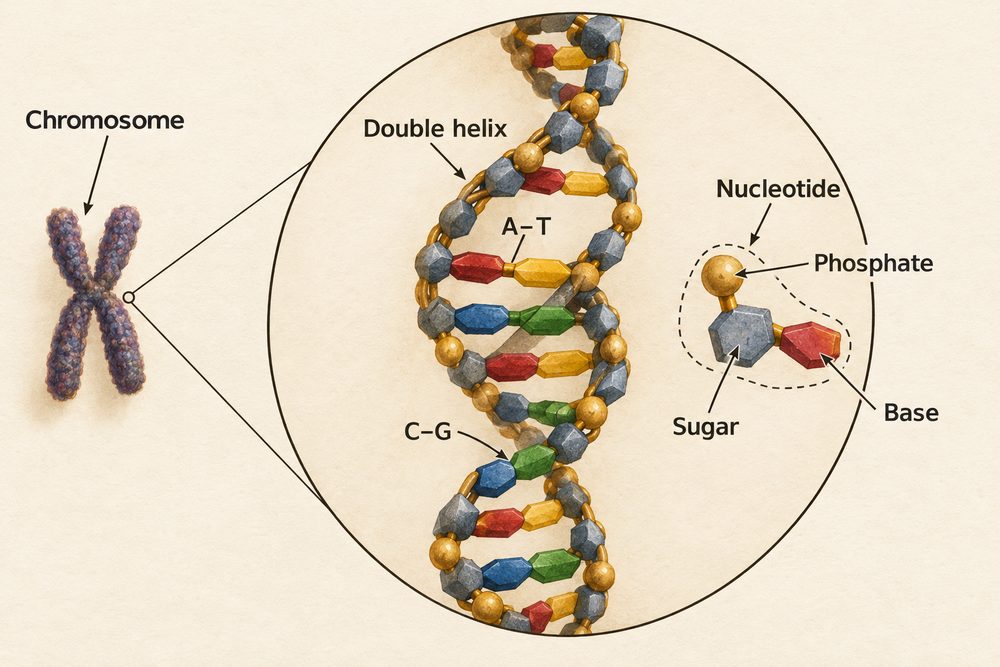
Inside the nucleus of most cells, DNA is packaged into thread-like structures called chromosomes. Humans have 46 chromosomes arranged in 23 pairs. One chromosome of each pair came from your mother; the other came from your father. Each chromosome carries hundreds to thousands of shorter sections of DNA called genes. A single human genome contains tens of thousands of protein-coding genes, plus large regions of DNA that regulate gene activity.
The genome is the complete DNA of an organism. In humans, DNA is packaged into 46 chromosomes (23 pairs) inside the cell nucleus. Genes are short sections of DNA on chromosomes that code for specific proteins.
DNA — A Polymer of Nucleotides
DNA is a polymer — a long molecule assembled from many smaller repeating units. The repeating unit of DNA is the nucleotide, which consists of a sugar (deoxyribose), a phosphate group, and one of four organic bases: adenine (A), thymine (T), cytosine (C), or guanine (G). Two strands of nucleotides twist around each other to form the famous double helix shape.
The two strands are held together by the bases, which pair in a fixed, complementary way: A always pairs with T, and C always pairs with G. This complementary base pairing is one of the most important rules in genetics. It means the sequence of bases on one strand automatically determines the sequence on the other, and it makes accurate copying of DNA possible before cell division.
The sequence of bases along the DNA acts as a code — a biological instruction manual. Every group of three consecutive bases (a triplet) codes for one specific amino acid. The order of these triplets along a gene determines which amino acids are assembled, in what order, at the ribosomes. Different sequences of amino acids fold into different protein shapes, and the shape of a protein determines its function. So ultimately, the base sequence in your DNA determines every protein your body makes.
Making a protein from a gene happens in two main stages. First, inside the nucleus, the relevant gene is used as a template to produce a molecule of mRNA (messenger RNA) — a single-stranded copy of the gene’s base sequence. This process is called transcription. The mRNA then travels out of the nucleus into the cytoplasm.
Second, the mRNA is read at a ribosome in a process called translation. The ribosome reads the base sequence three bases at a time, and for each triplet it recruits the matching amino acid. The amino acids are joined together in sequence to form a growing protein chain. Once complete, the chain folds into a specific three-dimensional shape — the shape that gives the protein its function.
Proteins carry out an enormous range of tasks. Enzymes catalyse chemical reactions. Structural proteins such as collagen give tissues strength. Hormones such as insulin regulate body processes. Antibodies defend against infection. All of these functions trace back to the DNA base sequence that coded for them.
Alleles: Different Versions of the Same Gene
Because you inherit one chromosome from each parent, you carry two copies of most genes — one on each chromosome of a pair. Different versions of the same gene are called alleles. For many genes, only one or two common alleles exist; for others, dozens of variants are known.
The particular combination of alleles a person carries is their genotype. The visible or measurable characteristic that results from those alleles interacting with the environment is the phenotype. Eye colour, blood group and whether your earlobes are attached or free are all examples of phenotypic characteristics with a genetic basis.
Alleles are different versions of the same gene. The genotype is the combination of alleles an organism has. The phenotype is the observable characteristic that results from the genotype and the environment.
How the Genome Shapes Your Characteristics
Some characteristics are controlled by a single gene, such as whether pea plants produce round or wrinkled seeds (the classic example studied by Gregor Mendel in his monastery garden experiments during the 1850s and 1860s). In humans, cystic fibrosis and certain blood groups are examples of single-gene traits. However, the vast majority of human characteristics — height, skin colour, intelligence, susceptibility to many diseases — are polygenic: influenced by many genes acting together.
On top of the genetic influence, the environment also shapes phenotype. A person may carry genes associated with above-average height, but if they suffer from severe malnutrition in childhood their growth will be stunted. This interaction between genotype and environment explains why identical twins, who share the same DNA, are not exactly identical in every measurable trait.
An international scientific collaboration known as the Human Genome Project set out to read the entire sequence of base pairs in the human genome. The project published a working draft in the early 2000s. The completed sequence revealed that the human genome is around 3 billion base pairs long and contains tens of thousands of protein-coding genes, far fewer than many scientists had predicted.
The practical consequences have been far-reaching. Scientists can now identify specific gene variants linked to inherited conditions such as Huntington’s disease or breast cancer risk, enabling genetic testing and counselling. Researchers use genomic data to understand why some people respond differently to the same drug, opening the door to personalised medicine tailored to a patient’s genetic profile.
Consumer DNA tests — the kind that arrive from a cheek swab — use a fraction of this genomic knowledge to estimate ancestry and flag certain variants. They are a striking example of how fundamental genetic science has moved from laboratory curiosity to everyday life within a generation.
One more idea is worth knowing, although it is not tested. Not all of the genome codes for proteins. Large sections of non-coding DNA control when and where genes are switched on or off. A mutation in one of these control regions can change how much protein a cell makes, even though the protein itself is not altered.