Inheritance and Genetic Variants
A Family Pedigree — Why Do Traits Skip Generations?
Consider a family in which neither parent has cystic fibrosis, yet one of their children is diagnosed with the condition. The parents are shocked — neither of them shows any symptoms. How is this possible? The answer lies in the way alleles are inherited and in the distinction between dominant and recessive patterns of inheritance.
Dominant and Recessive Alleles
Not all alleles behave the same way. A dominant allele is always expressed in the phenotype, regardless of whether the person carries one copy or two. A recessive allele is only expressed when both copies of the gene are recessive — when no dominant allele is present to mask it.
An individual with two identical alleles for a gene is homozygous for that gene. An individual with two different alleles is heterozygous. Heterozygous individuals carrying one dominant and one recessive allele express the dominant phenotype but can pass the recessive allele to their offspring — they are carriers.
Dominant alleles are expressed when one or two copies are present. Recessive alleles are only expressed when both copies are recessive (homozygous recessive). Heterozygous carriers have one copy of a recessive allele but show the dominant phenotype.
Genotype, Phenotype and the Environment
The genotype describes the actual alleles an individual carries; the phenotype is the observable characteristic that results. An important point is that the phenotype can be influenced by the environment as well as by the genotype. For example, a plant may carry the genetic potential for maximum height, but if it is grown in poor soil it will not reach that height. In humans, identical twins share the same genotype but can differ in phenotype if they have lived in different environments, follow different diets or develop different health conditions. Single-gene traits such as cystic fibrosis or blood type are largely unaffected by the environment, whereas polygenic traits like height or intelligence are influenced significantly by both genes and environment combined.
Punnett Squares
A Punnett square is a systematic way to work out the probabilities of offspring genotypes. One parent’s alleles are written along the top of the grid; the other parent’s along the side. Each box in the grid shows one possible combination of alleles in an offspring — one allele from each parent.
Let F represent the dominant allele (no cystic fibrosis) and f represent the recessive allele (cystic fibrosis). Both parents in our family pedigree are carriers: their genotype is Ff. Here is the cross:
Parent 1 (Ff) × Parent 2 (Ff)
Gametes from Parent 1: F or f. Gametes from Parent 2: F or f.
Offspring possibilities: FF, Ff, Ff, ff — giving a 1 : 2 : 1 genotype ratio. The phenotype ratio is 3 unaffected : 1 with cystic fibrosis. Each child has a 25% (1 in 4) chance of having cystic fibrosis, a 50% chance of being a carrier, and a 25% chance of being homozygous dominant (not a carrier).
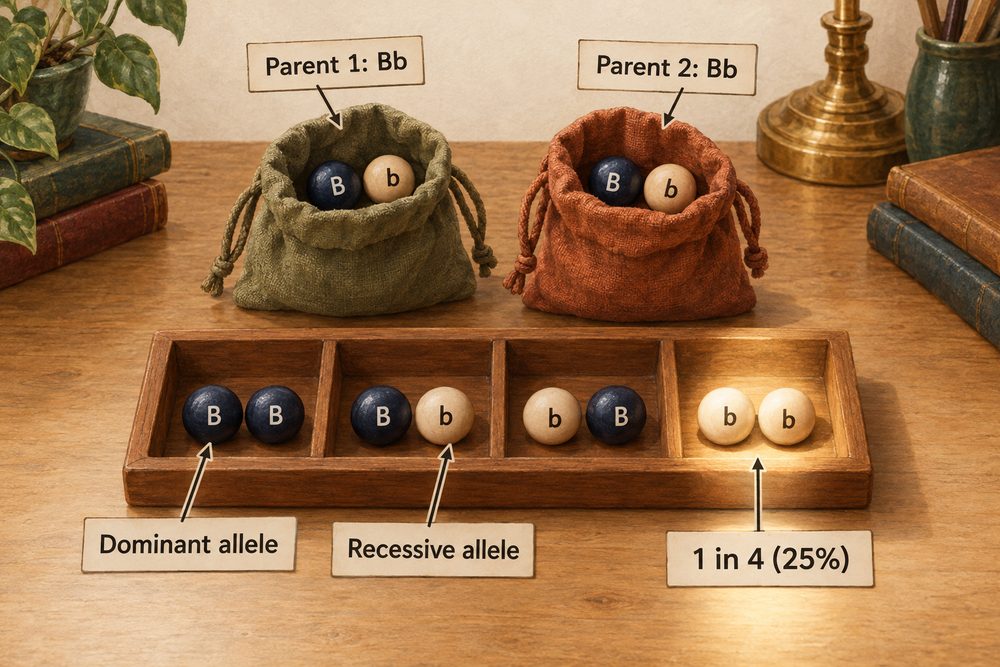
This explains the family scenario: the parents are both carriers (Ff) with no symptoms, but they each passed the recessive f allele to that child. The probabilities are independent for each pregnancy — having one affected child does not change the 25% probability for the next.
Crossing two carriers (Ff × Ff) gives offspring ratios of 1 FF : 2 Ff : 1 ff. The probability of the recessive phenotype is 25% per child. These are probabilities — actual outcomes vary with chance.
Cystic Fibrosis — A Recessive Inherited Condition
Cystic fibrosis is one of the most common serious inherited conditions in the UK. It is caused by a recessive allele, so a person needs two copies of the faulty allele (ff) to be affected. The faulty allele leads to the production of a defective version of a membrane protein that controls the movement of salt and water across cell surfaces. As a result, the mucus in the lungs and digestive tract becomes abnormally thick and sticky, obstructing airways and impairing digestion. Physiotherapy, enzyme supplements and respiratory treatments can manage symptoms, but the condition cannot currently be cured.
One pair of human chromosomes, the sex chromosomes, determines biological sex. Females carry two X chromosomes (XX); males carry one X and one Y chromosome (XY). During meiosis, gametes receive one sex chromosome each. All eggs carry an X chromosome. Sperm can carry either an X or a Y chromosome, each with equal probability.
At fertilisation: if a Y-bearing sperm fuses with the egg, the offspring is XY (male); if an X-bearing sperm fuses with the egg, the offspring is XX (female). A Punnett square for sex determination shows a 1 XX : 1 XY ratio — so there is a 50% probability that any given pregnancy will produce a male or female. The father’s sperm, not the mother’s egg, determines biological sex.
Polydactyly — A Dominant Inherited Condition
Polydactyly (extra fingers or toes) is caused by a dominant allele. A person needs only one copy of the dominant allele (D) to show the condition. Crossing an affected heterozygous parent (Dd) with an unaffected parent (dd) gives offspring genotypes of Dd and dd in a 1 : 1 ratio — a 50% chance per child. Because the allele is dominant, polydactyly can appear in every generation of a family, unlike recessive conditions which can skip generations when carried by heterozygous individuals.