Causes of Disease and Pathogens
An Outbreak in Context
In the winter of 2018–19, measles cases rose sharply across several European countries. Public health teams traced the outbreaks to communities with lower vaccination rates. The pathogen — the measles virus — spread rapidly through airborne droplets in schools and public spaces. At the same time, in the same communities, adults were being diagnosed with type 2 diabetes at record rates — a condition caused not by a pathogen but by a combination of lifestyle factors and genetic risk. These two parallel health crises illustrate the fundamental distinction at the heart of this lesson: communicable diseases versus non-communicable diseases.
What Is a Pathogen?
A pathogen is any microorganism capable of causing disease. There are four main types of pathogen, each with a distinct structure and way of causing harm:
Bacteria are single-celled prokaryotes — they have no true nucleus. They reproduce rapidly by binary fission inside the host and cause illness mainly by releasing toxins that damage cells and tissues. Examples of bacterial diseases include tuberculosis (TB), salmonella food poisoning, and cholera.
Viruses are far smaller than bacteria and are not cells. They consist of genetic material — either DNA or RNA — surrounded by a protein coat. Viruses cannot replicate independently. They invade host cells, hijack the cell’s machinery to make copies of themselves, and then burst out of the cell, destroying it. This is what causes the symptoms of diseases such as influenza, measles, HIV, and COVID-19.
Fungi are eukaryotic organisms (with nuclei) that can cause disease in humans. Many fungal infections are superficial, affecting the skin, nails or hair (for example, athlete’s foot is caused by Tinea fungi). In individuals with weakened immune systems, fungi can cause more serious internal infections.
Protists are single-celled eukaryotes. The most medically significant protist is Plasmodium, which causes malaria. Plasmodium is transmitted via the bite of infected female Anopheles mosquitoes, which act as a biological vector. The parasite multiplies inside red blood cells and the liver, causing cycles of fever, chills and anaemia.
The four types of pathogen are bacteria (reproduce and release toxins), viruses (invade cells and replicate inside them), fungi (cause surface or systemic infections) and protists (e.g. Plasmodium causing malaria via mosquito vectors).
How Communicable Diseases Spread
Understanding transmission routes is essential for controlling outbreaks. The main routes by which pathogens pass between hosts are:
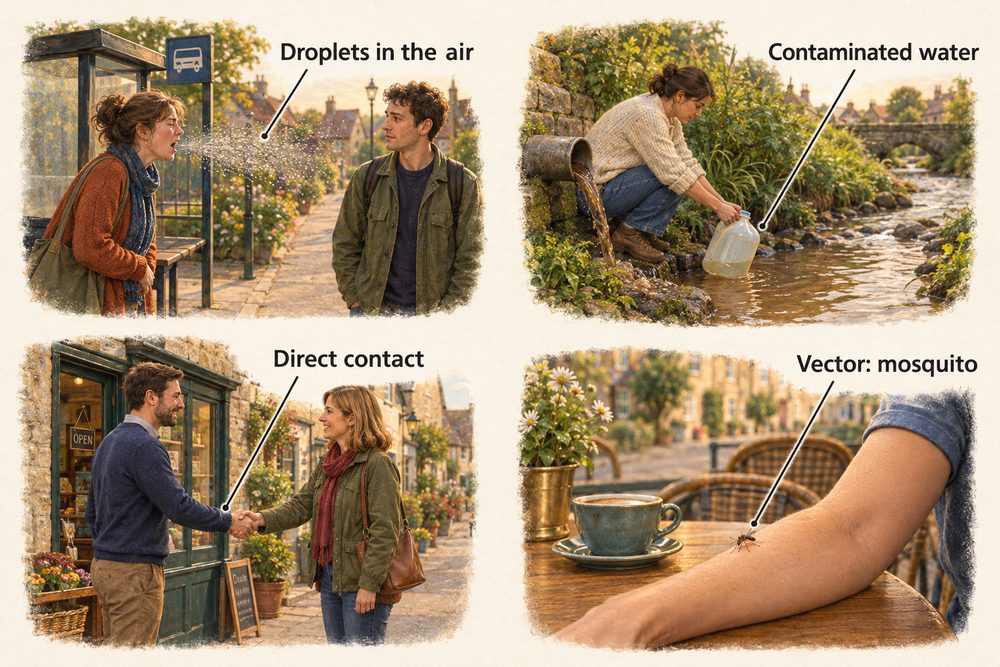
Direct contact — the pathogen passes directly from one person to another through touch, or through sexual contact (e.g. HIV, chlamydia). Airborne droplets — when an infected person coughs, sneezes or speaks, tiny droplets containing pathogens are released into the air and can be inhaled by others nearby. Measles and influenza spread this way. Contaminated food or water — pathogens enter the digestive system when a person eats or drinks contaminated material. Salmonella and cholera are transmitted via this route. Animal vectors — organisms such as mosquitoes, ticks and fleas transmit pathogens when they bite or feed on hosts. Malaria is transmitted by mosquito vectors.
Salmonella is a bacterial disease transmitted through contaminated food, particularly raw or undercooked poultry and eggs. The bacteria produce toxins that cause vomiting, diarrhoea and fever. Proper cooking kills the bacteria; hygiene in food preparation prevents cross-contamination.
HIV (Human Immunodeficiency Virus) is transmitted through bodily fluids, particularly blood, semen and breast milk. It attacks helper T lymphocytes, progressively damaging the immune system. Without treatment, HIV infection can progress to AIDS (Acquired Immune Deficiency Syndrome), leaving the person unable to fight off infections that a healthy immune system would control easily. Antiretroviral drugs suppress HIV replication, allowing people to live healthy lives.
Cholera is a bacterial disease caused by Vibrio cholerae, transmitted through water or food contaminated with infected faeces. The bacteria produce a toxin that causes the intestinal wall to secrete massive amounts of water, leading to severe diarrhoea and dehydration. Cholera outbreaks typically follow disasters that disrupt clean water supplies. Oral rehydration therapy saves lives by replacing fluids and electrolytes.
The Body’s First Line of Defence: Barriers
The body does not wait passively for pathogens to enter — it maintains a series of physical and chemical barriers that prevent most pathogens from getting in at all. These non-specific defences act against all types of pathogen regardless of what they are:
Skin is the body’s largest organ and its primary physical barrier. It is made of tightly packed cells that pathogens cannot easily penetrate. When the skin is cut or broken, the risk of infection rises sharply, which is why wound hygiene matters.
Mucus lines the airways and digestive tract, trapping pathogens before they reach the internal tissues. Cilia — tiny hair-like projections on cells lining the airways — beat rhythmically to sweep mucus (and the trapped pathogens) up towards the throat, where it can be swallowed and destroyed by stomach acid. Smoking damages cilia, which is one reason smokers are more susceptible to respiratory infections.
Stomach acid (pH 1–2) kills most pathogens that enter via food or drink. Tears, saliva and mucus contain lysozyme, an enzyme that breaks down bacterial cell walls. These chemical barriers provide constant background protection without requiring the immune system to be activated.
First-line (non-specific) defences include skin (physical barrier), mucus and cilia (trap and sweep pathogens), stomach acid (kills pathogens in food), and lysozyme in tears/saliva (destroys bacterial cell walls). These prevent pathogens from reaching internal tissues.
The symptoms of infectious disease arise in two quite different ways depending on the type of pathogen. Bacteria primarily cause damage by releasing toxins — chemical waste products or deliberate biological weapons produced as the bacteria multiply. For example, the cholera toxin causes excessive water secretion from the gut wall; the toxins from Staphylococcus aureus can cause food poisoning. The bacteria themselves may not directly invade all tissues, but their toxins travel through the body and cause harm.
Viruses cause damage differently. Because they replicate inside host cells by taking over the cell’s ribosomes and other machinery, they destroy cells from within. When the new virus particles burst out (a process called lysis), the cell is killed. If large numbers of cells are destroyed, tissues stop functioning. The sore throat of a cold is partly caused by destroyed throat cells; the lung damage of severe influenza or COVID-19 is caused by destruction of lung epithelial cells by the virus.