Immune System, Vaccination and Treating Disease
The Body’s Internal Defence Force
When the body’s barrier defences are breached — a cut becomes infected, a virus is inhaled, a bacterium slips past stomach acid — a second, more sophisticated line of defence takes over: the immune system. Unlike the barriers that act against all pathogens indiscriminately, the immune response can identify specific invaders, mount a targeted attack, and — crucially — remember the encounter so future attacks are defeated faster. Understanding how this system works explains both why vaccines are so effective and why antibiotic resistance is so dangerous.
Antigens and the Specific Immune Response
Every pathogen carries proteins on its surface called antigens. These antigens are unique to that particular pathogen — different strains of influenza virus have different surface antigens, for example, which is why the flu vaccine needs updating regularly. When a pathogen enters the body, the immune system recognises the foreign antigens and mounts a specific immune response targeted at that particular pathogen.
Lymphocytes are the white blood cells responsible for the specific immune response. When a lymphocyte encounters the antigen that matches its receptors, it rapidly divides to produce a clone of identical cells. These cells then produce large quantities of antibodies — Y-shaped proteins precisely complementary to the specific antigen.
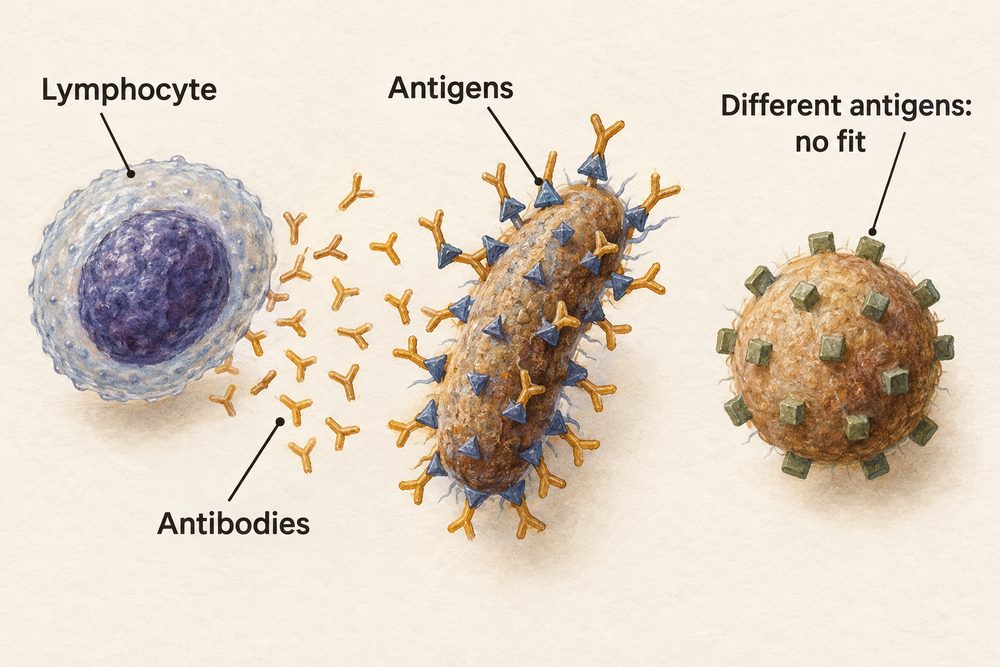
Antigens are foreign proteins on pathogens that trigger the immune response. Lymphocytes produce specific antibodies that are complementary in shape to those antigens. The antibody binds to the antigen, marking the pathogen for destruction.
How Antibodies Work
Antibodies destroy pathogens in three ways. First, they clump pathogens together (a process called agglutination), making it much easier for phagocytes to engulf and digest large numbers at once. Second, they neutralise toxins released by bacteria by binding to the toxin molecule and blocking its action. Third, they mark pathogens for destruction by other immune cells, a process called opsonisation — essentially tagging the pathogen so it cannot be missed.
Phagocytes complement the lymphocyte response by carrying out phagocytosis. Unlike lymphocytes, phagocytes are non-specific — they attack any foreign cell or particle. They are particularly effective at cleaning up pathogens that have been clumped or tagged by antibodies.
After an infection is overcome, most of the activated lymphocytes die off. However, some persist as memory cells. Memory cells may survive for years or decades in the bloodstream. They carry the ‘blueprint’ for producing the correct antibody for that pathogen.
If the same pathogen enters the body again, the memory cells recognise the antigen immediately and mount a response far faster and larger than the first time. The antibodies are produced so quickly that the pathogen is destroyed before symptoms develop — the person doesn’t even know they were reinfected. This accelerated secondary response is the biological basis for both natural immunity after infection and artificial immunity after vaccination.
How Vaccination Works
Vaccination exploits the immune system’s memory. A vaccine introduces antigens from a pathogen — typically via a dead or weakened version of the pathogen, a fragment of the pathogen, or a molecular instruction for producing the antigen — into the body. The immune system responds as if to a real infection: lymphocytes are activated, antibodies are produced, and memory cells are formed. The person has now acquired immunity without ever suffering the disease.
If enough people in a community are vaccinated, the pathogen cannot find susceptible hosts to infect and spread to. Even individuals who cannot be vaccinated (such as newborns or immunocompromised patients) are protected because the pathogen cannot circulate. This community-level protection is called herd immunity. The proportion of the population needed for herd immunity varies by how easily the disease spreads — measles requires very high coverage because it is extremely contagious.
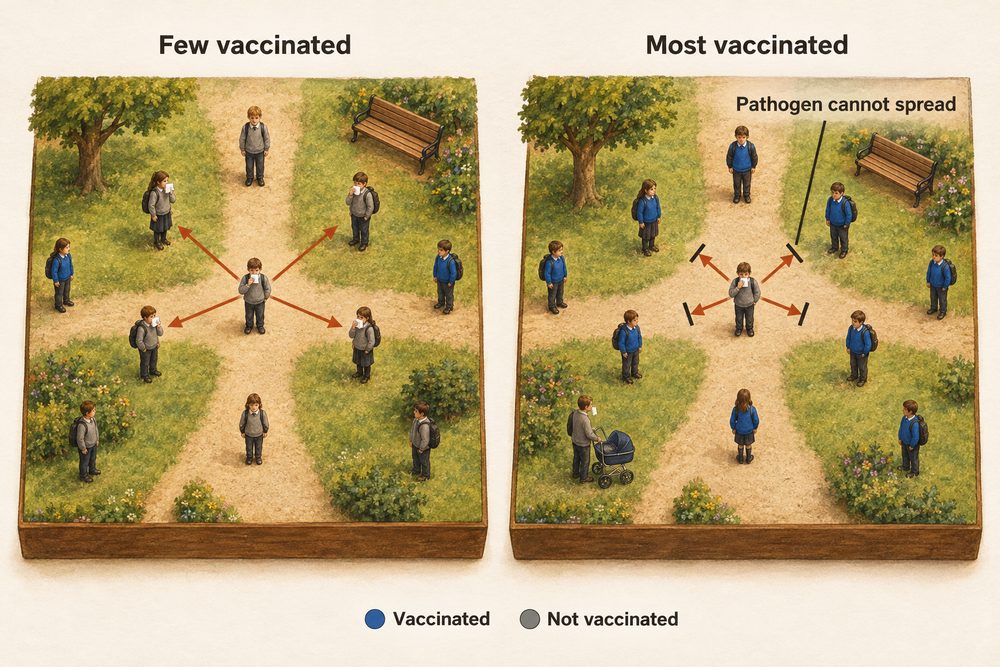
Vaccines introduce antigens to trigger memory cell formation without causing disease. Herd immunity occurs when enough people are immune that a pathogen cannot spread easily, protecting vulnerable individuals who cannot be vaccinated.
Antibiotics — Effective Against Bacteria, Not Viruses
Antibiotics are medicines that interfere with the life processes of bacteria. They work by targeting bacterial structures that are absent in human cells — the bacterial cell wall is a common target. Because viruses do not have cell walls and reproduce entirely inside host cells using the host’s own cellular machinery, antibiotics have no effect on viruses. Prescribing antibiotics for a viral infection (such as the common cold or flu) does nothing to treat the patient and contributes to antibiotic resistance.
Antibiotic resistance develops through natural selection. Within a bacterial population, random mutations occasionally produce an individual that is less affected by an antibiotic. If antibiotics are used widely — especially if patients stop a course early or antibiotics are used in livestock farming — the susceptible bacteria are killed, but any resistant mutants survive and reproduce. Over generations, the resistant form becomes dominant in the population. The result is infections that cannot be treated by standard antibiotics — so-called ‘superbugs’ such as MRSA (methicillin-resistant Staphylococcus aureus).
Before a new medicine reaches patients, it must pass through a carefully staged testing process. The process begins with preclinical testing — new compounds are tested on cells and tissues in the laboratory (in vitro), then on animals to check for toxicity and initial effectiveness. Only if these early tests are promising does the drug progress to clinical trials involving human volunteers.
Clinical trials are conducted in phases. Phase 1 tests the drug’s safety on a small group of healthy volunteers — this establishes what dose range is tolerable and identifies any serious side effects. Phase 2 tests the drug on a larger group of patients with the target condition to assess whether it is effective and what the optimum dose is. Phase 3 involves much larger numbers of patients and uses a double-blind, placebo-controlled design: half the patients receive the real drug; half receive an inactive placebo. Neither patients nor researchers know who has received which, removing bias from the results.
The double-blind, placebo-controlled trial is the scientific gold standard for testing medicines because it controls for the placebo effect (where patients feel better simply because they believe they are being treated) and for researcher bias in recording outcomes. Only after passing all phases and receiving regulatory approval can a drug be licensed for widespread use. This rigorous process is an example of the scientific community using evidence and peer review to protect the public — a direct application of the ideas-about-science principle that hypotheses must be tested and results scrutinised before conclusions are accepted.