Lifestyle, Genes and Non-Communicable Disease
Patterns in a Population
Epidemiologists — scientists who study the patterns of disease in populations — have assembled decades of data linking lifestyle behaviours to specific diseases. Countries where smoking rates are high tend to have higher rates of lung cancer. People with higher body mass index (BMI) have higher rates of type 2 diabetes. Communities with diets rich in saturated fat tend to have more cardiovascular disease. But here lies one of the most important thinking skills in science: just because two things are correlated does not mean one causes the other.
This lesson will build both your understanding of the science of non-communicable disease and your ability to interpret and evaluate risk-factor data critically — a skill that carries significant marks in your exam.
Risk Factors and Non-Communicable Disease
A risk factor is something that increases the probability of developing a disease. Risk factors can be lifestyle-related (smoking, diet, alcohol intake, physical activity), environmental (air pollution, UV radiation, carcinogens), or genetic (inheriting variants that increase susceptibility). Most non-communicable diseases result from multiple risk factors interacting, not a single cause.
Key lifestyle risk factors for non-communicable disease include smoking (cardiovascular disease, lung cancer), poor diet high in saturated fat and sugar (cardiovascular disease, type 2 diabetes), excessive alcohol consumption (liver disease, liver cancer), and physical inactivity (obesity, type 2 diabetes, cardiovascular disease).
Correlation vs Causation — A Worked Example
Consider a graph showing that in countries where more cigarettes are sold per person, the death rate from lung cancer is higher. This is a strong positive correlation. But does it prove smoking causes lung cancer? Not on its own — there could be confounding factors: perhaps countries with high smoking rates also have older populations, worse air quality, or poorer healthcare that detects cancer later.
Causation is only established when controlled experiments or very strong patterns across multiple independent studies rule out confounding factors. In the case of smoking and lung cancer, controlled studies, biological evidence (tobacco carcinogens directly mutate lung cell DNA), and consistent findings across decades and many populations together provide extremely strong evidence of causation. The scientific consensus is clear: smoking causes lung cancer. But the reasoning matters: correlation is the starting point, not the conclusion.
In exam questions you may be shown a table or graph of epidemiological data and asked to draw conclusions. When interpreting such data, follow these reasoning steps:
1. Describe the pattern: “As X increases, Y increases” — this is the correlation. 2. Note whether the correlation is strong or weak. 3. Consider whether a causal mechanism is plausible: could X biologically lead to Y? 4. Identify possible confounding factors that might explain the pattern without causation. 5. State whether the data alone is sufficient to conclude causation, and what additional evidence would strengthen the case.
For example: data shows that people who exercise less are more likely to have type 2 diabetes. Pattern: negative correlation between exercise and diabetes risk. Plausible mechanism: exercise improves insulin sensitivity and helps maintain healthy body weight. Possible confounding factor: people with poor diet (which also raises diabetes risk) may exercise less — both are linked to a third factor (overall lifestyle). Additional evidence needed: controlled studies where activity level is the only variable changed.
Cardiovascular Disease
Cardiovascular disease (CVD) is one of the leading causes of death in the UK and worldwide. The underlying process in most CVD is atherosclerosis: fatty deposits, called plaques, accumulate inside the walls of arteries, narrowing the space through which blood can flow and making the artery walls stiff. The process is driven by high levels of cholesterol in the blood, particularly the LDL (“bad”) form, combined with damage to the artery lining caused by high blood pressure or smoking.
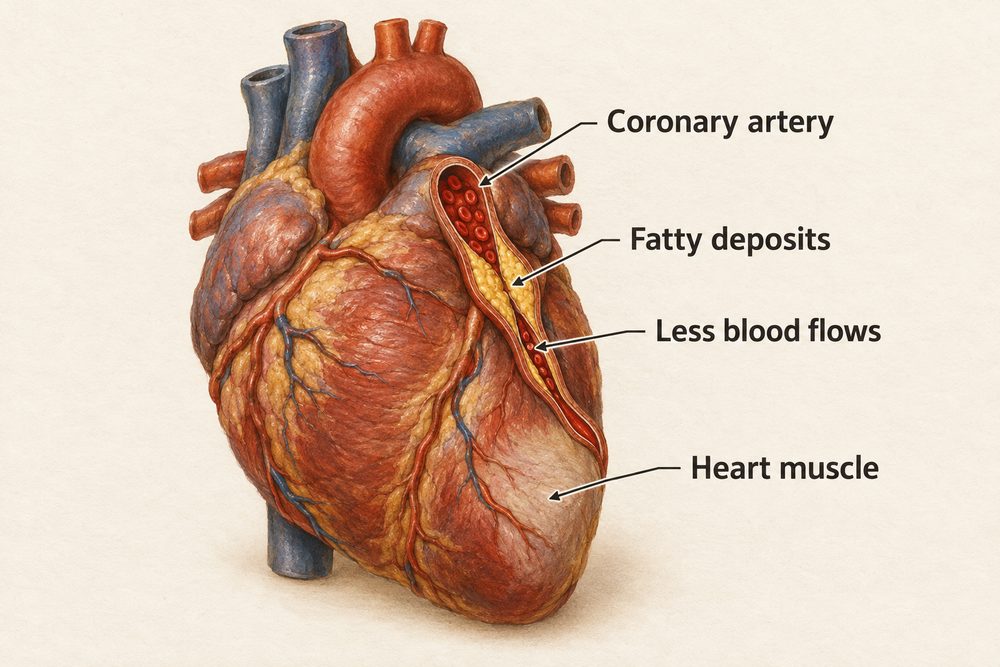
If a coronary artery (which supplies the heart muscle) becomes severely narrowed, the heart muscle receives insufficient oxygen during exertion, causing angina (chest pain). If a blood clot forms at a plaque and completely blocks the artery, the heart muscle is starved of oxygen and begins to die — this is a heart attack (myocardial infarction). If the blood supply to the brain is interrupted by a clot or a burst vessel, the result is a stroke.
Lifestyle changes — improving diet (reducing saturated fat and salt, increasing fruit and vegetables), taking regular aerobic exercise, stopping smoking, and reducing alcohol intake. These reduce blood cholesterol, blood pressure and body weight over time. Low risk with no side effects, but require sustained behavioural change.
Medical treatments — statins are drugs that reduce blood cholesterol levels by inhibiting the enzyme used to produce cholesterol in the liver. They significantly reduce the risk of heart attacks in people with existing CVD. Anticoagulants and antiplatelet drugs reduce the risk of blood clots forming on plaques. Medication is effective but requires lifelong adherence and can have side effects.
Surgical treatments — stents are small mesh tubes inserted into a narrowed artery to hold it open and restore blood flow. Coronary artery bypass grafting uses a blood vessel taken from another part of the body to create a new route around a blocked artery. Surgical treatments are effective in severe cases but carry risks of infection, blood clotting and complications from general anaesthesia.
Cancer
Cancer occurs when the normal controls on cell division break down. Mutations in the genes that regulate the cell cycle cause cells to divide uncontrollably, forming a tumour. A benign tumour grows slowly in one location and does not invade surrounding tissue. A malignant tumour invades surrounding tissues and can break off and travel through the blood to establish new tumours elsewhere in the body — a process called metastasis.
Risk factors for cancer include: smoking (the carcinogens in tobacco smoke directly damage DNA in lung cells), UV radiation (causes DNA mutations in skin cells, increasing the risk of melanoma), certain viruses (human papillomavirus, HPV, is associated with cervical cancer), obesity, and inherited genetic variants that increase susceptibility. Not all cases of cancer have an identifiable risk factor — mutations can occur spontaneously during normal cell division.
Cancer is caused by mutations that lead to uncontrolled cell division. Benign tumours stay in one location; malignant tumours invade tissues and spread (metastasis). Risk factors include smoking, UV radiation, certain viruses and genetic predisposition.
Type 2 Diabetes, Obesity and BMI
In type 2 diabetes, body cells become less responsive to insulin — a condition called insulin resistance. As a result, blood glucose remains elevated after eating, damaging blood vessels and nerves over time. Obesity is a major risk factor for type 2 diabetes because excess body fat — particularly around the abdomen — is associated with reduced insulin sensitivity. Diet high in refined sugars also raises blood glucose repeatedly, stressing the insulin-regulation system.
Body mass index (BMI) is used as an indicator of healthy weight. It is calculated as: $$\text{BMI} = \frac{\text{mass (kg)}}{\text{height (m)}^2}$$ A BMI above 30 is classified as obese. BMI is a population screening tool, not a perfect individual diagnostic — it does not distinguish between muscle and fat mass, for example. Nonetheless, population data consistently shows that higher average BMI correlates with higher rates of type 2 diabetes and cardiovascular disease.