Photosynthesis and Producers
Producers and the Source of All Food
Walk into any greenhouse and you’ll find growers carefully controlling light levels, temperature and the air composition around their crops. They’re manipulating the same process that drives every food chain on Earth: photosynthesis. Organisms that carry out photosynthesis are called producers — they form the foundation of almost every food chain because they are the only organisms capable of capturing energy from sunlight and locking it into chemical bonds.
Photosynthesis takes place in the chloroplast, an organelle containing the green pigment chlorophyll. Chlorophyll absorbs red and blue wavelengths of light while reflecting green light — which is why leaves appear green. The reaction is endothermic: it takes in energy from the surroundings in the form of light.
Photosynthesis equation: $$\text{carbon dioxide} + \text{water} \xrightarrow{\text{light}} \text{glucose} + \text{oxygen}$$
Symbol equation: \(6CO_2 + 6H_2O \rightarrow C_6H_{12}O_6 + 6O_2\). It is an endothermic reaction — it takes in light energy.
The Two Stages of Photosynthesis
Photosynthesis is a two-stage process. In the first stage, light energy is absorbed by chlorophyll and used to split water molecules, releasing oxygen as a by-product. In the second stage, the hydrogen released from water is combined with carbon dioxide to produce glucose. Both stages occur within the chloroplast.
The oxygen released in the first stage diffuses out of the leaf through tiny pores called stomata into the surrounding air. This oxygen is the source of almost all the oxygen in Earth’s atmosphere. The glucose produced in the second stage can be used immediately by the plant in respiration, or stored, or converted into other molecules.
Glucose made by photosynthesis has several important destinations within the plant. It may be broken down in respiration to transfer energy for life processes. Excess glucose is converted to insoluble starch for storage (starch does not affect osmosis because it is insoluble). Glucose is also converted to cellulose for building and strengthening cell walls.
When mineral ions such as nitrates are available from the soil, the plant can combine glucose-derived carbon skeletons with nitrogen to make amino acids, which are assembled into proteins. Glucose can also be converted into lipids (fats and oils) for energy storage in seeds. This explains why seeds are energy-rich foods: they store lipids made originally from photosynthetically produced glucose.
Limiting Factors and Rates of Photosynthesis
Three factors determine how fast photosynthesis can proceed: light intensity, carbon dioxide concentration and temperature. Each can become a limiting factor — the one in shortest supply that prevents the rate from rising. On a graph of rate against one factor, the rate rises then plateaus: the plateau shows that a different factor has become limiting.
Light intensity — more light means more energy available for the light-dependent stage. As light intensity increases, the rate rises. At high intensity, it levels off because CO\(_2\) or temperature has become the new limiting factor. If a plant is moved further from a light source, the light reaching it decreases.
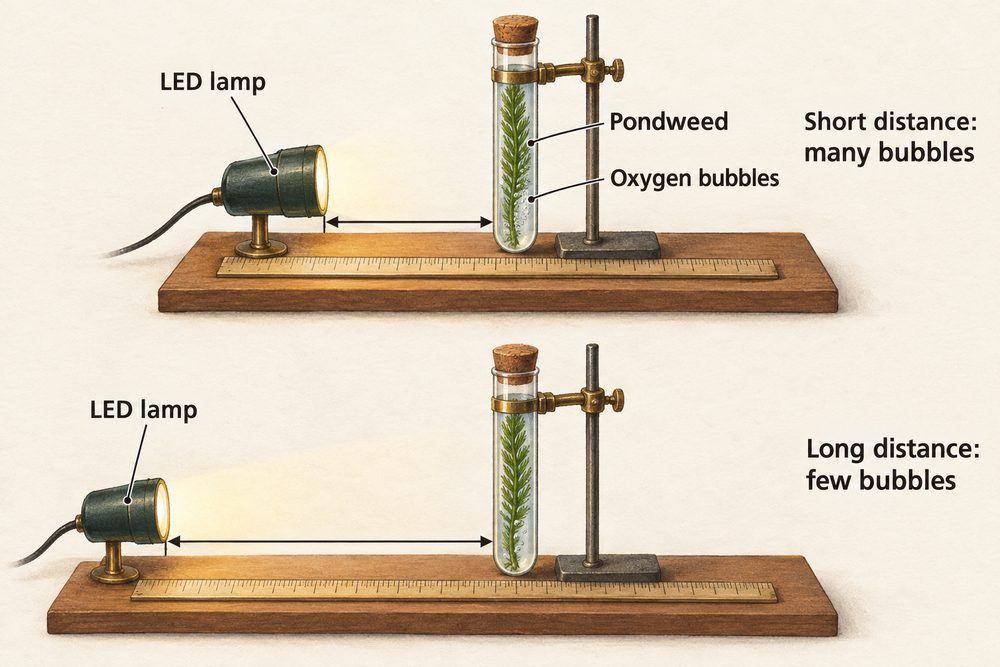
Carbon dioxide concentration — CO\(_2\) is a raw material for the carbon-fixing stage of photosynthesis. Increasing its concentration provides more molecules for the reaction, so the rate increases. In sealed glasshouses, growers can pump in extra CO\(_2\) from gas burners to raise yields.
Temperature — the reactions of photosynthesis are controlled by enzymes. Higher temperatures increase the kinetic energy of molecules, speeding up enzyme-substrate collisions. Above the enzyme’s optimum temperature (often around 25–30°C for many plants), the enzyme begins to denature and the rate falls sharply.
The three limiting factors interact. A graph plateau means a different factor is now limiting. To raise the rate further, you must increase whichever factor is currently limiting — not the one already in excess.
Resources That Producers Need: Minerals and Water
Producers need more than just light and CO\(_2\). They also require water, absorbed from the soil through root hair cells by osmosis, and mineral ions, absorbed by active transport. The most important mineral ions for plant growth are nitrates (to make amino acids and proteins) and phosphates (for DNA and cell membranes). A shortage of any of these resources limits growth regardless of how much light or CO\(_2\) is available.
Water absorbed by the roots travels upward through xylem vessels to the leaves. There it is used in photosynthesis or evaporates from cells and diffuses out through stomata — a process called transpiration. Transpiration keeps a continuous flow of water moving through the plant, carrying dissolved minerals to where they are needed.
Commercial growers use glasshouses to manipulate limiting factors and maximise crop yields year-round. Artificial lighting extends the ‘growing day’ and can be tailored to provide the red and blue wavelengths that chlorophyll absorbs most strongly. Gas burners add CO\(_2\) to the atmosphere inside the glasshouse. Heating systems maintain the optimum temperature for the crop being grown. Automatic irrigation delivers water directly to roots.
Each improvement has a cost, so farmers must weigh the extra income from increased yields against the running costs. If CO\(_2\) is already at an optimal level, spending money to increase it further will not raise the rate — light or temperature is then the limiting factor. Understanding which factor is currently limiting is therefore essential for making cost-effective decisions.
Producers need water (split in photosynthesis to release hydrogen and oxygen), CO\(_2\), light, and mineral ions including nitrates (for amino acids and proteins) and phosphates (for DNA). Transpiration drives water and mineral delivery through the xylem.