Ecosystems, Interdependence and Population Change
What Is an Ecosystem?
In the late 1980s, scientists tracking red fox populations across the Scottish Highlands noticed something unexpected: as foxes declined in certain areas, the populations of mountain hares — their prey — surged, only to crash again as overgrazing damaged the heather the hares depended on. One change rippled through an entire community. This is interdependence in action — a defining feature of every ecosystem.
Ecosystems are organised at four levels. Individual organisms of the same species living in the same area form a population. Multiple populations living and interacting together form a community. When that community interacts with the non-living environment, it constitutes the ecosystem.
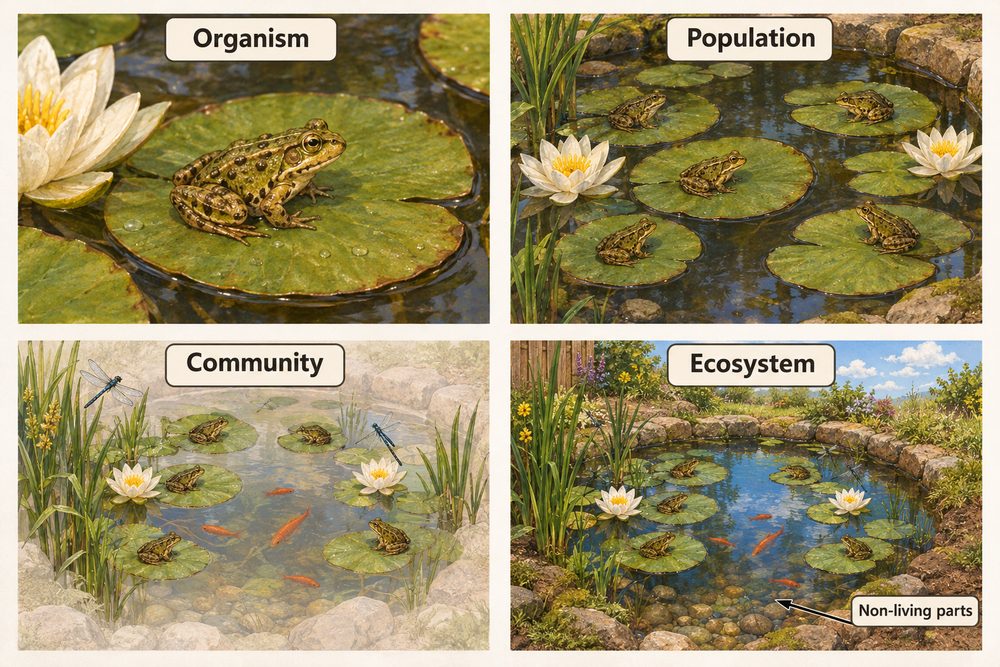
Ecosystem levels: individual → population (one species) → community (many species) → ecosystem (community + abiotic environment). Every organism within a community is interdependent — change in one population affects others.
Biotic and Abiotic Factors
Abiotic factors are the non-living conditions that shape an ecosystem. Temperature, light intensity, moisture level, soil pH and wind speed are all abiotic factors. Biotic factors are the living influences: the presence of predators, availability of prey, disease, and competition with other species for resources.
A change in any one factor can cascade through the whole community. In rivers, ecologists monitor dissolved oxygen levels (abiotic) as a pollution indicator, and survey populations of pollution-sensitive invertebrates such as stonefly larvae (biotic indicator). A drop in dissolved oxygen triggers a fall in stonefly populations, which in turn affects the trout that feed on them. Tracking both types of factors together gives a richer picture of ecosystem health.
Key types of biotic relationship between organisms in a community include: predation (one organism kills and eats another), mutualism (both organisms benefit — for example, bees collect nectar from flowers while carrying pollen, benefiting both), and parasitism (one organism benefits while the other is harmed — for example, a flea living on a dog).
Organisms compete for resources whenever supply is limited. Animals compete for food, water, territory and mates. Plants compete for light, water, mineral ions and physical space. Competition can be intraspecific (within the same species — e.g. two male deer competing for a mate) or interspecific (between different species — e.g. red squirrels and grey squirrels competing for the same food sources in woodland). In the UK, the introduction of the larger, more competitive grey squirrel has contributed to the decline of the native red squirrel across much of England and Wales.
Food Webs and Energy Flow
Energy enters most ecosystems through sunlight, captured by producers (plants and algae) through photosynthesis. It then passes along a food chain through trophic levels: producer → primary consumer (herbivore) → secondary consumer (carnivore) → tertiary consumer (top predator).
At every trophic level, energy is lost to the surroundings through respiration, movement and heat. This is why less biomass is available at each successive level, and why food chains rarely have more than four or five trophic levels. A single oak tree can support thousands of caterpillars, which support far fewer blue tits, which support very few sparrowhawks.
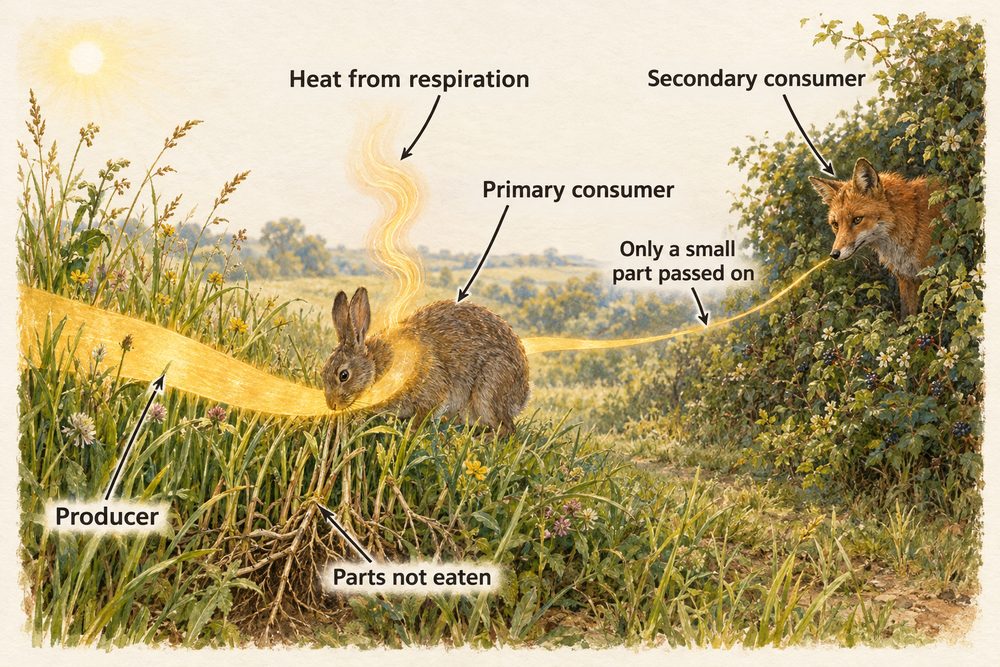
A food web shows all the interconnected food chains in a community. Because organisms typically eat several prey species and are eaten by several predators, changes in one population have complex knock-on effects. Removing a secondary consumer (a carnivore) typically causes its prey (primary consumer) population to increase rapidly, which then over-consumes the producer trophic level below. These cascading effects are sometimes called trophic cascades.
In the Yellowstone National Park in the USA, the reintroduction of wolves in the 1990s reduced elk populations and changed their grazing behaviour. This allowed riverside vegetation to recover, which stabilised riverbanks and even altered river channels — a striking example of how one species can reshape an entire ecosystem.
Energy is lost at every trophic level through respiration and heat, so biomass decreases up the food chain. Food webs are interconnected — removing or adding one species has knock-on effects throughout the whole community.
Predator–Prey Cycles and Population Change
Predator and prey populations are closely linked. When prey is plentiful, predators have more food, so their population rises. More predators mean more prey are eaten, so the prey population falls. With less food, predator numbers then decline, allowing the prey to recover — and the cycle repeats. These oscillating cycles, offset in time, are a classic pattern in ecology and can be modelled graphically with the predator curve always lagging slightly behind the prey curve.
Population size is also affected by density-dependent factors such as food supply, disease and competition, which intensify as populations grow. Populations are also affected by abiotic events like drought, fire or severe winters, which can cause sudden, large crashes in numbers regardless of population density.
Biodiversity and Why It Matters
Biodiversity refers to the variety of species within an ecosystem. High biodiversity confers resilience: if one species declines, others can often fill its ecological role, preventing the whole system from collapsing. A wheat monoculture has very low biodiversity; a native wildflower meadow has very high biodiversity and is far more resilient to pests, drought and disease.
Human activities including deforestation, habitat fragmentation, pollution and over-hunting have reduced biodiversity globally. Conservation strategies aim to reverse this: protected nature reserves maintain habitats, breeding programmes support endangered species, and rewilding projects introduce keystone species (such as beavers in parts of Scotland) that engineer new habitats and support many other species.
High biodiversity makes ecosystems more stable and resilient. Human activities reduce biodiversity; conservation programmes (reserves, breeding programmes, rewilding) aim to protect it. Biodiversity loss increases the risk of ecosystem collapse.