Respiration and Cellular Energy
Why Every Cell Needs Energy
In the final metres of a 400-metre race, a runner’s muscles begin to burn. Oxygen can no longer be delivered fast enough to sustain the pace, and a different energy pathway kicks in — one that works without oxygen but produces a painful build-up of lactic acid. This is cellular respiration at its limits. But respiration is not just for athletes: it happens continuously in every cell of every living organism, from bacteria to blue whales, twenty-four hours a day.
The energy transferred by respiration powers all life processes: muscle contraction, nerve impulse transmission, active transport across membranes, protein synthesis and cell division. This energy is stored in a molecule called ATP, which acts as the cell’s immediate energy currency. Respiration is exothermic — it releases energy to the surroundings, which is why your body stays warm even on a cold day.
Cellular respiration is NOT breathing. Respiration is an exothermic chemical reaction inside every living cell that transfers energy from glucose to ATP. Breathing (ventilation) is the physical movement of air in and out of the lungs.
Aerobic Respiration
Aerobic respiration uses oxygen and takes place in the mitochondria. It completely breaks down glucose and produces a large yield of ATP, making it the most efficient form of respiration. The word equation is:
$$\text{glucose} + \text{oxygen} \rightarrow \text{carbon dioxide} + \text{water} + \text{energy (ATP)}$$
The balanced symbol equation: \(C_6H_{12}O_6 + 6O_2 \rightarrow 6CO_2 + 6H_2O\)
Because glucose is completely broken down, aerobic respiration extracts the maximum possible ATP from each glucose molecule. This is why cells with high energy demands — such as muscle cells, liver cells and sperm cells — contain large numbers of mitochondria. The folded inner membranes of the mitochondria (cristae) increase the surface area available for respiration reactions.
Anaerobic Respiration
Anaerobic respiration occurs when oxygen supply is insufficient — for example, during intense exercise, or in waterlogged soil. Unlike aerobic respiration, it takes place in the cytoplasm and produces far less ATP because glucose is only partially broken down. The products depend on the type of organism.
In animal cells (and some bacteria), glucose is partially broken down to produce lactic acid:
\(\text{glucose} \rightarrow \text{lactic acid}\)
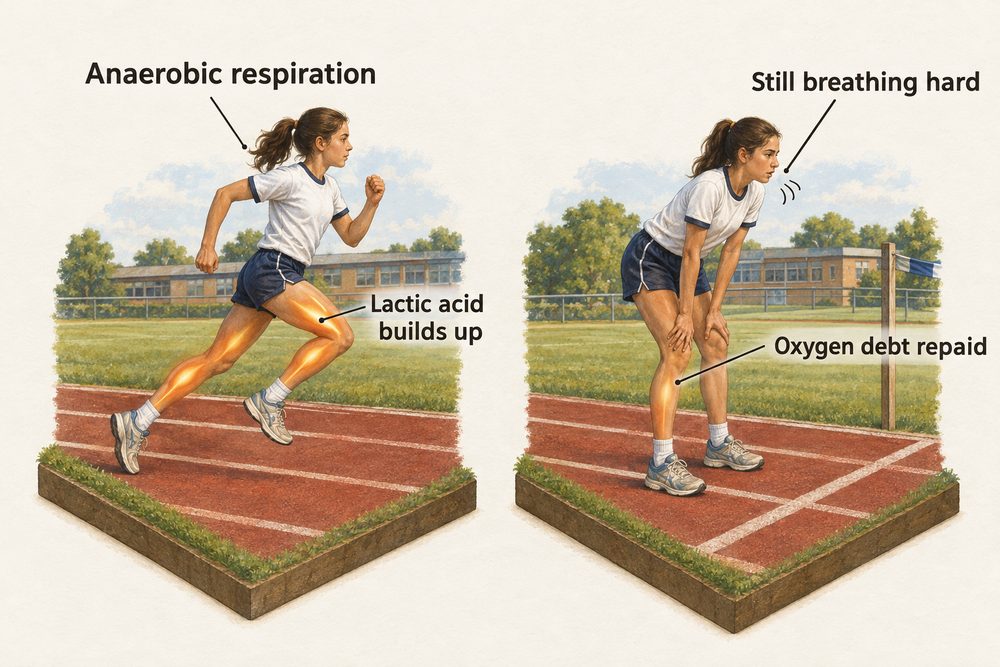
Lactic acid builds up in muscles during intense exercise, lowering pH and interfering with enzyme function — causing the burning sensation and fatigue athletes experience. After exercise stops, you continue to breathe deeply to supply the extra oxygen needed to convert accumulated lactic acid back to glucose (in the liver). This extra oxygen requirement is called the oxygen debt (or excess post-exercise oxygen consumption).
In yeast and plant cells, anaerobic respiration produces ethanol and carbon dioxide:
\(\text{glucose} \rightarrow \text{ethanol} + \text{carbon dioxide}\)
This process is called fermentation. It has important commercial applications. In brewing and wine-making, yeast ferments sugar in fruit juice or malt to produce ethanol. In bread-making, yeast ferments sugars in dough, and the CO\(_2\) produced forms bubbles that make the bread rise. The ethanol evaporates during baking.
Aerobic respiration (with oxygen, mitochondria): high ATP yield, products are CO\(_2\) + water. Anaerobic in animals (no oxygen, cytoplasm): low ATP, product is lactic acid. Anaerobic in yeast/plants: low ATP, products are ethanol + CO\(_2\).
Respiration During and After Exercise
During exercise, muscle cells need more energy so the rate of respiration increases. The body responds by increasing heart rate (to pump more oxygenated blood to muscles), increasing breathing rate and depth (to take in more O\(_2\) and remove more CO\(_2\)), and breaking down glycogen stores in muscles and the liver into glucose. If exercise is intense enough that oxygen cannot be supplied fast enough, muscles switch to anaerobic respiration, producing lactic acid. The oxygen debt is repaid after exercise as the lactic acid is converted back to glucose in the liver.
You can detect the products of respiration experimentally. Breathing out through limewater turns it milky, confirming CO\(_2\) production. Placing a temperature probe in a sealed flask with germinating seeds shows a temperature increase over time, confirming that respiration is exothermic. The rate can be measured by monitoring CO\(_2\) output using a carbon dioxide sensor or pH indicator solution.
When interpreting data from these experiments, consider: whether the change observed could have another cause (a confounding variable), whether the results are repeatable, and whether a control is needed (e.g. dead seeds in a sealed flask) to confirm that any heat or gas is coming from the biological process and not a chemical contaminant.
The oxygen debt is the extra oxygen needed after exercise to break down lactic acid built up during anaerobic respiration. It is repaid by continued heavy breathing after exercise stops. Lactic acid is converted back to glucose in the liver.