Growth, Development and Stem Cells
Growth Through Cell Division
A human being begins as a single fertilised cell no wider than a human hair. Over the following nine months, that cell divides billions of times, eventually producing the trillions of specialised cells that form a newborn baby. The key question in developmental biology is not just how cells divide, but how they become so different from one another — a liver cell, a neuron and a skin cell all contain identical DNA, yet they look and behave completely differently.
Mitosis is the form of cell division responsible for growth and repair in multicellular organisms. Before mitosis begins, during interphase, the cell’s DNA replicates so that every chromosome is copied. Then during mitosis itself, the copies are separated and two genetically identical daughter cells are produced, each with the same number of chromosomes as the parent. It is crucial to understand that DNA replication happens before mitosis starts, not during it.
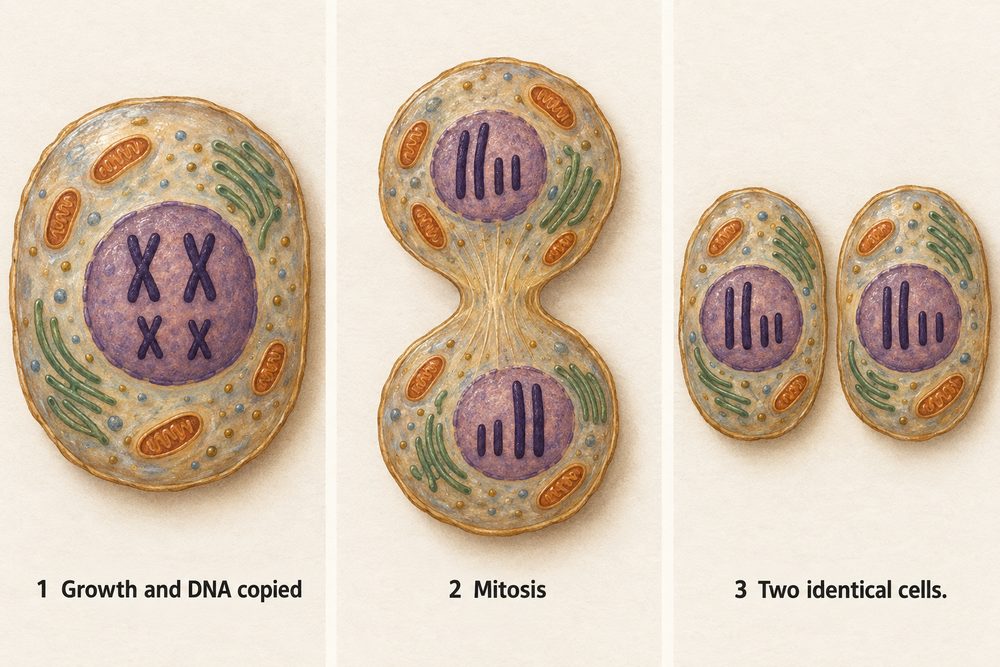
DNA replication occurs during interphase, before mitosis begins — not during mitosis itself. Mitosis then separates the copied chromosomes to produce two genetically identical daughter cells with the same chromosome number as the parent.
Cell Differentiation
Differentiation is the process by which a cell becomes specialised. Although every cell in the body contains the same DNA, different genes are switched on or off in different cell types. This means each specialised cell produces only the proteins needed for its specific function.
The design of specialised cells directly reflects their function. Red blood cells are biconcave discs with no nucleus — the biconcave shape increases the surface area for absorbing oxygen, and having no nucleus leaves more room for haemoglobin. Neurones have long axons that allow electrical impulses to travel over large distances quickly. Root hair cells have long thin extensions that dramatically increase their surface area for absorbing water and mineral ions from the soil.
Sperm cells have a streamlined head containing an acrosome (with enzymes to penetrate the egg), a midpiece packed with mitochondria to supply energy for swimming, and a long flagellum tail for motility. Every feature serves the single purpose of delivering genetic material to an egg.
Muscle cells (muscle fibres) are elongated cells that can shorten and extend. They contain large numbers of mitochondria (for ATP production during contraction) and specialised proteins (actin and myosin) that slide past each other to generate force. Cells with highly specific roles like these are the endpoint of the differentiation process.
Stem Cells: Undifferentiated and Versatile
Stem cells are cells that have not yet differentiated. They retain the ability to divide and produce cells that can become specialised. There are two main types of stem cell relevant to your course: embryonic stem cells and adult stem cells.
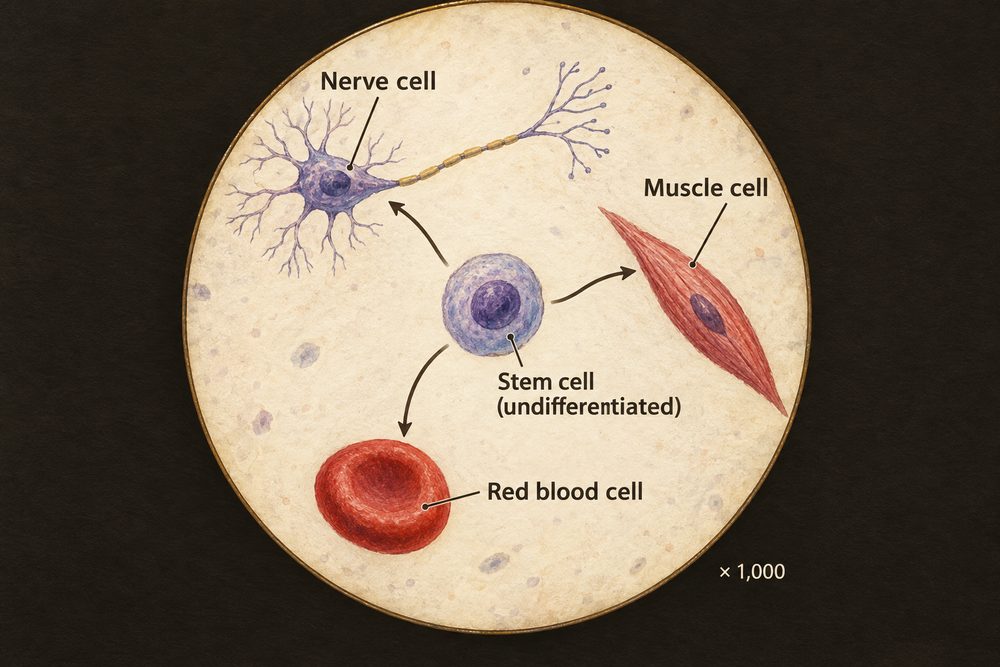
Embryonic stem cells are found in the embryo in the first few days after fertilisation. They are described as pluripotent — they can differentiate into any cell type in the body. This makes them potentially very useful for treating diseases caused by cell loss or damage, such as Parkinson’s disease, type 1 diabetes, or spinal cord injury.
Adult stem cells are found in specific tissues, such as bone marrow (which produces blood stem cells that can differentiate into all blood cell types). They are more limited than embryonic stem cells — they can only produce the range of cells relevant to their tissue. Bone marrow transplants, which replace diseased blood stem cells, are an established medical therapy using adult stem cells.
Scientists have developed a technique to take ordinary adult cells (such as skin cells) and “reprogramme” them genetically to behave like embryonic stem cells. These are called induced pluripotent stem cells (iPS cells). Because they can be made from a patient’s own cells, they would avoid the risk of immune rejection and sidestep many of the ethical concerns associated with embryonic stem cells. iPS cell research is an active and rapidly developing field.
Embryonic stem cells are pluripotent — they can become any cell type. Adult stem cells (e.g. bone marrow) can only produce cells of their own tissue type. iPS cells are reprogrammed adult cells that regain pluripotency without using embryos.
The Ethics of Stem Cell Research
Using embryonic stem cells requires destroying a human embryo at an early stage of development (3–5 days old). This raises serious ethical questions. People who hold that human life begins at fertilisation argue that destroying any embryo is morally wrong, regardless of the medical benefits. Others argue that the potential to alleviate suffering for millions of people outweighs concerns about a cluster of cells at such an early stage, which has no consciousness or capacity for pain.
This is a genuine values-based disagreement, not a scientific one. The science can establish what embryonic stem cells are capable of and what risks they carry. But the question of whether they should be used involves moral, religious and philosophical judgements that science alone cannot resolve. Being able to separate these two types of question is itself an important scientific skill — the distinction between an evidence-based claim and a values-based claim.
Even setting ethics aside, stem cell therapy faces practical challenges. Transplanted cells may be rejected by the patient’s immune system, requiring immunosuppressant drugs that leave the patient vulnerable to infection. There is also a risk that undifferentiated stem cells could divide uncontrollably after transplantation, forming tumours. Researchers must demonstrate that transplanted cells differentiate correctly and integrate safely into the host tissue before therapies can be considered safe enough for widespread clinical use.
The risk–benefit framework applied here mirrors wider scientific decision-making: weighing evidence-based risks (immune rejection, tumour formation) against potential benefits (restored function for people with otherwise untreatable conditions) under conditions of uncertainty. This is a classic IaS4 scenario — science provides the risk data, but the decision about acceptable risk involves values as well as evidence.
The ethics of embryonic stem cell use involves values about when human life begins — a question science cannot answer. Practical risks include immune rejection and uncontrolled cell division (tumour risk). iPS cells and adult stem cells partially address both concerns.