Transport, Circulation and Exchange Surfaces
Why Size Changes Everything
A single-celled organism like an amoeba gets all the oxygen it needs simply by diffusion across its cell surface. No circulatory system required. But a blue whale — the largest animal ever to have lived — needs a massive heart, kilometres of blood vessels, enormous lungs and elaborate exchange surfaces in its intestines. The fundamental reason is mathematics: as organisms grow, their surface area to volume ratio (SA:V) decreases. The volume (and therefore the number of cells needing supplies) grows faster than the surface area available for exchange.
Consider cubes: a 1 cm cube has a surface area of 6 cm2 and a volume of 1 cm3 — SA:V ratio of 6:1. A 2 cm cube has a surface area of 24 cm2 and volume of 8 cm3 — SA:V ratio of only 3:1. A 3 cm cube has SA:V of 2:1. As the cube grows, its surface area–to–volume ratio keeps falling. For a large, complex organism, simple diffusion across the body surface cannot supply oxygen and nutrients fast enough to reach every cell.
As organisms get larger, their surface area to volume ratio decreases. This means the surface area available for gas exchange and nutrient uptake is insufficient to supply all the cells by diffusion alone. Large organisms therefore need specialised exchange surfaces and transport systems.
Moving Substances Across Cell Membranes
Cells exchange substances with their surroundings by three mechanisms. Diffusion is the passive net movement of particles down a concentration gradient — from high to low concentration. No energy is needed. Oxygen diffuses into cells for respiration; carbon dioxide and urea diffuse out.
Osmosis is a special case of diffusion involving only water molecules moving through a partially permeable membrane. Water moves from a region of high water concentration (dilute solution) to a region of low water concentration (concentrated solution). This is important in, for example, kidney function and plant cell water regulation.
Active transport moves substances against the concentration gradient — from low to high concentration. This requires energy in the form of ATP from respiration. Root hair cells use active transport to absorb nitrate ions from the soil even when their internal concentration already exceeds that in the soil. Intestinal epithelial cells also use active transport to absorb glucose from the gut lumen into the blood.
The rate of diffusion is increased by: a steeper concentration gradient (greater difference in concentration between the two sides); a larger surface area (more molecules can cross at once); a shorter diffusion distance (thinner membrane means less distance to travel); and a higher temperature (molecules have more kinetic energy and collide more frequently).
These four factors explain the design of every specialised exchange surface in the body: alveoli have a huge surface area, very thin walls and are richly supplied with blood capillaries that maintain a steep gradient. Villi in the small intestine have a large surface area (with microvilli), a thin epithelium and a dense capillary network. Both surfaces are optimised to maximise diffusion rate.
Diffusion and osmosis are passive (no energy). Active transport requires ATP and moves substances against the concentration gradient. All three are essential for supplying cells — the correct mechanism depends on whether the substance moves with or against its gradient.
Specialised Exchange Surfaces
Because large organisms cannot rely on diffusion alone, evolution has produced highly specialised exchange surfaces shared by several structures in the body. All share the same design principles: large surface area, thin walls and a good supply of blood capillaries that maintain steep concentration gradients.
Alveoli are tiny air sacs clustered at the ends of the smallest airways (bronchioles). Each alveolus is surrounded by a dense network of capillaries. Oxygen diffuses from the air in the alveolus, across the single-cell-thick alveolar wall and capillary wall, into the blood. Carbon dioxide diffuses in the opposite direction. The human lungs contain several hundred million alveoli, giving a combined surface area estimated at around 70 m2 in an average adult — roughly the floor area of a studio flat.
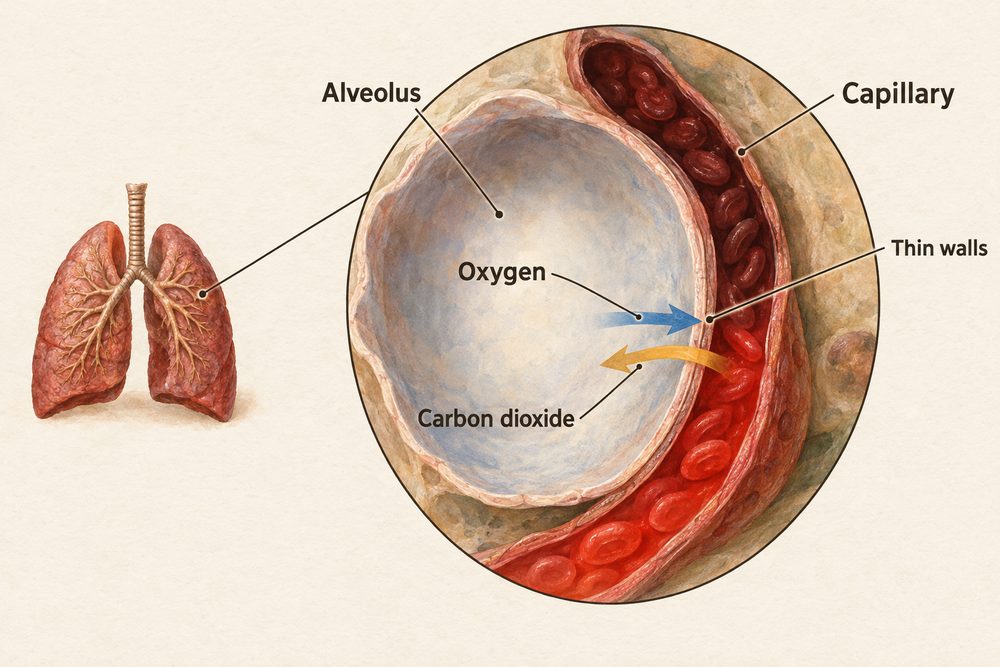
In lung diseases such as emphysema (caused primarily by smoking), alveolar walls break down, reducing the total surface area available for gas exchange. This means less oxygen enters the blood, leaving patients breathless even at rest. This clinical context illustrates why the design features of alveoli — surface area, thin wall, blood supply — are so important: any reduction in these factors directly reduces the efficiency of gas exchange.
Villi are finger-like projections that line the small intestine, increasing its surface area enormously. Each villus has a thin epithelium (one cell thick), a dense network of blood capillaries for absorbing glucose and amino acids into the blood, and a lacteal (lymph vessel) for absorbing fatty acids and glycerol. The epithelial cells themselves also have microvilli (tiny projections on their surface) that further multiply the surface area — this folded structure within a folded structure is a striking example of biological design maximising exchange.
The Circulatory System: Delivering and Collecting
Even with efficient exchange surfaces, substances still need to be transported throughout the body. In humans, this is achieved by the double circulatory system: one circuit carries deoxygenated blood from the heart to the lungs for gas exchange (the pulmonary circuit); a second carries oxygenated blood from the heart to all body tissues (the systemic circuit). Having two circuits maintains high blood pressure for efficient delivery.
Arteries carry blood away from the heart at high pressure and have thick, elastic, muscular walls to withstand this. Veins carry blood back to the heart at lower pressure, with thinner walls and valves to prevent backflow. Capillaries are the key exchange vessels: walls just one cell thick allow substances to diffuse efficiently between blood and surrounding tissues.
Capillaries, alveoli and villi all share the same design principle: thin walls (one cell thick), large total surface area and a good blood supply to maintain steep concentration gradients. These features maximise the rate of substance exchange.