Nervous System and Hormonal Coordination
The Nervous System
Your body constantly receives information from the world around you — light, temperature, sound, pain. The nervous system processes this information and produces fast, coordinated responses. It has two main divisions: the central nervous system (CNS) — the brain and spinal cord — and the peripheral nervous system, the network of nerves connecting the CNS to every part of the body.
The pathway of a nervous response follows a fixed sequence: a stimulus is detected by a sensory receptor, which sends a signal along a sensory neurone to the CNS. A relay neurone within the CNS passes the signal to a motor neurone, which carries it to an effector — a muscle that contracts or a gland that secretes. The result is a coordinated response.
The nervous pathway: stimulus → sensory receptor → sensory neurone → relay neurone (CNS) → motor neurone → effector → response. The CNS processes information and coordinates the appropriate reaction.
Neurones and Synapses
There are three types of neurone. Sensory neurones carry signals from receptors to the CNS; relay neurones connect sensory and motor neurones within the CNS; motor neurones carry signals from the CNS to effectors. All neurones have a cell body, dendrites (short branches that receive signals), and a long axon that transmits the electrical impulse. Many axons are wrapped in a myelin sheath, which speeds up signal transmission.
Where two neurones meet there is a tiny gap called a synapse. An electrical impulse cannot cross this gap directly. Instead, when the impulse reaches the end of the first neurone, chemical neurotransmitters are released from vesicles into the synaptic cleft. They diffuse across and bind to specific receptor molecules on the next neurone, triggering a new electrical impulse. Synapses ensure signals travel in one direction only and allow complex coordination across many pathways.
A reflex arc is a shorter version of the nervous pathway that produces automatic, protective responses. The signal travels through the spinal cord rather than all the way to the brain, which makes the response much faster. The pathway is: receptor → sensory neurone → relay neurone (in spinal cord) → motor neurone → effector.
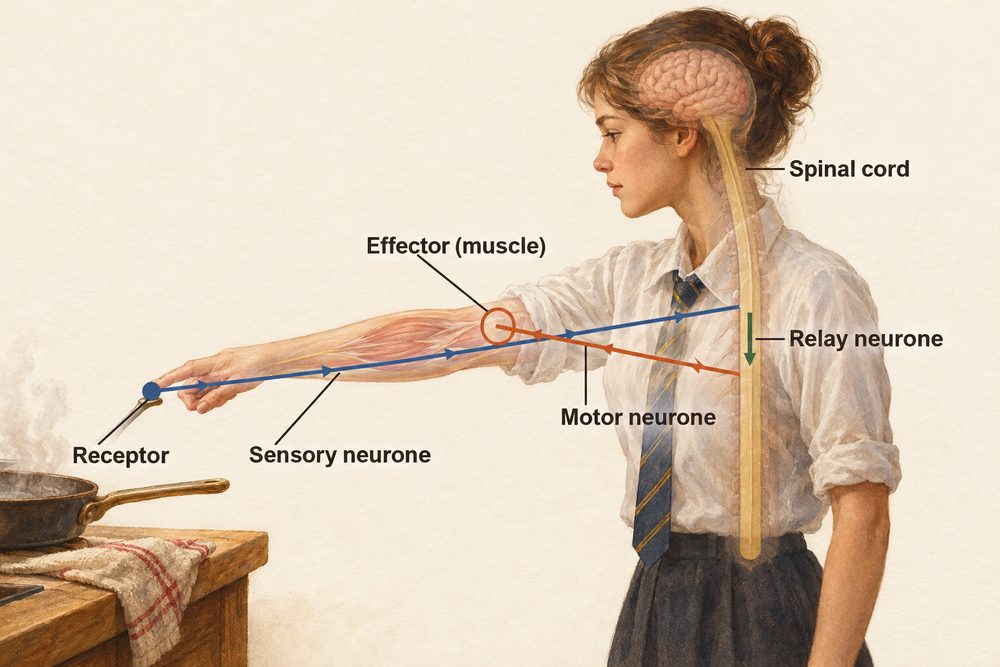
Consider touching a sharp object. Pain receptors in the skin detect the stimulus and send a signal along a sensory neurone to the spinal cord. A relay neurone immediately connects to a motor neurone, which stimulates the arm muscle to contract and pull the hand away — all before the brain has consciously registered pain. The brain receives the information afterwards, which is why you feel the sensation a fraction of a second after the withdrawal.
Reflexes are important because they have fewer synapses to cross and a shorter pathway, making them significantly faster than voluntary responses. Other reflexes include the pupil reflex (the pupil constricts in bright light to protect the retina) and the knee-jerk reflex.
Reflex arcs bypass the brain — the signal goes through the spinal cord only. This reduces the distance the signal must travel and the number of synapses to cross, making the response faster and protecting the body from harm before conscious awareness.
The Endocrine System
The endocrine system uses chemical messengers called hormones to coordinate and control body functions. Unlike the nervous system, which produces fast, short-lived, localised responses, the endocrine system produces slower, longer-lasting and more widespread responses. Hormones travel in the blood to target organs; only cells with the correct receptor proteins will respond.
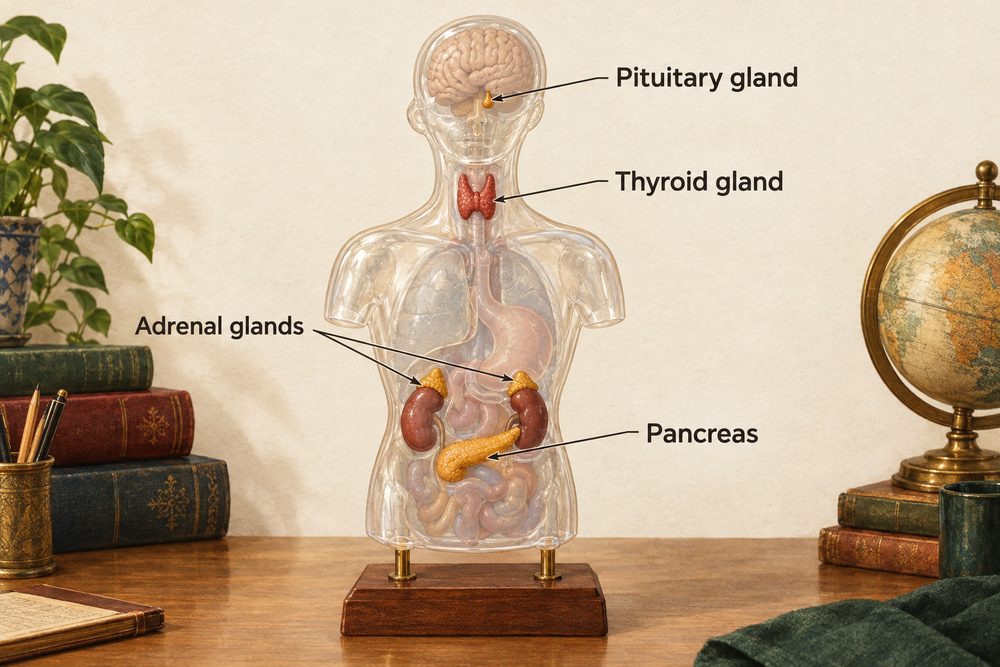
Key endocrine glands include the pituitary gland (the “master gland” that controls other glands), the thyroid gland (controls metabolic rate), the adrenal glands (produce adrenaline), and the pancreas (produces insulin and glucagon to control blood glucose). The ovaries and testes produce the sex hormones that control reproduction and secondary sexual characteristics.
Both systems coordinate the body, but they work in fundamentally different ways. The nervous system uses electrical impulses along neurones — responses are fast (fractions of a second), short-lived and precise (a specific muscle contracts). The endocrine system uses hormones in the blood — responses are slower (seconds to hours), longer-lasting and widespread (affecting many tissues at once).
A useful way to remember this: nervous = fast, precise, short (like a phone call); endocrine = slow, widespread, sustained (like a broadcast message). Many physiological processes are coordinated by both systems working together — for example, the “fight or flight” response involves both nerve impulses and the release of adrenaline from the adrenal glands.
The ruler drop test is a classic investigation of reaction time. One person holds a ruler vertically while their partner places thumb and finger at the 0 cm mark. When the ruler is released without warning, the partner catches it as quickly as possible. A shorter distance fallen means a faster reaction time.
To design a reliable investigation, you must consider: what variable you are testing (e.g. does caffeine improve reaction time?), what you will keep constant (same ruler, same person catching, same hand position), how to reduce random error (repeat at least five times and calculate a mean, discard anomalous results). When writing a hypothesis, you should provide a scientific justification — for example, “caffeine is predicted to decrease reaction time because it is a stimulant that increases neurotransmitter activity at synapses.” A prediction states the expected outcome for a specific measurement, while a hypothesis explains why you expect it. These are not the same thing.