Homeostasis: Glucose, Water and Temperature
What is Homeostasis?
Homeostasis is how your body keeps its internal conditions within narrow, safe limits. Enzymes and metabolic reactions function best at specific temperatures, pH levels and ion concentrations — drift too far from these ideal conditions and cells stop working efficiently, or stop working altogether. Every homeostatic system has three components working together: receptors detect a change; a coordination centre (such as the brain or pancreas) processes the information; effectors (muscles or glands) produce the corrective response.
All these systems use the same underlying control mechanism: negative feedback. When a condition rises above its set point, the body acts to bring it down. When it falls below, the body acts to bring it up. Once the set point is restored, the response switches off. This self-correcting loop keeps internal conditions stable despite constant change.
Homeostasis uses negative feedback: receptor detects change → coordination centre processes signal → effector produces corrective response → condition returns to normal → response switches off. This applies to blood glucose, water balance and temperature.
Controlling Blood Glucose
Blood glucose concentration rises after eating a carbohydrate-rich meal and falls during exercise or between meals. The pancreas acts as both the receptor and coordination centre. When blood glucose rises, the pancreas secretes insulin. Insulin causes body cells — especially muscle and liver cells — to take up glucose from the blood. The liver converts the excess into glycogen for storage. These actions bring blood glucose back down to its normal range.
When blood glucose falls, the pancreas secretes glucagon. Glucagon signals the liver to break stored glycogen back into glucose and release it into the blood. Insulin and glucagon work in opposite directions — this opposing action is how negative feedback achieves precise control.
In a glucose tolerance test, a person drinks a standard glucose solution. Their blood glucose level is measured at regular intervals for two hours. A typical result for a person without diabetes: blood glucose rises steeply in the first 30–60 minutes as the glucose is absorbed, then returns to near-normal within two hours as insulin triggers glucose uptake.
For someone with Type 1 diabetes, the trace looks different: blood glucose rises to a much higher level and stays elevated, because the pancreas produces little or no insulin. For Type 2 diabetes, blood glucose also stays elevated but may rise more slowly because some insulin is still produced. Identifying these differences from a graph is a common examination task. When describing a correlation in data like this, remember that correlation does not prove causation — the elevated blood glucose is caused by insulin deficiency, not simply “caused by” the glucose drink itself.
Type 1 diabetes is an autoimmune condition in which the immune system destroys the insulin-producing beta cells in the pancreas. Without insulin, blood glucose cannot be lowered after eating, so it rises to dangerously high levels. Treatment requires regular insulin injections or an insulin pump, alongside careful monitoring of blood glucose and carbohydrate intake. Type 1 usually develops in childhood or early adulthood and cannot be prevented.
Type 2 diabetes occurs when body cells become resistant to insulin — they do not respond properly even when insulin is present. The pancreas may produce some insulin but its effect is reduced. Blood glucose stays elevated because cells do not absorb it efficiently. Type 2 is strongly linked to obesity and a sedentary lifestyle, and is becoming more common worldwide. Treatment focuses on dietary changes (reducing sugar intake), regular exercise and, when needed, medication. In some cases insulin injections may eventually be required.
Type 1 diabetes: pancreas does not produce insulin (autoimmune) — treated with insulin injections. Type 2 diabetes: body cells become resistant to insulin (often linked to obesity) — treated with diet, exercise and medication. Mixing these up is one of the most common errors in biology exams.
Water Balance and the Kidneys
The kidneys filter the blood and control the concentration of water, ions and urea in the body — a process called osmoregulation. Excess water, ions and the waste product urea are removed as urine. The hormone ADH (anti-diuretic hormone), produced by the pituitary gland, controls how much water the kidneys reabsorb. When you are dehydrated, more ADH is released, the kidneys reabsorb more water, and urine becomes concentrated. When you are well hydrated, less ADH is released, and urine is more dilute.
Temperature Regulation
Human body temperature is maintained at approximately 37°C by the thermoregulatory centre in the brain. It receives signals from temperature receptors in the skin (monitoring external temperature) and in the blood (monitoring core temperature). When body temperature rises too high, cooling responses are triggered: vasodilation increases blood flow to the skin surface so heat is lost by radiation; sweat glands produce sweat that evaporates from the skin, transferring heat energy away from the body.
When body temperature falls too low, warming responses are triggered: vasoconstriction reduces blood flow to the skin, conserving heat; muscles shiver (rapid involuntary contractions that generate heat from respiration); body hairs stand up, trapping an insulating layer of air close to the skin.
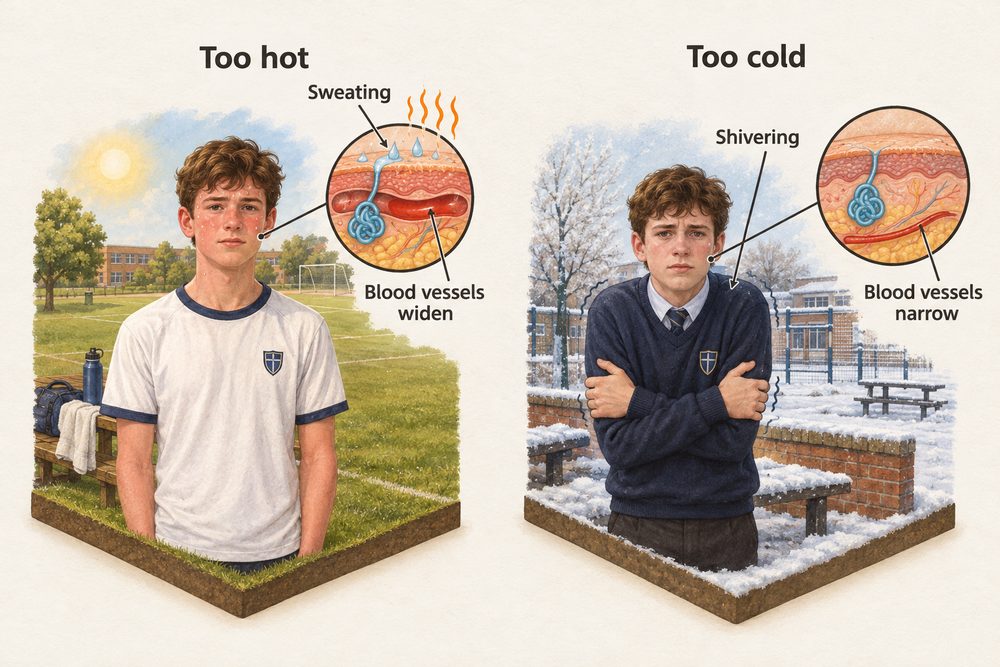
If thermoregulation fails, the consequences can be life-threatening. Hypothermia occurs when core body temperature drops well below 37°C — cellular enzymes begin to function too slowly, reflexes slow, and in severe cases organs can fail. Heat stroke occurs when the body overheats beyond its cooling capacity — sweating may cease, enzymes begin to denature, and organ damage can result. Both conditions illustrate why maintaining a stable internal temperature is so critical for enzyme function and metabolism.