Reproduction, Hormones and Failing Organs
The Menstrual Cycle
The menstrual cycle prepares the female body for potential pregnancy each month. It is controlled by four interacting hormones that form a complex feedback system. Understanding the timing and role of each hormone is essential for explaining contraception and fertility treatment.
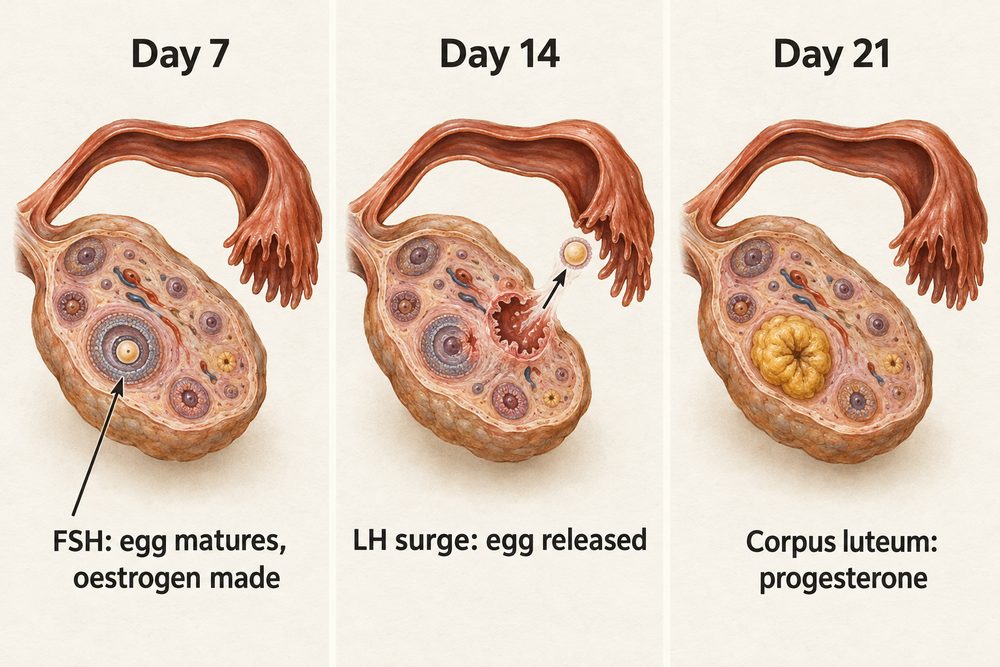
The four hormones and their roles: FSH (follicle-stimulating hormone) is produced by the pituitary gland and stimulates the maturation of an egg inside a follicle in the ovary. As the follicle matures, it produces oestrogen. Oestrogen has three effects: it causes the uterus lining to thicken and repair after menstruation, it inhibits further FSH production (negative feedback), and it stimulates a surge of LH. The LH surge (around day 14 of the cycle) triggers ovulation — the release of the mature egg from the ovary. After ovulation, the empty follicle (now called the corpus luteum) produces progesterone, which maintains the thickened uterus lining ready for implantation. If fertilisation does not occur, progesterone levels drop, the lining breaks down, and menstruation begins, restarting the cycle.
Hormones control the menstrual cycle and trigger ovulation each month. Higher tier only: FSH stimulates egg maturation → oestrogen thickens the uterus lining and triggers the LH surge → LH causes ovulation → progesterone maintains the lining. If no pregnancy, progesterone drops → menstruation begins.
Hormonal methods of contraception include the combined pill (containing synthetic oestrogen and progesterone), the progesterone-only mini-pill, implants and injections. These work by maintaining artificially high levels of these hormones, which inhibit FSH production from the pituitary gland. Without FSH, no egg matures, so ovulation does not occur. Hormonal methods are highly effective but can have side effects including headaches and, rarely, increased risk of blood clots.
Non-hormonal methods include condoms (a barrier method that prevents sperm reaching the egg and also protects against sexually transmitted infections), diaphragms (placed over the cervix), copper IUDs (create an environment hostile to sperm), and surgical sterilisation (permanent). When evaluating contraceptive methods, consider effectiveness, reversibility, protection against infections, side effects and convenience — the right choice depends on individual circumstances.
Some people have difficulty conceiving naturally. Fertility treatments use hormones to assist. FSH injections can stimulate ovulation in women whose pituitary gland does not produce sufficient FSH naturally — this is called ovulation induction.
In vitro fertilisation (IVF) is a more complex treatment. FSH is used to stimulate the ovaries to produce several eggs at once. These are collected surgically and fertilised with sperm in a laboratory dish. The embryos are allowed to develop for a few days before one or two are transferred into the uterus. IVF raises important questions about balancing benefits (allowing parenthood for those who cannot conceive naturally) against risks (physical and emotional demands on the patient, the fate of unused embryos) and costs. This kind of risk–benefit reasoning under uncertainty is at the heart of how science informs medical decisions.
When Organs and Control Systems Fail
When key organs fail, medical technology can take over their function — but there are always trade-offs between different treatments. The kidney is a good example. Healthy kidneys filter the blood and remove waste products (especially urea), maintain ion balance and regulate water content. When kidneys fail, waste products accumulate to life-threatening levels.
Two main approaches exist for treating kidney failure. Dialysis uses a machine to filter the blood artificially. Blood flows from the patient through a membrane into a dialysate solution; waste products (urea, excess ions) move across the membrane by diffusion into the solution, while needed substances remain in the blood. Dialysis must be done regularly — typically several sessions a week, each lasting several hours. This places a significant burden on the patient’s time and quality of life, but it does not require surgery and can be maintained long-term.
Kidney transplant involves receiving a healthy kidney from a donor (either a living donor or a recently deceased donor). A successful transplant restores full kidney function and frees the patient from dialysis. However, the patient must take immunosuppressant drugs for life to prevent the immune system from rejecting the donated organ. These drugs increase the risk of infections and other complications. Donors and recipients must be carefully matched to reduce rejection risk, and there are far fewer kidneys available than patients who need them.
Dialysis filters blood artificially — regular sessions required, no surgery, sustainable long-term. Kidney transplant restores full function but requires lifelong immunosuppressants and depends on donor availability. The decision between them involves weighing clinical, personal and logistical factors.
The kidney is not the only organ that can fail. Heart failure can be managed with medication, mechanical assist devices, or — in severe cases — a heart transplant. Liver failure may require a liver transplant (the liver can partially regenerate, so living donors can donate a segment). Pancreatic beta cell failure (Type 1 diabetes) is managed with insulin replacement rather than organ transplant, though research into islet cell transplantation is ongoing. In every case, the principles are the same: understand what function has been lost, weigh the available interventions, and consider both the benefits and the risks for the individual patient.