Evolution, Classification and Biodiversity
How Was the Theory of Evolution Developed? (IaS3)
Scientific theories do not appear fully formed — they are built gradually from observations, hypotheses and accumulating evidence. The theory of evolution by natural selection is a powerful example of this process. Charles Darwin (1809–1882) developed his ideas during a five-year voyage around the world, recording variation in animals and plants across different environments. His observations of finch beak shapes on the Galápagos Islands — each suited to a different food source — helped him form the idea that species change in response to their environment over many generations.
Alfred Russel Wallace (1823–1913) reached similar conclusions independently during fieldwork in South America and Southeast Asia. He and Darwin jointly presented their ideas to the Linnean Society in 1858. Their combined evidence — from different continents and different organisms — strengthened the case that natural selection was a real and general process, not just an observation specific to one place. This is an important example of how scientific explanations develop: independent evidence from multiple sources makes a theory more robust.
Natural selection works in four steps: (1) variation exists within a population; (2) individuals compete for limited resources; (3) those with the most advantageous characteristics are more likely to survive and reproduce; (4) advantageous alleles are inherited by the next generation. Over many generations, this changes the characteristics of the population.
Evidence for Evolution
Multiple independent lines of evidence support the theory of evolution. The fossil record shows gradual changes in the structure of organisms over geological time — transitional fossils show intermediate forms between ancestral and modern species. Comparative anatomy reveals similar bone structures across very different animals (such as the human arm, bat wing and whale flipper), suggesting they share common ancestors. DNA analysis shows that closely related species share more DNA sequences than distantly related ones — a finding that was entirely unknown to Darwin and Wallace, yet confirms their theory from a completely independent direction.
The peppered moth provides a well-documented example of natural selection observed over a short timescale. Before industrialisation, pale-coloured moths were camouflaged against lichen-covered trees and survived in greater numbers; dark (melanic) moths were more visible to predators and were rarer. When industrial pollution killed the lichens and darkened tree bark with soot, dark moths gained a survival advantage and became more common. After the introduction of pollution controls, pale moths became dominant again. This demonstrates that the direction of natural selection depends on the environment — and can reverse when conditions change.
Speciation occurs when a population becomes geographically or reproductively isolated. Once isolated, each group is exposed to different environmental pressures and accumulates different mutations through random genetic change. Over many generations, the two groups diverge until they are so genetically different that they can no longer interbreed to produce fertile offspring — at this point they are considered separate species. Extinction occurs when a species cannot adapt quickly enough; the fossil record documents this throughout Earth's history.
It is important to remember that individuals do not evolve — populations evolve over many generations as the frequency of advantageous alleles increases. Evolution has no direction or goal; it simply reflects which traits happen to be best suited to the current environment.
Classification and Phylogenetic Trees
Classification is the process of grouping organisms based on their evolutionary relationships. The traditional Linnaean hierarchy (kingdom, phylum, class, order, family, genus, species) has been refined with modern DNA evidence. Phylogenetic trees show how species are related by shared ancestry — the more recently two species share a common ancestor, the more similar their DNA.
Modern classification uses evolutionary (phylogenetic) classification rather than grouping organisms solely by appearance. Two organisms can look similar because they share a recent common ancestor (homology) or because they evolved similar features independently in response to similar environments (convergent evolution). DNA evidence helps distinguish between these possibilities.
Darwin’s original theory was based on observed variation and the fossil record. Wallace’s independent observations from a different continent added further support. Since then, genetics, molecular biology and direct observation of evolution in bacteria and insects have added independent lines of evidence. When a theory is supported by multiple, independent strands of evidence from different disciplines, it becomes extremely well established. This is why evolution is one of the most strongly supported theories in all of science, despite being controversial when first proposed.
A key skill in science is recognising the difference between data (what is measured) and explanation (why it happens). The fossil record is data; natural selection is the explanation for why it shows the patterns it does. Both are needed for a complete scientific account.
Biodiversity and Its Threats
Biodiversity — the variety of species and genetic diversity within species — is essential for healthy ecosystems. Greater biodiversity makes ecosystems more stable and resilient to change; loss of species can cause cascading effects through food webs. Human activities are the primary cause of the current rapid decline in biodiversity worldwide: habitat destruction (especially deforestation), pollution, overexploitation of species, introduction of invasive species, and climate change all reduce biodiversity at rates far exceeding natural background extinction levels.
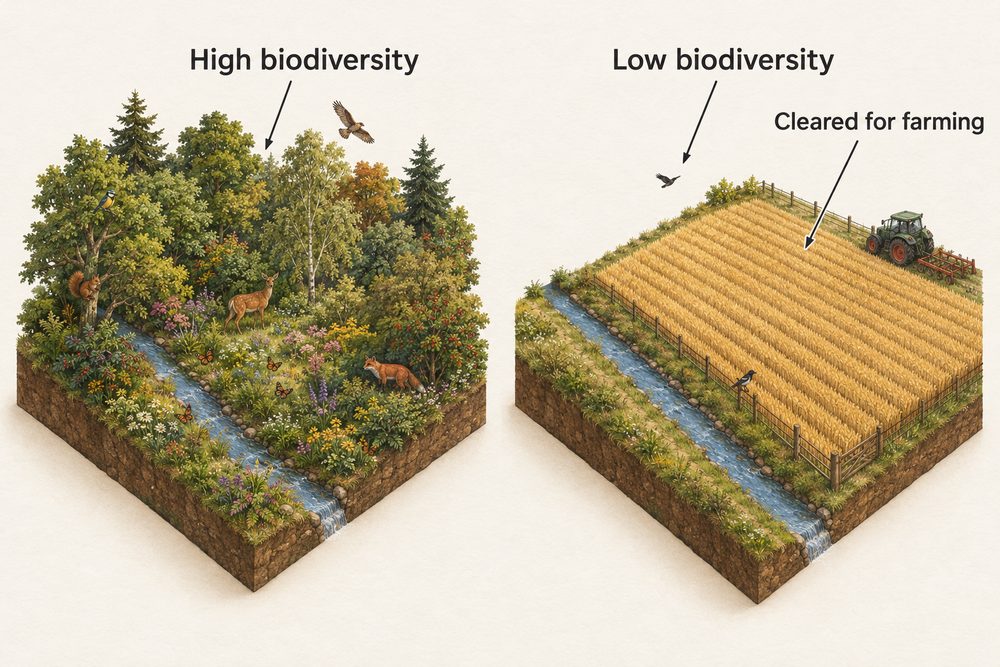
Biodiversity is threatened by habitat destruction, pollution, overexploitation, invasive species and climate change. These all reduce biodiversity at rates much faster than natural processes, destabilising ecosystems and reducing their resilience.
Conservation strategies aim to protect biodiversity and allow natural ecosystems to recover. Protected areas (national parks, nature reserves) limit damaging human activity in key habitats. Captive breeding programmes maintain viable populations of endangered species in zoos, with the aim of eventual reintroduction to the wild. Seed banks preserve the genetic diversity of plant species as insurance against extinction. Fishing quotas and logging regulations prevent over-exploitation of natural resources. Reforestation projects restore destroyed habitats and increase carbon absorption.
Effective conservation requires long-term scientific monitoring to assess whether biodiversity is recovering, and international cooperation since many threatened species and habitats cross national borders. Scientific data from monitoring programmes informs policy decisions — but these decisions also involve economic trade-offs and values, not just science.