Cell Chemistry and Enzymes
DNA — The Code of Life
Inside every cell is DNA, the molecule that carries the genetic instructions for building and running an organism. For OCR Gateway B1.2, you need to understand DNA’s structure and how it leads to protein production.
DNA is a polymer — a long molecule made of many repeating sub-units called nucleotides. It consists of two strands twisted around each other to form a double helix. The strands are held together by pairs of complementary bases. There are four bases in DNA, and they always pair in the same way: adenine (A) with thymine (T), and cytosine (C) with guanine (G). This is known as complementary base pairing.
The sequence of bases along the DNA acts as a code. Each group of three bases codes for a particular amino acid. This triplet code determines the order in which amino acids are assembled during protein synthesis at the ribosomes. Different sequences of amino acids produce different proteins, each with a unique shape and function.
DNA is a polymer made of two strands forming a double helix. The sequence of bases along the DNA provides a code that determines the order of amino acids assembled into proteins at the ribosomes.
From DNA to Protein
The journey from gene to protein involves two key stages. First, in the nucleus, the relevant section of DNA is used as a template to produce a molecule of mRNA (messenger RNA). This mRNA carries the copied code out of the nucleus and into the cytoplasm. Second, at the ribosomes, the code on the mRNA is read and used to assemble amino acids in the correct order. The resulting chain of amino acids folds into a specific 3D shape, forming a functional protein.
Proteins are essential for life. They include enzymes (biological catalysts), structural proteins (such as collagen and keratin), hormones (such as insulin), and antibodies (part of the immune system). Because the DNA base sequence determines which proteins are made, DNA ultimately controls the cell’s characteristics and functions.
Enzymes — Biological Catalysts
Enzymes are proteins that act as biological catalysts, speeding up the chemical reactions that occur inside cells without being used up themselves. They play a central role in metabolism — the sum of all chemical reactions in a cell. Without enzymes, metabolic reactions would be too slow to sustain life.
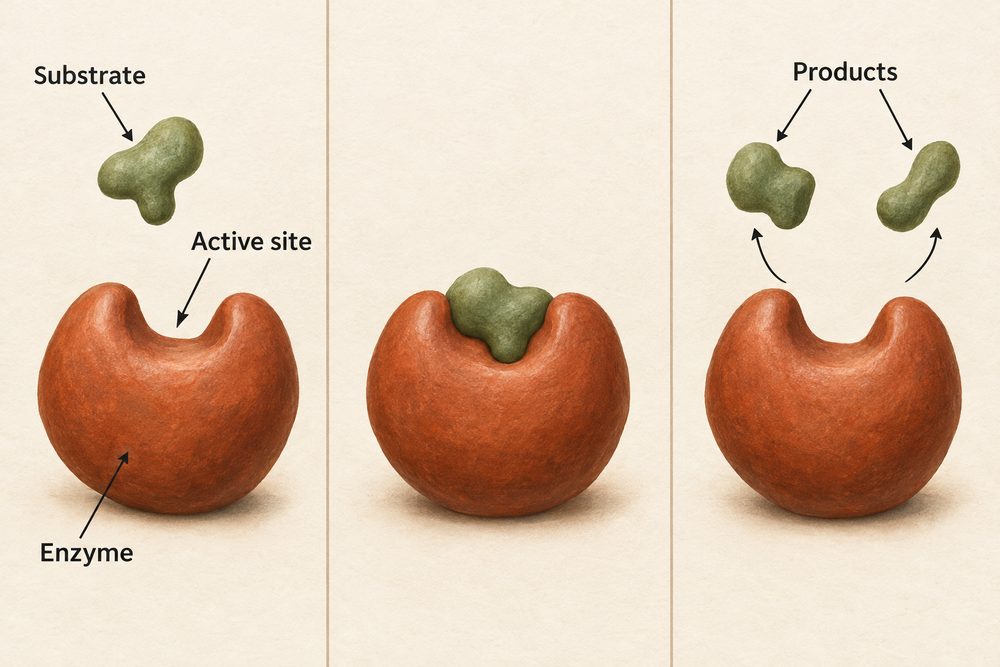
Each enzyme has a uniquely shaped region called the active site. Only a substrate with the correct complementary shape can fit into the active site, like a key fitting into a lock. This is the lock and key hypothesis. When the substrate binds, the enzyme-substrate complex forms, the enzyme catalyses the reaction, and the products are released. The enzyme is then free to accept another substrate molecule.
Temperature — as temperature increases, molecules move faster and collide more frequently with the enzyme, increasing the rate of reaction. However, above the optimum temperature, the enzyme begins to denature — the bonds holding the active site in shape break, the active site changes shape, and the substrate can no longer fit. The reaction rate drops sharply. It is important to note that different enzymes have different optimum temperatures — not all enzymes work best at 37°C.
pH — each enzyme has an optimum pH at which it works fastest. For most human enzymes this is around pH 7 (neutral), but pepsin in the stomach works best at pH 2 (acidic). Moving away from the optimum causes the active site to change shape, reducing activity. Extreme pH values cause permanent denaturation.
Substrate concentration — increasing substrate concentration increases the rate because more substrate molecules collide with enzyme active sites per unit time. Eventually, all active sites are occupied simultaneously (the enzyme is saturated) and the rate plateaus — adding more substrate has no further effect.
Enzyme concentration — more enzyme molecules mean more active sites available, so the rate increases (assuming there is excess substrate to bind to them).
Enzymes have a specific active site that fits only one substrate (lock and key). Above the optimum temperature or at extreme pH, the active site changes shape permanently — the enzyme is denatured and can no longer catalyse the reaction.
A common practical involves testing the effect of amylase on starch (B1.2c). Amylase is a digestive enzyme that breaks down starch into simpler sugars (maltose). You can monitor this reaction by taking samples at regular intervals and testing with iodine solution — the iodine turns blue-black when starch is present, but stays brown-orange once the starch has been fully digested.
To investigate the effect of temperature, set up water baths at different temperatures (e.g. 20, 30, 40, 50, 60°C). Place test tubes containing amylase and starch in each water bath, allow them to equilibrate, then mix and start timing. Sample at regular intervals and test with iodine. Record the time taken for starch to be fully digested at each temperature.
To calculate the rate of reaction: \(\text{rate} = \frac{1}{\text{time}}\). A shorter time means a faster rate. Plot rate against temperature to find the optimum. Control variables include the volume and concentration of amylase and starch, and the pH of the buffer solution.
Understanding enzyme-controlled reactions is fundamental to biology. Enzymes control digestion (amylase, protease, lipase break down food), respiration (enzymes in mitochondria transfer energy from glucose), photosynthesis (enzymes in chloroplasts fix carbon dioxide) and protein synthesis (enzymes help assemble amino acids).
In industry, enzymes are used in biological washing powders (proteases and lipases break down stains at lower temperatures, saving energy), food production (e.g. isomerase converts glucose to fructose for slimming foods), and brewing (yeast enzymes ferment sugars into ethanol). Their specificity and efficiency make them invaluable tools.