Respiration
What is Cellular Respiration?
Cellular respiration is a chemical process that occurs continuously in every living cell — animals, plants, fungi and bacteria all respire. It is not the same as breathing (ventilation) — respiration is a chemical reaction inside cells that transfers energy from glucose to a molecule called ATP. This energy drives all life processes, from muscle contraction and nerve impulse transmission to protein synthesis and active transport (B1.3a).
Respiration is an exothermic reaction — it transfers energy to the surroundings, which is why your body feels warm (B1.3b). This transferred energy is vital: without it, cells could not carry out any of their functions.
Cellular respiration is a universal, exothermic chemical process that occurs continuously in all living cells. It transfers energy from glucose to ATP. It is NOT breathing.
Aerobic Respiration
Aerobic respiration uses oxygen and occurs in the mitochondria. It produces a large yield of ATP, making it the most efficient form of respiration. This is why organisms with high energy demands (like mammals) rely primarily on aerobic respiration.
The word equation is:
$$\text{glucose} + \text{oxygen} \rightarrow \text{carbon dioxide} + \text{water} + \text{energy (ATP)}$$
The balanced symbol equation: \(C_6H_{12}O_6 + 6O_2 \rightarrow 6CO_2 + 6H_2O\)
Notice that glucose is completely broken down in aerobic respiration. All the chemical energy stored in the glucose molecule is transferred — some to ATP for cellular work, and some as heat to the surroundings. This complete breakdown is why aerobic respiration releases much more ATP than anaerobic respiration.
Anaerobic Respiration
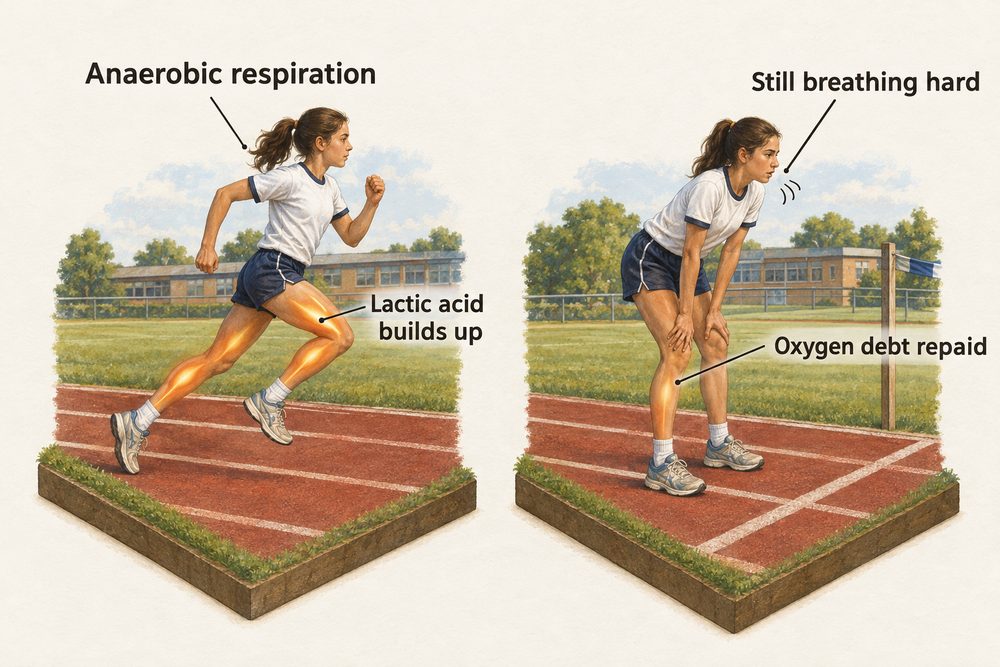
Anaerobic respiration occurs when oxygen is not available (or in short supply), for example during intense exercise when the blood cannot deliver oxygen fast enough to muscles. It takes place in the cytoplasm and produces much less ATP than aerobic respiration because glucose is only partially broken down (B1.3c).
In animal cells: \(\text{glucose} \rightarrow \text{lactic acid}\)
The incomplete breakdown of glucose produces lactic acid, which builds up in muscles during intense exercise, causing cramps and fatigue. After exercise, the body needs extra oxygen to break down the accumulated lactic acid — this is called the oxygen debt. You continue to breathe heavily after exercise to repay this debt: the extra oxygen is used to oxidise lactic acid in the liver, converting it back to glucose.
In plants and fungi: \(\text{glucose} \rightarrow \text{ethanol} + \text{carbon dioxide}\)
This process is called fermentation. It is used commercially in brewing (yeast produces ethanol for alcoholic drinks) and bread-making (yeast produces carbon dioxide that makes dough rise; the ethanol evaporates during baking). Plant cells use this same ethanol pathway when their roots are waterlogged and the oxygen runs out.
Aerobic respiration (with oxygen, in mitochondria) produces a large yield of ATP. Anaerobic respiration (without oxygen, in cytoplasm) produces much less ATP. In animals it makes lactic acid; in fungi and plants it makes ethanol and carbon dioxide.
Biological Molecules
Respiration links to the synthesis and breakdown of key biological molecules. You need to understand the role of sugars, amino acids, fatty acids and glycerol as building blocks (B1.3d–f).
Carbohydrates: Simple sugars (monomers) such as glucose join together to form complex carbohydrates (polymers such as starch and glycogen). Glucose is the key monomer used in respiration. Starch is the storage form of glucose in plants; glycogen is the storage form in animals (stored in the liver and muscles).
Proteins: Amino acid monomers join together in specific sequences (determined by DNA) to form protein polymers. Proteins are essential for enzymes, structural components (collagen, keratin), hormones (insulin) and antibodies. The sequence and type of amino acids determines the protein’s shape and function.
Lipids: Formed from fatty acids and glycerol. Lipids are used for long-term energy storage (they contain more energy per gram than carbohydrates), thermal insulation, and making cell membranes. Lipids are not polymers in the strict sense because they are not made of repeating identical monomers.
The energy transferred by respiration is used to build these molecules as well as break them down. For example, energy from respiration drives the synthesis of proteins from amino acids, and the conversion of glucose to glycogen for storage. When the body needs energy, glycogen is broken back down into glucose for respiration.
Exercise and Respiration
During exercise, your muscles need more energy, so the rate of respiration increases. Your body responds by increasing heart rate (to deliver more oxygenated blood to muscles), increasing breathing rate and depth (to take in more oxygen and remove more carbon dioxide), and breaking down glycogen stored in muscles and the liver into glucose. If exercise is intense enough that the blood cannot supply oxygen fast enough, muscles switch to anaerobic respiration, producing lactic acid. After exercise stops, you continue breathing heavily to supply the extra oxygen needed to break down lactic acid in the liver — this is the oxygen debt.
You can test for the products of respiration experimentally. Breathing out through limewater turns it milky, confirming the presence of carbon dioxide. Using a temperature probe in a flask of germinating seeds shows a temperature increase over time, confirming that respiration is exothermic.