Supplying the Cell and Challenges of Size
Moving Substances Into and Out of Cells
Cells need to transport substances across their membranes to survive. There are three main mechanisms: diffusion, osmosis and active transport (B2.1a).
Diffusion is the net movement of particles from an area of high concentration to an area of low concentration — it is passive (no energy needed). Oxygen diffuses into cells for respiration; carbon dioxide and urea diffuse out. The steeper the concentration gradient, the faster the rate of diffusion. Temperature and surface area also affect the rate — higher temperature means faster-moving particles and more frequent collisions.
Osmosis is specifically the movement of water molecules through a partially permeable membrane from a dilute solution (high water potential) to a more concentrated one (low water potential). The OCR spec uses the term water potential but does not require mathematical calculations with it.
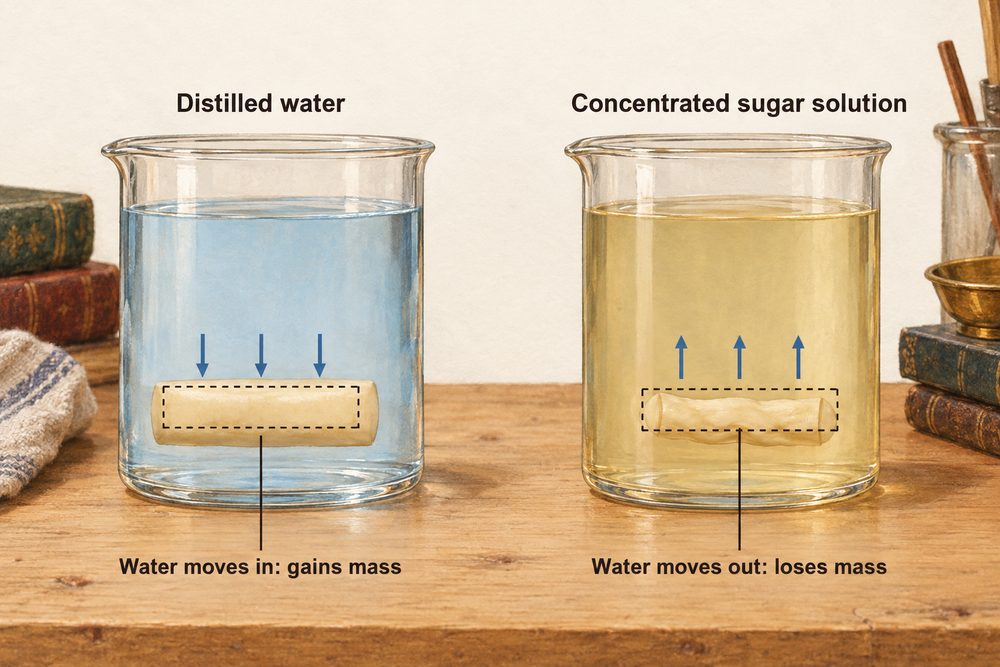
Active transport moves substances against the concentration gradient — from low to high concentration. This requires energy from respiration. Root hair cells use active transport to absorb mineral ions from the soil, where the concentration of minerals is lower than inside the cell. The energy comes from ATP produced by mitochondria in the root hair cells.
Diffusion and osmosis are passive processes (no energy needed). Active transport requires energy from respiration to move substances against the concentration gradient, from low to high concentration.
The Cell Cycle and Mitosis
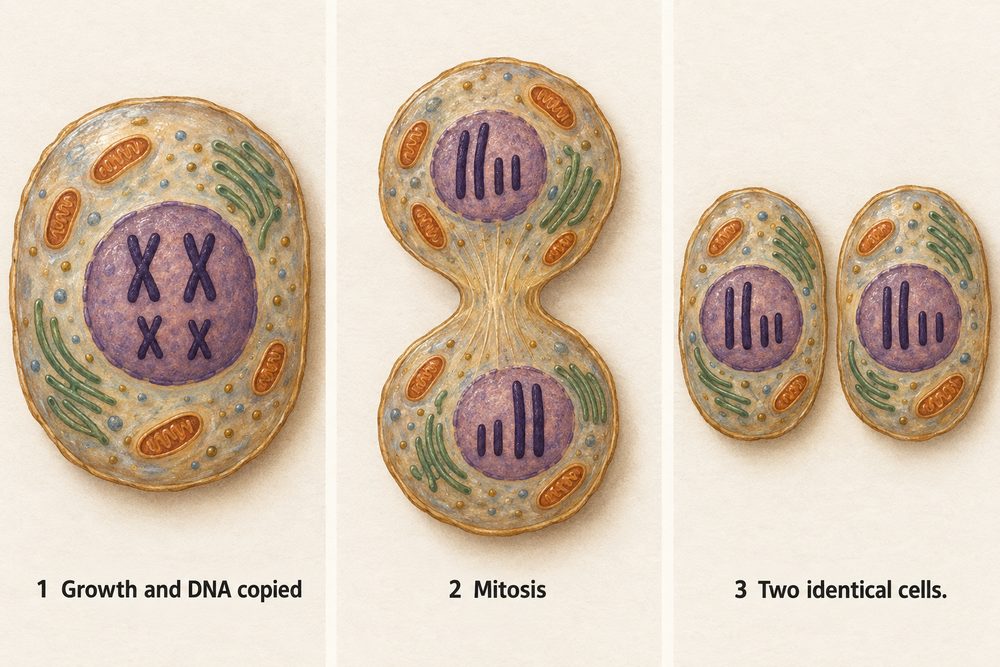
Cells divide to produce new cells for growth, repair and replacement of damaged tissue. The cell cycle has several stages (B2.1b): first the cell grows and increases in size, then the DNA replicates so there are two copies of every chromosome, the cell grows a little more, and finally it divides by mitosis. Mitosis produces two genetically identical daughter cells, each with the same number of chromosomes as the parent cell.
Differentiation is the process by which a cell becomes specialised to perform a particular function (B2.1c). Specialised cells have specific structures suited to their role, making the organism more efficient. For example, red blood cells are biconcave with no nucleus to maximise space for haemoglobin; nerve cells have long axons to transmit impulses over distance; root hair cells have extensions to increase surface area for absorption.
Stem cells are undifferentiated cells that can divide and produce different cell types (B2.1d–f). Embryonic stem cells can differentiate into any cell type in the body, making them potentially useful for treating diseases. Adult stem cells (e.g. in bone marrow) can only produce a limited range of cell types, such as blood cells. Meristems in plants contain stem cells that allow plants to continue growing and differentiating throughout their lives — unlike most animal cells, which lose the ability to differentiate early in development.
The use of embryonic stem cells raises ethical questions because the embryo is destroyed in the process. Some people argue the medical benefits outweigh this concern; others oppose it on moral or religious grounds.
The Challenges of Size
As organisms get larger, their surface area to volume ratio (SA:V) decreases (B2.2a). Consider a cube: a 1 cm cube has a SA:V ratio of 6:1, while a 2 cm cube has a ratio of only 3:1. This means simple diffusion alone cannot supply enough substances or remove waste fast enough for large organisms. Multicellular organisms therefore need specialised exchange surfaces and transport systems.
Humans have a double circulatory system (B2.2c): one circuit pumps blood from the heart to the lungs for gas exchange (pulmonary circuit), the other pumps oxygenated blood from the heart to the body and back (systemic circuit). This maintains high blood pressure for efficient delivery of oxygen and nutrients.
The heart has four chambers — two atria (receive blood) and two ventricles (pump blood out). The right side pumps deoxygenated blood to the lungs; the left side pumps oxygenated blood to the body. The left ventricle has a thicker muscular wall because it pumps blood further (around the whole body). Valves prevent backflow and ensure blood flows in one direction (B2.2d).
Arteries carry blood away from the heart at high pressure (thick muscular walls, small lumen, elastic fibres). Veins carry blood back to the heart at low pressure (thinner walls, larger lumen, valves to prevent backflow). Capillaries are tiny vessels with walls just one cell thick, allowing efficient exchange of substances by diffusion between the blood and surrounding tissues (B2.2d).
Red blood cells are biconcave discs with no nucleus, packed with haemoglobin to carry oxygen. Their biconcave shape increases surface area for oxygen absorption. Plasma is the liquid component of blood that transports dissolved substances including glucose, amino acids, urea, hormones, carbon dioxide and antibodies (B2.2e).
As organisms get larger, their surface area to volume ratio decreases. This is why multicellular organisms need specialised exchange surfaces (e.g. alveoli in lungs, villi in the intestine) and transport systems (e.g. the circulatory system) to move substances efficiently.
Root hair cells have long thin extensions that greatly increase the surface area for absorbing water (by osmosis) and mineral ions (by active transport) from the soil (B2.2f).
Xylem vessels transport water and dissolved minerals upwards from roots to leaves in a continuous column (B2.2h). Xylem cells are dead, hollow tubes reinforced with lignin (a waterproof, rigid material) that provides structural support. The movement of water through the plant is called the transpiration stream — water evaporates from the leaves through stomata, creating a “pull” that draws water up through the xylem (B2.2g).
Phloem tubes transport dissolved sugars (sucrose) from the leaves (where they are made by photosynthesis) to the rest of the plant — this is called translocation (B2.2g–h). Phloem cells are living and have sieve plates with tiny pores to allow movement of dissolved substances. Unlike xylem, translocation requires energy and can move substances both up and down the plant.
Environmental factors affect how quickly water is lost from leaves (B2.2i–j): light intensity (more light causes stomata to open wider), temperature (higher temperature increases evaporation rate), air movement/wind (blows away humid air from around the leaf, maintaining a steep diffusion gradient). A potometer is used to measure the rate of water uptake by a plant cutting, which is a proxy for transpiration rate.