The Nervous System
Structure of the Nervous System
The human nervous system allows the body to detect changes in the environment (stimuli) and produce rapid, coordinated responses (B3.1a). It consists of the central nervous system (CNS) — the brain and spinal cord — and the peripheral nervous system — nerves that extend to all parts of the body, connecting the CNS to receptors and effectors.
The pathway for a nervous response involves a clear sequence: stimulus → sensory receptor → sensory neurone → CNS (relay neurone) → motor neurone → effector (muscle or gland) → response.
The nervous system is able to coordinate responses because it has many links between different parts of the body, has different types of sensory receptors for different stimuli (light receptors in the eyes, temperature receptors in the skin, chemical receptors in the nose and tongue), and can process information in the CNS before sending out appropriate signals (B3.1b).
The nervous pathway: stimulus → receptor → sensory neurone → relay neurone (in CNS) → motor neurone → effector → response. The CNS (brain and spinal cord) processes information and coordinates the response.
Neurones and Their Structure
There are three types of neurone: sensory neurones carry impulses from receptors to the CNS, relay neurones are found within the CNS and connect sensory neurones to motor neurones, and motor neurones carry impulses from the CNS to effectors.
The OCR spec requires you to know the structure of sensory and motor neurones (B3.1b). Both have a cell body containing the nucleus, dendrites (short branches that receive impulses), and a long axon that transmits the electrical impulse. Motor neurones have a long axon running from the spinal cord to the effector. Sensory neurones have a long dendron connecting the receptor to the cell body, and a shorter axon entering the CNS. The axon may be insulated by a myelin sheath, which speeds up impulse transmission.
Synapses
Where two neurones meet there is a tiny gap called a synapse. The electrical impulse cannot cross this gap directly. Instead, when the impulse arrives at the end of the first neurone, chemicals called neurotransmitters are released from vesicles into the synaptic gap. These neurotransmitters diffuse across the gap and bind to specific receptor molecules on the membrane of the next neurone, triggering a new electrical impulse that continues along the pathway (B3.1b).
Synapses ensure impulses travel in one direction only (because neurotransmitters are only released from one side and receptors are only on the other). They also allow the nervous system to connect many different pathways — a single neurone can have synapses with multiple other neurones, enabling complex coordination.
A reflex arc is the pathway that produces a rapid, automatic, protective response (a reflex) without conscious thought (B3.1c). The pathway is: receptor → sensory neurone → relay neurone (in spinal cord, not the brain) → motor neurone → effector.
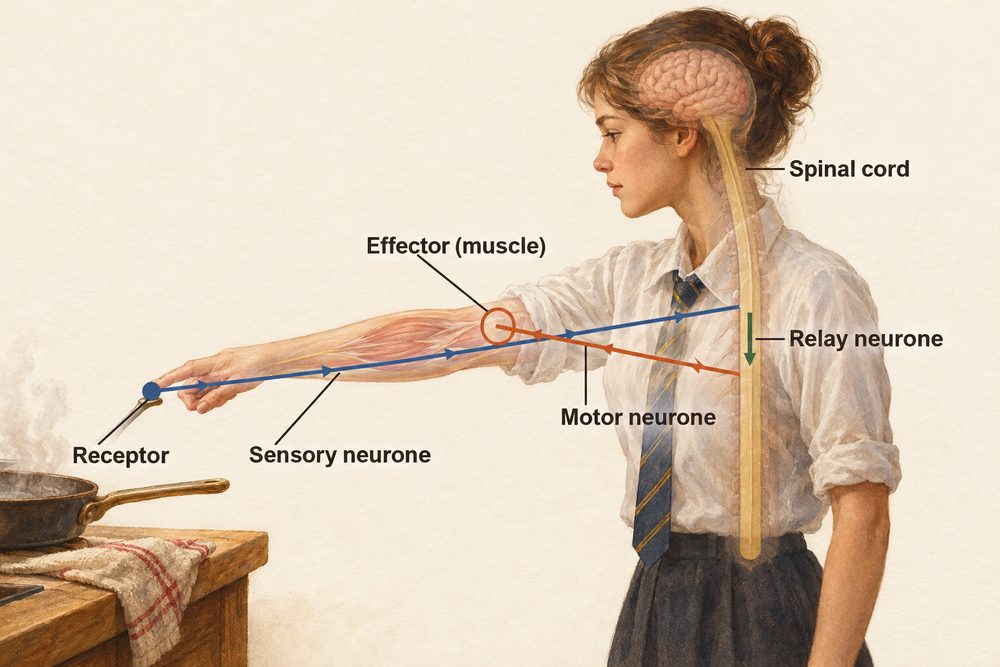
For example, touching a hot object: pain receptors in the skin detect heat → sensory neurone carries the impulse to the spinal cord → relay neurone passes it directly to a motor neurone → motor neurone stimulates the muscle (effector) in the arm to contract → hand is pulled away. This bypasses the brain, making the response faster and protecting the body from harm.
Reflexes are important because they are faster than voluntary responses (fewer synapses to cross and a shorter pathway through the spinal cord rather than the brain). They protect the body from damage before you are consciously aware of the danger. Other examples include the pupil reflex (pupil constricts in bright light to protect the retina) and the knee-jerk reflex.
Reflex arcs produce rapid, automatic responses that bypass the brain, going through the spinal cord instead. This makes reflexes faster and protects the body from danger. The pathway involves fewer synapses than a voluntary response.
The ruler drop test measures reaction time (B3.1c practical). One person holds a ruler vertically; the other places their thumb and finger at the 0 cm mark without touching the ruler. When the ruler is released without warning, the subject catches it as quickly as possible. The distance fallen is recorded — a shorter distance means a faster reaction time.
To improve reliability: repeat the test at least five times and calculate a mean, discard anomalous results, and ensure the same person drops the ruler each time. You can convert the distance to time using the equation: \(t = \sqrt{\frac{2d}{g}}\) where \(d\) is distance in metres and \(g\) is \(9.8 \text{ m/s}^2\). Variables that could affect reaction time include caffeine, tiredness, distractions and practice.
The nervous system and endocrine system both coordinate body functions, but they work differently. The nervous system transmits electrical impulses along neurones for fast, short-lived, precise responses (e.g. pulling your hand away from heat). The endocrine system uses chemical hormones carried in the blood for slower, longer-lasting, widespread responses (e.g. controlling blood glucose over hours). The next lesson covers the endocrine system in detail.