Homeostasis and Reproduction
What is Homeostasis?
Homeostasis is the maintenance of a constant internal environment (B3.3a). This is crucial because enzymes and other biological processes work best within narrow ranges of temperature, pH, water balance and blood glucose concentration. If internal conditions change too much, metabolic reactions slow down, become less efficient, or stop entirely — potentially killing the organism.
All homeostatic control systems have three key components working together: receptors (detect changes in the internal or external environment), a coordination centre (processes the information and determines the response — e.g. the brain, the pancreas or the thermoregulatory centre) and effectors (muscles or glands that bring about the corrective response). This system works through negative feedback — when a condition deviates from the normal level, the body acts to bring it back, then the response is switched off.
Homeostasis maintains a stable internal environment using receptors, coordination centres and effectors working through negative feedback. It is essential for enzymes and metabolic reactions to function at their optimum rates.
Blood Glucose Control
Blood glucose concentration is monitored and controlled by the pancreas (B3.3b–c). When blood glucose rises (e.g. after eating a carbohydrate-rich meal), the pancreas detects the increase and secretes insulin. Insulin has two main effects: it causes body cells (especially muscle and liver cells) to take up glucose from the blood, and it stimulates the liver to convert excess glucose into glycogen for storage. These actions lower the blood glucose back to normal.
When blood glucose drops (e.g. during exercise or between meals), the pancreas detects the decrease and secretes glucagon. Glucagon stimulates the liver to break stored glycogen back into glucose and release it into the blood, raising blood glucose back to normal. This opposing action of insulin and glucagon is a classic example of negative feedback — both hormones work together to keep blood glucose within a narrow, safe range.
Type 1 diabetes (B3.3d): The pancreas produces little or no insulin because the immune system has destroyed the insulin-producing beta cells (it is an autoimmune condition). Without insulin, blood glucose can rise to dangerously high levels after eating. Treatment requires regular insulin injections (or an insulin pump) combined with careful monitoring of blood glucose levels and carbohydrate intake. Type 1 usually develops in childhood or early adulthood and cannot be prevented.
Type 2 diabetes (B3.3d): The body’s cells become resistant to insulin — they no longer respond properly to it, even though the pancreas may still produce insulin (sometimes in reduced amounts). Blood glucose remains elevated because cells do not take up glucose effectively. Type 2 is strongly linked to obesity, a sedentary lifestyle, and genetic factors. Treatment involves a controlled diet (reducing sugar and refined carbohydrate intake), regular exercise, weight loss, and sometimes medication (such as metformin). In some cases, insulin injections may eventually be needed.
Type 2 diabetes is becoming increasingly common worldwide, particularly in countries with high obesity rates. It can often be prevented or managed through lifestyle changes, unlike Type 1 which cannot be prevented.
Type 1 diabetes: the pancreas does not produce insulin (autoimmune); treated with insulin injections. Type 2 diabetes: body cells become resistant to insulin (often lifestyle-linked, especially obesity); treated with diet, exercise and medication.
Temperature Regulation
Body temperature in humans is maintained at approximately 37°C by the thermoregulatory centre in the brain, which acts as the coordination centre. It receives information from temperature receptors in the skin (detecting external temperature) and in the blood (detecting core body temperature).
When the body is too hot, several effectors are activated: blood vessels near the skin surface vasodilate (widen), allowing more blood to flow close to the skin surface so more heat is lost to the surroundings by radiation. Sweat glands produce sweat that evaporates from the skin surface, transferring heat energy away from the body (evaporative cooling). Body hairs lie flat against the skin (reducing the insulating layer of trapped air).
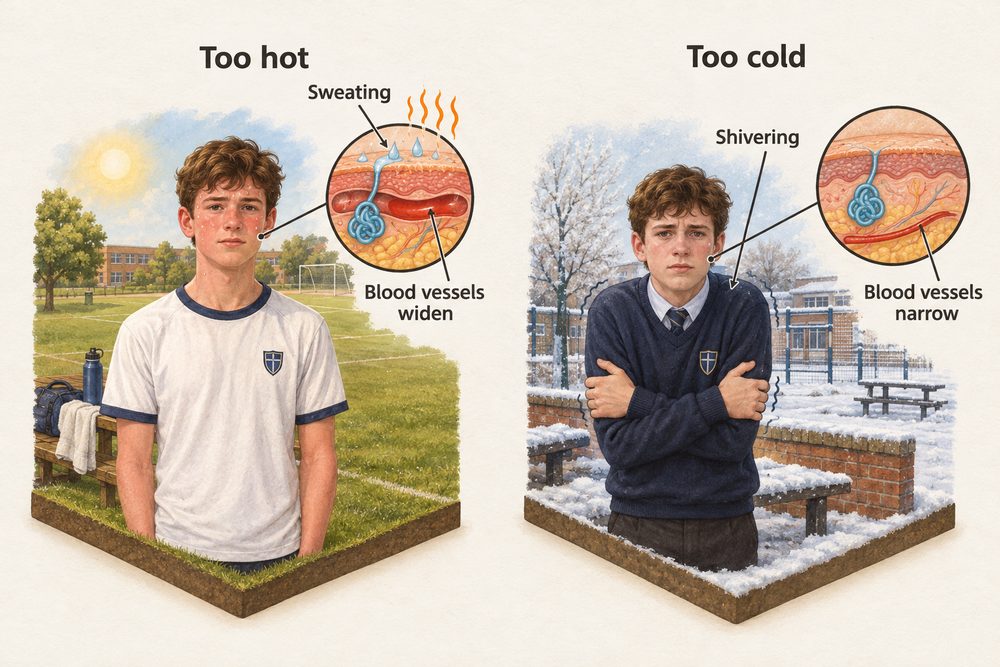
When the body is too cold: blood vessels near the skin surface vasoconstrict (narrow), reducing blood flow near the surface and therefore reducing heat loss by radiation. Muscles shiver — rapid, involuntary contractions that generate heat from respiration in muscle cells. Body hairs stand up (erector muscles contract), trapping a thicker layer of insulating air close to the skin.
Temperature regulation is another example of negative feedback. If the body temperature rises above 37°C, cooling mechanisms activate to bring it down. If it drops below, warming mechanisms activate to bring it up. Once the temperature returns to normal, the response is switched off.
If temperature regulation fails, it can be life-threatening: hypothermia occurs when core body temperature drops below about 35°C (organs begin to fail), while heat stroke occurs when the body overheats and cannot cool down effectively (can cause organ damage).