Ecosystems
Levels of Organisation in an Ecosystem
An ecosystem is a community of living organisms interacting with each other and their physical environment (B4.1d). Ecosystems range in scale from a small pond to an entire ocean, but all share the same levels of organisation. Individual organisms of the same species living in the same area form a population. Different populations living together form a community. A community interacting with the abiotic (non-living) environment makes up the ecosystem.
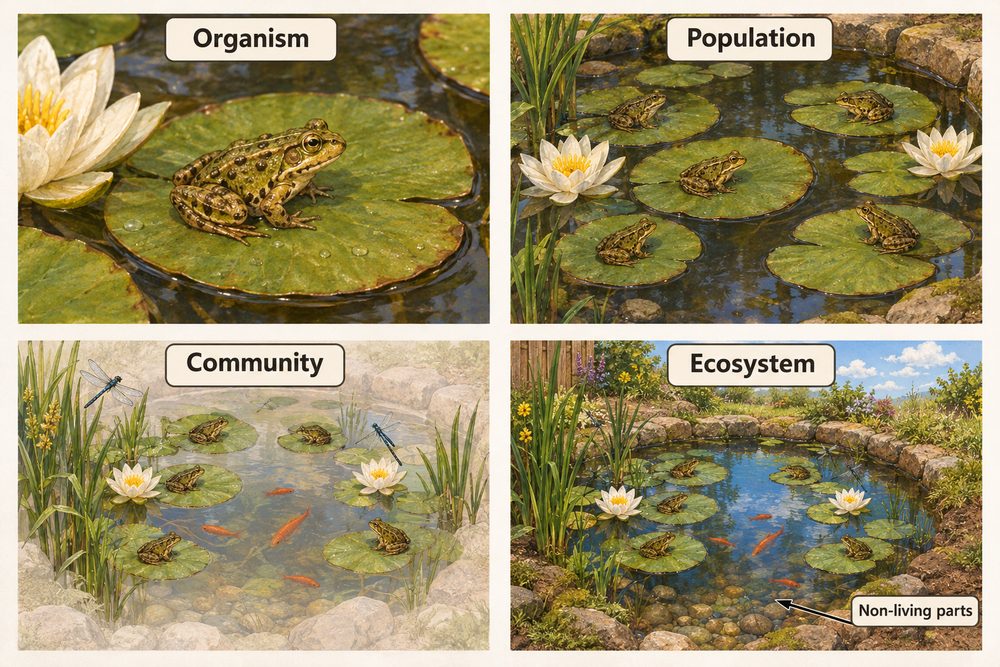
Within communities, organisms depend on each other — this is interdependence (B4.1f). Key relationships include predation (one organism hunts and eats another), mutualism (both organisms benefit, such as bees pollinating flowers while collecting nectar) and parasitism (one organism benefits while the other is harmed, such as fleas on a dog). Organisms also compete for limited resources: animals compete for food, water, territory and mates, while plants compete for light, water, minerals and space.
Ecosystems are organised into: individual organisms → populations (one species) → communities (many species) → ecosystems (community + abiotic environment). Organisms are interdependent through predation, mutualism and parasitism.
Biotic and Abiotic Factors
Abiotic factors are non-living conditions that influence an ecosystem. Key examples include temperature, light intensity, moisture level, soil pH and wind speed. Biotic factors are living components: predators, prey availability, disease and competition between species (B4.1e). Changes in either type of factor affect the size and distribution of populations. For instance, a drought (abiotic) reduces plant growth, which in turn reduces herbivore populations (biotic knock-on effect).
Understanding these factors is essential for conservation. Scientists monitor abiotic factors like dissolved oxygen and pH in rivers to detect pollution, and track biotic indicators such as lichen diversity (which decreases with air pollution) or freshwater invertebrate species (some tolerate pollution, others do not).
An example of interdependence in action is the relationship between flowering plants and pollinating insects. Bees depend on flowers for nectar, and plants depend on bees for pollination. If one population declines — as seen with recent declines in bee numbers — the other is directly affected. This illustrates how changes in one part of an ecosystem ripple through the whole community.
The concept of niche is also important: every species has a specific role within its ecosystem, including what it eats, where it lives and how it interacts with other species. No two species can occupy exactly the same niche in the same area for long — one will outcompete the other. This is known as the competitive exclusion principle.
Pyramids of biomass represent the mass of organisms at each trophic level in a food chain. They are almost always pyramid-shaped (wider at the base) because energy is lost at each level. In contrast, pyramids of numbers can be inverted — for example, a single oak tree (one producer) may support thousands of insects. This is why biomass pyramids give a more accurate picture of energy flow than number pyramids.
Energy enters most ecosystems as sunlight, captured by producers (green plants and algae) through photosynthesis. Energy then passes through trophic levels: producer → primary consumer (herbivore) → secondary consumer (carnivore) → tertiary consumer (top predator).
At each trophic level, energy is lost to the surroundings through respiration, movement and heat. This means less energy — and therefore less biomass — is available at each successive level. This is why food chains rarely have more than four or five trophic levels.
A food web shows all the interconnected food chains in a community. Removing or adding a species in a food web has knock-on effects throughout the community. For example, if a secondary consumer is removed, its prey population may increase rapidly, which then over-consumes the trophic level below.
Energy flows through trophic levels: producer → primary consumer → secondary consumer → tertiary consumer. Energy is lost at each level through respiration and heat, so biomass decreases up the chain.
Organisms have adaptations — inherited features that help them survive in their environment. These can be structural (e.g. thick fur for insulation in cold climates, or streamlined bodies for swimming), behavioural (e.g. migration to warmer areas in winter, or nocturnal hunting to avoid predators) or functional (e.g. producing venom to subdue prey, or antifreeze proteins in Arctic fish). Adaptations arise through natural selection over many generations.
Biodiversity refers to the variety of species in an ecosystem. High biodiversity makes an ecosystem more stable and resilient because if one species declines, others can fill its role. Human activities such as deforestation, pollution and over-hunting reduce biodiversity. Conservation programmes — including habitat protection, breeding programmes and seed banks — aim to maintain biodiversity for future generations.
Adaptations can be structural, behavioural or functional. High biodiversity makes ecosystems more stable. Conservation programmes protect endangered species and habitats.