Cycling Materials and Decomposition
The Carbon Cycle
Many materials cycle through the abiotic and biotic components of an ecosystem (B4.1a). The carbon cycle is one of the most important. Carbon enters living organisms when plants absorb CO\(_2\) during photosynthesis. It passes through food chains when animals eat plants. Carbon is returned to the atmosphere through respiration (by all living organisms), combustion of fossil fuels and wood, and decomposition of dead organisms (B4.1c).
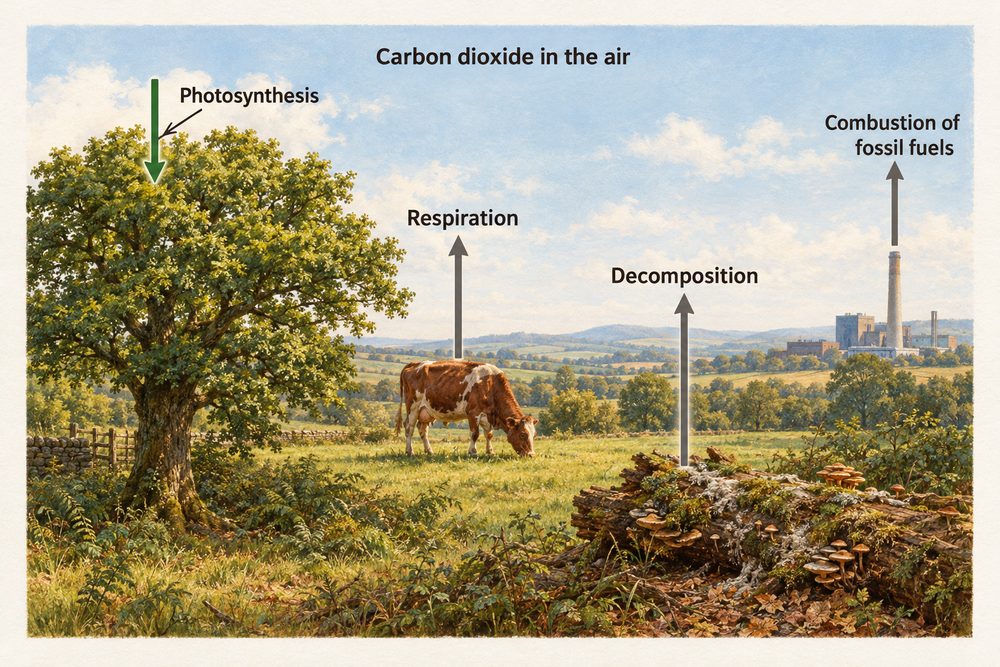
Over millions of years, some carbon becomes locked in fossil fuels (coal, oil, natural gas) and sedimentary rocks like limestone. Burning fossil fuels releases this stored carbon rapidly, increasing atmospheric CO\(_2\) concentrations. The oceans also act as a carbon sink, dissolving CO\(_2\) from the atmosphere, but rising levels are causing ocean acidification, which threatens marine life such as coral reefs and shellfish.
Carbon enters living organisms via photosynthesis and is returned to the atmosphere by respiration, combustion and decomposition. Only photosynthesis removes CO\(_2\) from the atmosphere. Fossil fuels lock carbon away for millions of years until combustion releases it.
The Water Cycle
The water cycle describes how water moves continuously between the Earth’s surface and atmosphere. Water evaporates from oceans, lakes and rivers (heated by the Sun), forming water vapour. Plants also release water vapour through transpiration from their leaves. As water vapour rises, it cools and condenses into clouds. Water returns to the ground as precipitation (rain, snow, hail) and is collected in rivers, lakes and underground stores before the cycle repeats.
The water cycle is essential because it provides fresh water for drinking, agriculture and industry. It also transports dissolved minerals through the soil, making nutrients available to plant roots. Human activities such as deforestation reduce transpiration, which can alter local rainfall patterns.
The nitrogen cycle is another critical nutrient cycle. Nitrogen gas (\(N_2\)) makes up 78% of the atmosphere but plants cannot use it directly. Nitrogen-fixing bacteria in the soil and in root nodules of legumes (peas, beans, clover) convert atmospheric nitrogen into ammonia (\(NH_3\)). Nitrifying bacteria then convert the ammonia into nitrates (\(NO_3^-\)), which plants absorb through their roots for making proteins and DNA. When organisms die, decomposers break down the nitrogen-containing compounds, and denitrifying bacteria convert some nitrates back into nitrogen gas, completing the cycle.
Understanding nutrient cycles is essential for sustainable agriculture. Farmers who grow legumes in rotation add nitrogen to the soil naturally, reducing the need for synthetic fertilisers. This mirrors how natural ecosystems recycle nutrients without human intervention.
Human activities disrupt these cycles. Burning fossil fuels increases atmospheric carbon faster than photosynthesis can remove it. Excessive use of nitrogen fertilisers leads to nutrient run-off into waterways, causing eutrophication — algal blooms that block light and deplete oxygen, killing aquatic organisms. Understanding both cycles helps explain why sustainable land management is so important.
In laboratory experiments, you can investigate decomposition by measuring the rate of decay of milk using pH indicators (as bacteria decompose lactose, they produce lactic acid, lowering pH) or by monitoring the mass loss of a compost bag over several weeks. Controlled variables include temperature, moisture and initial mass. These experiments demonstrate the real-world principles of nutrient recycling in a measurable, quantitative way.
Decomposition is the breakdown of dead organic matter by bacteria and fungi (known as decomposers). These microorganisms secrete enzymes onto dead material, digest it externally, and absorb the soluble products. Decomposition releases CO\(_2\) back into the atmosphere through the decomposers’ respiration and returns essential minerals (such as nitrates, phosphates and potassium) to the soil, where they can be taken up by plant roots.
Without decomposition, dead organisms and waste would accumulate, and the nutrients locked within them would never be recycled. This would eventually starve living plants of the minerals they need for growth.
Decomposers (bacteria and fungi) break down dead matter, recycling carbon and minerals back into the ecosystem. Without decomposition, nutrients would remain locked in dead organisms.
The rate of decomposition depends on several factors. Temperature — warm conditions increase enzyme activity in decomposers, but very high temperatures denature the enzymes. Moisture — water is needed for chemical reactions and for decomposers to survive. Oxygen — aerobic decomposers respire faster with more oxygen, breaking down material more quickly. Surface area — smaller pieces decompose faster because more surface is exposed to enzymes.
Composting applies these principles deliberately. Gardeners and farmers shred material (increases surface area), turn compost heaps regularly (introduces oxygen) and keep them moist and warm. The resulting compost is rich in minerals and can be used as a natural fertiliser, reducing the need for chemical alternatives.
In anaerobic conditions (without oxygen), decomposition still occurs but more slowly, and produces methane rather than CO\(_2\). This is why waterlogged landfill sites produce methane, a potent greenhouse gas.
Decomposition is fastest in warm, moist, oxygen-rich conditions with high surface area. Composting uses these principles to recycle organic waste into nutrient-rich soil.