Inheritance
Genes, Chromosomes and DNA
The genome is the entire set of genetic material in an organism. In humans, DNA is packaged into 23 pairs of chromosomes (46 total) inside the nucleus of most cells. Each chromosome carries hundreds of genes — short sections of DNA that code for specific proteins. These proteins determine our characteristics, from eye colour to blood type (B5.1a).
Most body cells are diploid — they contain two copies of each chromosome (one from each parent). Sex cells (gametes) are haploid, containing just one set of 23 chromosomes. At fertilisation, two haploid gametes fuse to restore the diploid number (B5.1e).
Human body cells are diploid (46 chromosomes in 23 pairs). Gametes are haploid (23 chromosomes). At fertilisation, two gametes fuse to restore the diploid number.
Alleles and Inheritance
Because chromosomes come in pairs, we have two copies of each gene — one from each parent. Different versions of a gene are called alleles. If both alleles are the same, the individual is homozygous (e.g. BB or bb). If the alleles are different, the individual is heterozygous (e.g. Bb). A dominant allele is expressed whenever it is present (shown with a capital letter), while a recessive allele is only expressed when homozygous (both copies the same, shown with a lowercase letter) (B5.1a).
The combination of alleles an organism has is its genotype (e.g. Bb). The observable characteristic that results is the phenotype (e.g. brown eyes). The phenotype depends on both the genotype and environmental factors.
Some characteristics are controlled by a single gene (monogenic inheritance), such as ear lobe attachment or tongue rolling. However, most characteristics are influenced by multiple genes (polygenic inheritance), such as height, skin colour and intelligence. Polygenic traits show continuous variation — a range of phenotypes rather than distinct categories — and are strongly influenced by environmental factors alongside genetics.
The Human Genome Project, completed in 2003, mapped the entire human genome — around 20,000–25,000 genes. This has enabled scientists to identify genes linked to inherited disorders, develop genetic tests, and research personalised medicine where treatments are tailored to a patient’s specific genetic makeup.
Genetic screening can identify carriers of conditions like cystic fibrosis before they have children, allowing informed family planning. Embryos created through IVF can be tested for genetic disorders using pre-implantation genetic diagnosis (PGD), though this raises ethical questions about selecting embryos.
Meiosis is the type of cell division that produces gametes. During meiosis, chromosomes are shuffled and randomly assorted, and sections of DNA can be exchanged between chromosomes (crossing over). This creates genetically unique gametes, which is why siblings (other than identical twins) are genetically different from each other despite having the same parents. Meiosis is essential for maintaining genetic diversity within a population.
A Punnett square is used to predict the possible offspring from a genetic cross. Place one parent’s alleles along the top and the other parent’s alleles down the side. Each box shows a possible genotype of the offspring.
Example: crossing two heterozygous parents (Bb × Bb) for a trait where B (brown eyes) is dominant over b (blue eyes):
The predicted ratio is 3 brown : 1 blue (genotype ratio 1 BB : 2 Bb : 1 bb). This gives a 75% probability of the dominant phenotype and 25% probability of the recessive phenotype. Remember, these are probabilities — actual results may differ due to chance, especially with small sample sizes.
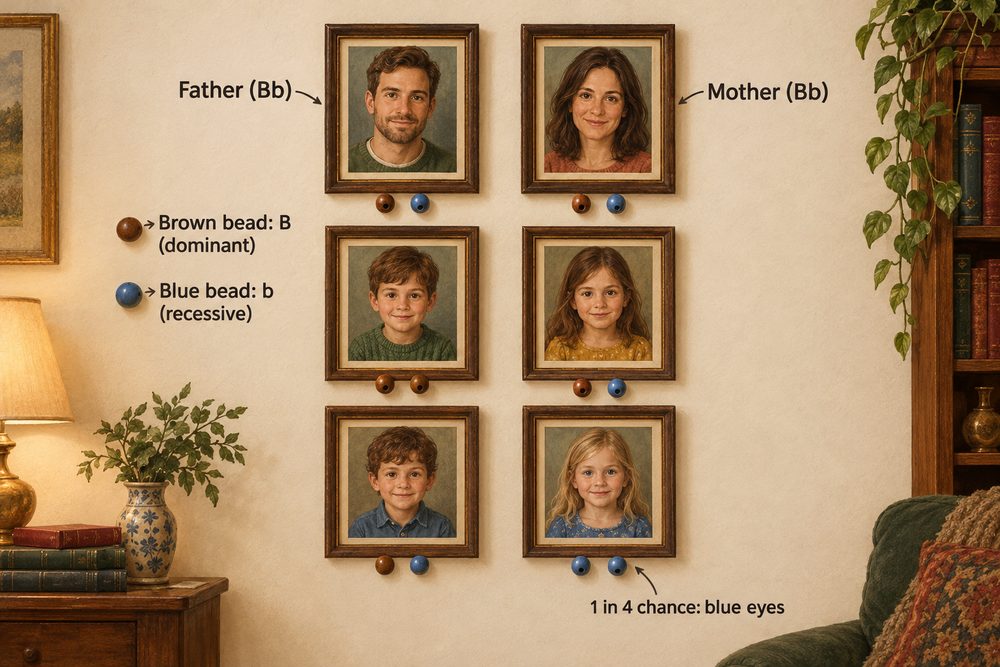
For OCR Gateway, you should be able to construct genetic diagrams showing: parental phenotypes and genotypes, gametes, a Punnett square, and offspring ratios with probabilities (B5.1h).
A Punnett square predicts offspring genotypes and phenotypes. Crossing Bb × Bb gives a 3:1 phenotype ratio (75% dominant, 25% recessive). These are probabilities, not certainties.
Some genetic disorders are caused by faulty alleles. Cystic fibrosis is caused by a recessive allele (ff). A person must be homozygous recessive to have the condition; heterozygous individuals (Ff) are carriers — they carry the allele but do not show symptoms. If two carriers have children, there is a 25% chance each child will have cystic fibrosis.
Polydactyly (extra fingers or toes) is caused by a dominant allele (D). Only one copy of the allele is needed for the condition to appear, so a cross between Dd and dd gives a 50% chance of affected offspring.
Sex is determined by the 23rd chromosome pair. Females have XX, males have XY. Since the father can pass either an X or a Y chromosome, there is a 50:50 chance of a child being male or female (B5.1i).
Cystic fibrosis is caused by a recessive allele (two copies needed). Polydactyly is caused by a dominant allele (one copy is enough). Sex determination: XX = female, XY = male.